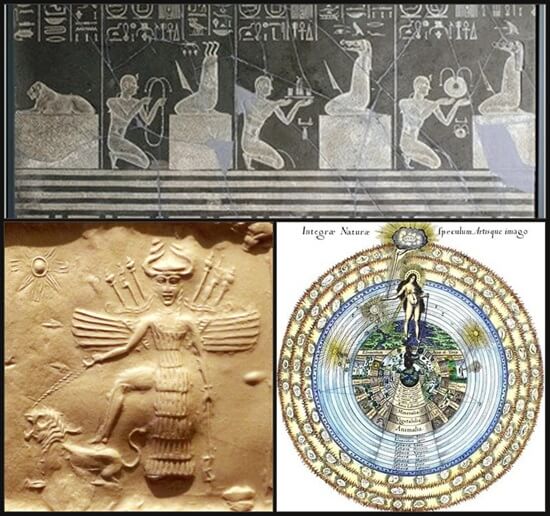

The Seven Gates of the Underworld and Their Occult Symbolism
Ancient civilizations described mysterious gateways separating the living from otherworldly realms, often demanding secret knowledge, sacrifice, or spiritual transformation.
Seven gates echoed across these ancient traditions, marking thresholds that even gods couldn’t cross without paying a price.
The same symbolism later emerged in mystical and occult traditions, raising an intriguing question.
So what’s lurking behind the recurring mystery of seven gates?
Inanna’s Descent Through the Seven Gates of the Underworld
In Inanna’s Descent to the Netherworld, the goddess journeys into the realm ruled by her sister Ereshkigal, adorned with seven divine powers represented by garments and ornaments.
But the underworld doesn’t welcome visitors with open arms.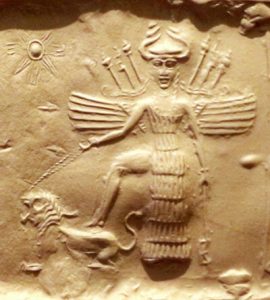
At each gate, the gatekeeper Neti removes another piece of her regalia.
Related: Ancient Planetary Gods
When Inanna protests, she’s ordered to remain silent because the underworld’s laws cannot be questioned.
“Be silent, Inana, a divine power of the underworld has been fulfilled. Inana, you must not open your mouth against the rites of the underworld.” — The Electronic Text Corpus of Sumerian Literature, Inana’s Descent to the Netherworld
By the seventh gate, Inanna has surrendered everything.
She enters the throne room naked, where seven judges condemn her to death.
Her corpse hangs on a hook until divine intervention restores her.
Every gate strips away something that once defined her identity and authority.
To reach the deepest realm, even a goddess must surrender her powers.
Egypt’s Seven Gates and the Guardians of the Dead
Ancient Egypt preserved another elaborate system of supernatural gates, complete with terrifying guardians and secret names.
In the Book of the Dead, Spell 144 describes seven gates, each guarded by three supernatural beings.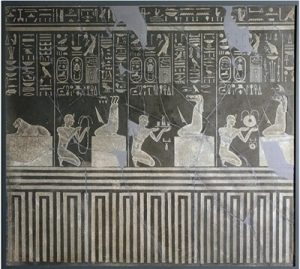
The deceased must know their names to pass.
“Knowing the names of (them) that are at the 7 gates and their guardians and the announcers in them.” — Book of the Dead, Spell 144, translated by Thomas George Allen
The guardians bear unusual names such as Face Downward, Numerous of Shapes, and Fiercely Bright. Others evoke beings that consume filth or rotten flesh.
Another funerary composition, the Book of Gates, describes Ra passing through twelve divisions of the night, encountering guarded portals along the way.
Egyptian afterlife traditions weren’t limited to seven gates, but Spell 144 provides an intriguing parallel with Mesopotamia.
Where Inanna surrenders her divine ornaments, the Egyptian deceased must demonstrate sacred knowledge.
The Seven Planetary Gates of the Mithraic Mysteries
Centuries later, the Roman mystery religion of Mithras preserved another sevenfold system associated with the planets.
In Contra Celsum, the third-century philosopher Origen preserves an earlier account of a Mithraic ladder containing seven gates, with an eighth above them.
Each gate corresponds to a planetary power and a particular metal.
“There is a ladder with lofty gates, and on the top of it an eighth gate. The first gate consists of lead, the second of tin, the third of copper, the fourth of iron.” — Origen, Contra Celsum, Book VI, Chapter 22
The seven gates correspond to Saturn, Venus, Jupiter, Mercury, Mars, the Moon, and the Sun.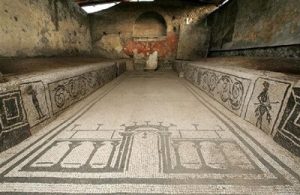
The eighth represents the realm of fixed stars beyond the planetary spheres.
Unlike Inanna’s descent, the Mithraic ladder symbolizes passage through the heavens.
The Mithraeum of the Seven Spheres at Ostia preserves planetary imagery, while Mithraism’s seven initiation grades were associated with planetary protectors.
Here, the gates represented the cosmic structure through which the soul traveled.
And that eighth gate introduces another fascinating connection.
Hermeticism and the Seven Rulers of Fate
The ancient Hermetic text Poimandres, the first treatise of the Corpus Hermeticum, describes seven planetary rulers governing fate within the material cosmos.
Following death, the soul ascends through seven cosmic zones, surrendering an earthly quality at each stage.
Related: The Obscure Ancient Corpus Hermeticum
These include impulses associated with deception, desire, arrogance, ambition, and falsehood.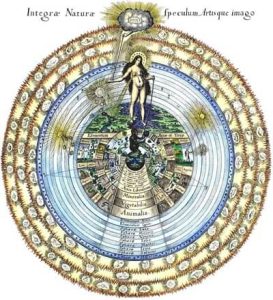
“And thus it is that man doth speed his way thereafter upwards through the Harmony. To the first zone he gives the Energy of Growth and Waning.” — Corpus Hermeticum I, Poimandres, translated by G. R. S. Mead
After passing through all seven zones, the soul reaches the eighth realm and joins the divine powers.
The resemblance to Inanna’s descent is difficult to overlook.
Inanna loses her garments of power at seven gates, while the Hermetic soul sheds its earthly qualities through seven spheres.
Both describe transformation through successive acts of surrender, although their journeys move in opposite directions.
Like Mithraism, Hermeticism also places an eighth realm beyond the seven planetary powers.
Kabbalah and the Seven Gates of Perception
Jewish Kabbalah describes ten divine emanations known as the sefirot, with the seven lower emanations forming an important grouping.
These represent aspects of divine manifestation and spiritual refinement.
Another intriguing connection appears in Sefer Yetzirah, an early Jewish mystical text linking seven Hebrew letters with the planets, days of the week, and seven openings of human perception.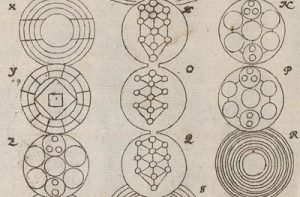
“These Seven Double Letters point out seven localities; Above, Below, East, West, North, South, and the Palace of Holiness in the midst of them sustaining all things.” — Sefer Yetzirah, Chapter IV, translated by W. Wynn Westcott
The seven bodily openings are the two eyes, two ears, two nostrils, and mouth.
Here, the gateways aren’t located in the underworld or heavens.
Related: Esoteric Symbolism Number 7
They’re built into the human body.
Later Western occult traditions developed further correspondences between the Tree of Life, planetary symbolism, and spiritual initiation.
The Seven Gates of Dreaming in Don Juan’s Teachings
A more recent parallel appears in Carlos Castaneda’s The Art of Dreaming, published in 1993.
Don Juan Matus describes seven gates of dreaming, each representing a threshold practitioners must cross as they develop dreaming attention.
“There are seven gates, and dreamers have to open all seven of them, one at the time. You’re up against the first gate.” — Carlos Castaneda, The Art of Dreaming
The first gate involves becoming aware while falling asleep and sustaining attention within dreams.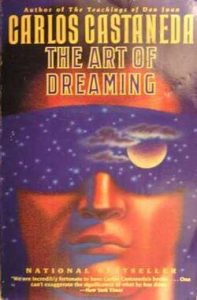
The second concerns moving deliberately between dreams, while the third involves encountering one’s own sleeping body.
At the fourth, practitioners learn to travel to specific locations through dreaming, including other realms of perception.
Related: My Top 10 Quotes From The Art Of Dreaming
Castaneda concentrates primarily on these first four gates, leaving the remaining three without equally detailed explanations.
Where Inanna surrenders her possessions, Don Juan’s dreamer develops greater awareness and control over perception.
The gates aren’t crossed through death but through deliberate dreaming practices.
Beyond the Seventh Gate
Ancient civilizations described mysterious gateways separating the living from otherworldly realms, often demanding secret knowledge, sacrifice, or spiritual transformation.
Seven gates repeatedly marked these boundaries, appearing again centuries later in mystical/occult traditions.
But why the number seven, and what did ancient mystics believe awaited those who crossed the final threshold?
References:
https://www.newadvent.org/fathers/04166.htm
https://sacred-texts.com/egy/ebod/index.htm
https://iapsop.com/ssoc/1893__westcott___sepher_yetzirah.pdf
https://sacred-texts.com/jud/yetzirah.htm