
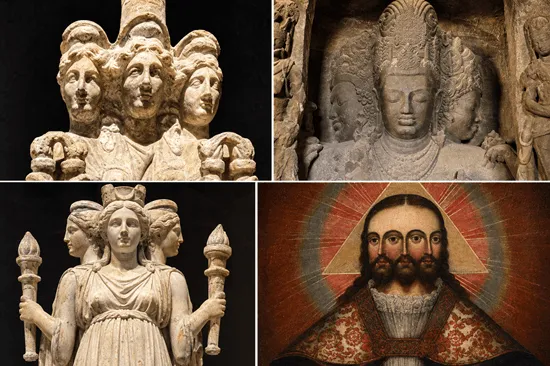

Three Headed God Symbol Across Ancient Civilizations
Three faces emerging from a single head, each looking in a different direction.
It’s one of the strangest divine images to appear in ancient religious art, turning up among the Celts, Hindus, Greeks and eventually Christians.
Some believed these figures represented different powers of the same god, while others associated them with supernatural vision and the mysteries of existence.
But why did so many religious traditions give their gods three faces?
The Mysterious Three Faced Celtic God
In 1855, a farmer searching for building stone near Corleck Hill in County Cavan, Ireland, discovered a mysterious stone head carved with three human faces. 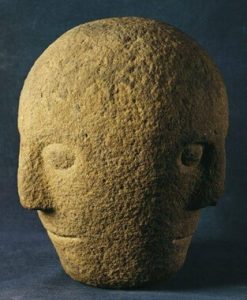
Known as the Corleck Head, the artifact dates to approximately the first or second century CE, with a hole beneath suggesting it once stood on a pedestal or wooden post.
The National Museum of Ireland associates the sculpture with the Celtic god Lugh, although its true identity remains uncertain.
Related: Ancient Priests Of Dagon Adopted Into Catholicism
Irish writer Fintan O’Toole described the discovery in his series on Ireland’s most important historical objects.
“The head is often taken to represent an ‘all-knowing god’, who can see all dimensions of reality. But its three faces also link us back to much older traditions of the three-natured goddess.” – Fintan O’Toole, A History of Ireland in 100 Objects
Similar triple faced figures appeared across Celtic and Gallo-Roman territories, particularly in ancient Gaul, where stone sculptures sometimes portrayed three heads sharing a single body.
The recurring arrangement has inspired interpretations involving supernatural knowledge, divine power and the ability to perceive past, present and future simultaneously.
Perhaps the three faces represented different identities belonging to one god, or a divine being capable of seeing what ordinary humans couldn’t.
Whatever the answer, the Celts weren’t alone in giving their gods more than one face.
The Colossal Three Headed Shiva of India
Hidden within the Elephanta Caves near Mumbai stands one of the most impressive three headed divine sculptures ever created.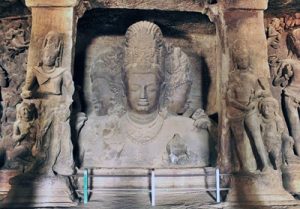
Carved directly into the rock during the sixth century CE, the enormous Sadashiva sculpture rises approximately seven meters high.
Three faces emerge from one monumental figure, each displaying a dramatically different expression.
The central face remains peaceful and composed, while one side reveals Shiva’s fierce, destructive nature and the other presents a gentler, more nurturing aspect.
India’s Indira Gandhi National Centre for the Arts explains how scholars have interpreted the monument’s unusual arrangement.
“The Trimurti image at the end of the north-south axis is one of the images that has received considerable attention and various explanations have been given for it.” – Indira Gandhi National Centre for the Arts, Art and Architecture of Elephanta
Shiva’s three visible faces represent different manifestations of divine power, embodying the interconnected forces of creation, preservation and destruction.
Related: 2 Headed Bird Symbol Soaring Through Ancient Cultures
This recalls the Hindu Trimurti of Brahma, Vishnu and Shiva, although the Elephanta sculpture portrays different aspects of Shiva himself.
The image reflects a cosmic unity where opposing forces belong to one divine being, echoing the mysterious three faced gods of ancient Europe.
Hecate and the Three Faces of the Greek Goddess
In ancient Greece, the mysterious goddess Hecate guarded crossroads, entrances and the boundaries between the living and the dead.
Greek sculptors depicted her as three joined female figures facing different directions, unlike Shiva’s three faces emerging from a single head.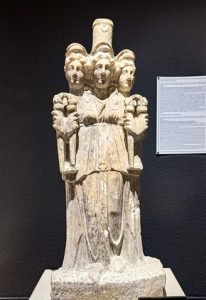
The second century traveler Pausanias described an early triple representation attributed to the sculptor Alcamenes.
“Within the enclosure is a temple; its xoanon is the work of Myron [doubtful], and it has one face and one body.” – Pausanias, Description of Greece, Book 2
Alcamenes’ triple Hecate stood near the Temple of Athena Nike in Athens, reflecting her association with crossroads and the ability to observe three directions simultaneously.
Her connections with the underworld, magic and spiritual boundaries later inspired esoteric interpretations, including associations with youth, maturity and old age.
Like the Celtic carvings, Hecate’s triple form suggests supernatural awareness beyond ordinary human perception, a striking image that would later appear in Christianity itself.
Christianity’s Forbidden Three Faced Trinity
Christianity’s Holy Trinity represents the Father, Son and Holy Spirit as three distinct persons sharing one divine essence.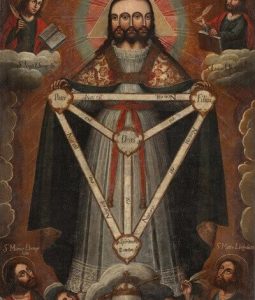
Yet some medieval and Renaissance artists portrayed God with three overlapping faces, sometimes sharing eyes and other features.
Known as the Trifacial Trinity, the imagery bears a striking resemblance to ancient three faced deities.
One surviving example, painted by Gregorio Vásquez de Arce y Ceballos in seventeenth century Colombia, depicts Christ with three faces surrounded by a triangular diagram representing the Trinity.
The Colonial Museum in Bogotá preserves this unusual artwork.
“This image shows Jesus Christ with three faces, representing the Holy Trinity: Father, Son, and the Holy Spirit.” – Colonial Museum, Trifacial Trinity
In 1628, Pope Urban VIII prohibited three faced representations of the Trinity, leading to some images being altered or concealed.
In the Colombian painting, the two outer faces were painted over to resemble Christ’s hair, hiding the original design until restoration work in the 1980s revealed them.
Related: The Nag Hammadi Ancient Christian Scroll Discovered in the 1940’s
The discovery raises an intriguing question.
Did Christian artists inherit this symbolism from older religious traditions, or independently arrive at the same imagery?
Either way, a divine image resembling ancient pagan gods had found its way into Christian art.
Why Did So Many Gods Have Three Faces?
Across these traditions, three faces represented different aspects of divine existence, from Celtic supernatural perception to Shiva’s cosmic powers.
The symbolism echoes ancient triads of heaven, earth and the underworld, or creation, preservation and destruction, suggesting a divine consciousness encompassing multiple aspects of reality.
Perhaps that’s why civilizations repeatedly imagined their gods looking in different directions.
After all, there may be more than one way to look at the divine.
References:
https://sourcebooks.web.fordham.edu/ancient/pausanias-bk2.asp
https://www.theoi.com/Text/Pausanias2C.html
https://artrkl.com/blogs/news/how-the-trifacial-trinity-became-a-forbidden-image
https://blog.museunacional.cat/en/a-three-faced-trinity-at-the-museu-nacional-dart-de-catalunya/