


Stargate Project: When the U.S. Government Investigated Psychic Spies
For more than 20 years, the United States intelligence community quietly investigated an idea that sounds like it belongs in a science fiction novel.
Could a person sit inside a room and mentally describe a secret location 100’s or even thousands of miles away? 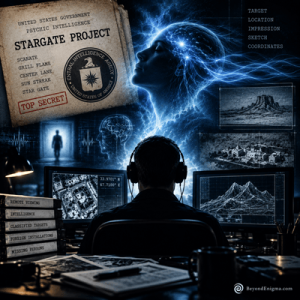
The technique became known as remote viewing, and the government took the possibility seriously enough to spend decades investigating it.
The programs operated under several names, including Scanate, Grill Flame, Center lane, Sun streak, and eventually Star Gate.
Behind those code names were experiments involving psychics, scientists, military intelligence officers, classified targets, etc.
This isn’t one of those stories where researchers are trying to prove that a secret government program existed.
The paperwork is sitting on the CIA’s own website.
Psychic Spies Enter the Intelligence World
The story began in the early 1970s at the Stanford Research Institute, or SRI, in California.
Physicists Harold Puthoff and Russell Targ investigated people who claimed unusual perceptual abilities. 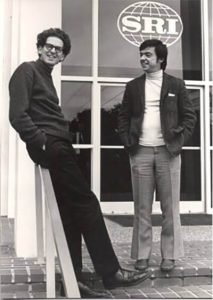
One of their most important subjects was artist and psychic Ingo Swann.
Swann claimed he could mentally perceive distant locations without physically traveling to them.
Related: Operation Gladio NATO’s Secret Military
Researchers would provide coordinates or other limited information about a target while Swann attempted to describe what was there.
CIA records confirm that the agency contracted with SRI from roughly 1972 to 1976 to investigate whether paranormal phenomena might have intelligence applications.
“This phenomenon we investigated most extensively was the ability of individuals to view remote geographical locations… given only coordinates or a person at a location on whom to target.”
The researchers said some participants appeared capable of describing “geographical or technical material, such as buildings, roads, laboratory apparatus, and the like.”- Stanford Research Institute, Perceptual Augmentation Techniques research report
If remote viewing actually worked, even occasionally, the intelligence implications were obvious.
Why sneak a spy into a restricted facility if someone could peek inside without ever leaving California?
A sniper can blast someone’s ass away without the need of a scope (Remote Sniping).
Put the Coordinates on the Table
One of the early experiments involved Swann being handed geographic coordinates while at SRI in Menlo Park.
On May 29, 1973, he was given coordinates for what became known in the records as the West Virginia site. 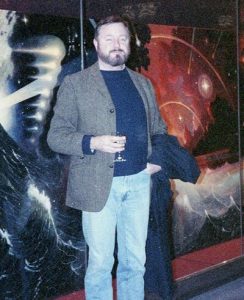
According to the SRI documentation, Swann was not allowed maps and was asked to immediately describe his impressions.
The experiment was recorded on videotape and SRI researchers believed results from experiments like these justified further investigation.
Related: MK Ultra CIA Trying To Hack The Human Mind
The work gradually moved beyond laboratory curiosity and into something considerably stranger.
Military intelligence wanted to know whether remote viewing could be used operationally.
Grill Flame
By the late 1970s and early 1980s, remote viewing research was operating within military intelligence under names including Grill Flame.
And the targets weren’t always practice exercises.
Declassified records show remote viewers were tasked during the Iran hostage crisis. 
“The purpose of the session was to provide information relevant to the hostage situation in Iran.”
It cautioned that the viewer’s impressions were being supplied as “raw intelligence data” and had not undergone intermediate analysis or evaluation.” – Grill Flame Remote Viewing Session D 8, August 26, 1980
The existence of the session doesn’t prove that the psychic information was correct. It proves something almost as fascinating historically.
Hits, Misses and Some Very Strange Results
The surviving records don’t paint a simple picture of psychics hitting targets with laser precision.
Some sessions were considered impressive by researchers, while others fell flat on their face.
One training report bluntly states that the viewer’s impressions showed “absolutely no target correlation.”
Another session produced a much stranger result. 
A viewer was supposed to target Offutt Air Force Base in Nebraska, but the coordinates supplied were incorrect.
They actually pointed toward an area near Pisgah, Iowa.
According to the session report, the viewer described a narrow winding body of water running through a flat plain with cliffs on either side.
Investigators later noted that the mistaken coordinates landed near the Soldier River, where the geography reportedly resembled the description.
The report concluded that the viewer described the location indicated by the incorrect coordinates, rather than the intended Air Force base.
Either something unusual happened or researchers were finding patterns in ambiguous descriptions.
That argument would follow remote viewing for decades.
From Experiment to Star Gate
The bureaucratic names changed as responsibility for the research moved through different parts of the intelligence community.
Eventually the umbrella program became widely known as Star Gate. 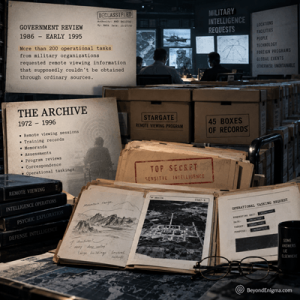
This wasn’t merely a handful of psychic experiments gathering dust in a filing cabinet.
Related: Are Psychics Real? Hardcore Undeniable Proof
A later government review found that between 1986 and early 1995, the program received more than 200 operational tasks from military organizations requesting remote viewing information that supposedly couldn’t be obtained through ordinary sources.
The surviving archive eventually grew to roughly 45 boxes of records, covering material from 1972 through 1996, including remote viewing sessions, training records, memoranda, assessments, and program reviews.
The breadcrumbs had turned into a paper trail.
Did Remote Viewing Actually Work?
By 1995, the CIA commissioned an outside evaluation of the program.
This is where the story gets especially interesting because the conclusion wasn’t simply, “Psychics are nonsense. Case closed.” 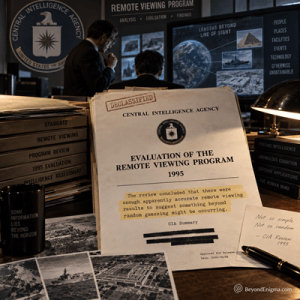
According to the CIA’s own later summary, the review concluded that there were enough apparently accurate remote viewing results to suggest something beyond random guessing might be occurring.
But there was a catch….
The results were considered too inconsistent, unreliable, and sporadic to provide useful intelligence. The CIA therefore chose not to restart the operational program.
That leaves Project Stargate sitting in an unusual historical no man’s land.
The Psychic Files Are Open
After the program ended, Congress pushed for the records to be reviewed and declassified.
Today, 1000’s of pages connected with Star Gate and its predecessor programs are available through the CIA’s electronic reading room.
They contain transcripts, drawings, target coordinates, evaluations, experimental protocols, correspondence, and reports that once carried classification markings.
Whether remote viewing represents an unexplained human ability, statistical noise, or some combination of those possibilities remains debated.
But one part of the story requires no psychic ability to see.
For more than 20 years, elements of the United States intelligence and military establishment seriously investigated whether the human mind could gather information beyond the reach of the ordinary senses.
Sometimes the strangest conspiracy stories don’t end with proof of the paranormal.
They end with a declassified government file stamped Secret.
References:
CIA.gov/readingroom/docs/CIA-RDP96-00791R000200300002-2.pdf
CIA.gov/readingroom/document/cia-rdp96-00788r000800060001-8?
CIA.gov/readingroom/document/cia-rdp96-00791r000300030003-0?