
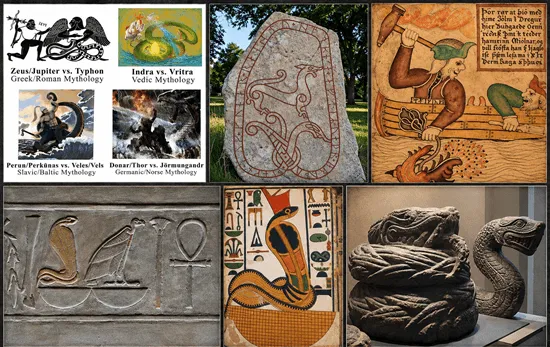

Ancient Serpents Mystery and Why the Same Creature Appears Across Civilizations
Long before dragons entered medieval legends, serpents were already wrapped around some of humanity’s oldest myths.
They protected kings in Egypt, joined earth and sky in Mesoamerica, inhabited sacred waters in India and appeared as enemies of the gods.
Across widely separated cultures, the serpent could represent healing, renewal and divine power or chaos, danger and destruction.
Why did the same creature keep appearing at the boundaries between life and death, earth and heaven, knowledge and danger?
The Serpent Slithers Into the Story
Part of the answer may have been hiding in plain sight.
Snakes move without legs, disappear underground, live around water and trees, carry deadly venom and shed their skin. 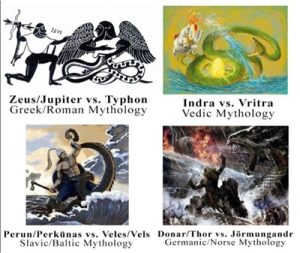
Related: Ancient Handbag Motif Discovered World Wide
To ancient observers, those traits would’ve made them natural symbols of death, renewal and transformation.
“the most unsettling of creatures for man”– Walter Burkert, Greek Religion
Burkert called its shape and behavior uncanny, while anthropological discussions of serpent symbolism have repeatedly emphasized the unusual emotional response snakes produce.
“no other animal is so rich in meaning for the whole human species”– Roy Willis, Signifying Animals
That richness may explain why the serpent was never easy to pigeonhole.
It could belong to the earth, vanish beneath it, enter water and climb toward the sky.
Ancient mythology had plenty to work with, and the serpent soon found itself moving between worlds.
Quetzalcoatl Bridges Earth and Sky
Mesoamerica produced one of the clearest examples.
The Feathered Serpent appeared centuries before the Aztec Empire.
Monumental serpent imagery decorated Teotihuacan, while related traditions later appeared across Mesoamerica under names including Quetzalcoatl and Kukulkan. 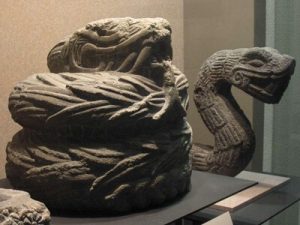
The serpent moved against the earth while feathers belonged to the sky, turning the hybrid into a fitting symbol for a being capable of crossing boundaries.
“a god of Heaven and earth, light and darkness, and life, death, and rebirth”– Tamra Andrews, Dictionary of Nature Myths
Andrews notes that Quetzalcoatl accumulated associations with earth, sky, water, wind and rebirth.
That puts the Feathered Serpent right in the thick of the same opposites that follow serpent symbolism elsewhere.
Instead of belonging neatly to one realm, the creature bridges several of them.
Egypt Put Serpents on Both Sides of the Fence
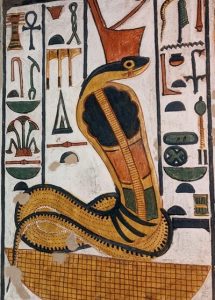
Ancient Egypt takes the serpent’s double nature and runs with it.
The cobra represented royal and divine protection.
Wadjet appeared in cobra form, while the uraeus placed a rearing serpent directly on the forehead of kings and gods.
Related: Greek God Dionysus Turned Water Into Wine Before Jesus Arrived
Its ability to strike wasn’t something the Egyptians ignored because that danger was precisely what made it a powerful guardian.
“The rearing cobra, its upper body raised and its hood inflated, was a symbol of protection in ancient Egypt. Images show royal and divine headdresses adorned with uraei at the forehead, facing forward to spit fire and venom at the enemies of Egypt.”– The Metropolitan Museum of Art, Department of Egyptian Art
Yet Egyptian religion also produced Apophis, the enormous serpent that threatened the nightly journey of Ra.
Egyptologist Jan Assmann interpreted the struggle as part of a much larger Egyptian concern with keeping cosmic order from collapsing.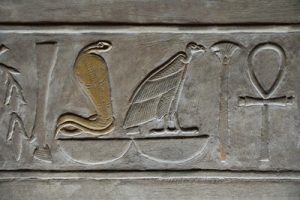
Describing Apophis, he wrote that the solar journey was threatened by
“a gravitation towards chaos, standstill, and termination”– Jan Assmann, The Ancient Egyptian Myth of the Journey of the Sun
Assmann explains that this force was symbolically embodied as a giant water serpent that had to be defeated again and again so the solar cycle could continue.
That puts 2 very different serpents inside the same civilization.
One protected divine authority, while another represented the force trying to stop the cosmic machine in its tracks.
The serpent could guard the line or cross it.
Mesopotamia and the Monsters of Chaos
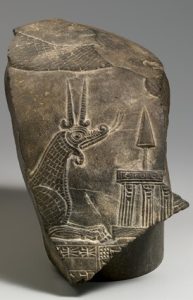
Mesopotamian mythology adds another layer to the mystery cake.
The Enuma Elish pits Marduk against Tiamat and her monstrous forces, including serpentine and dragon like beings.
Related: Did Jesus Exist? Greek Hellenistic Era Says No
Yet dragons weren’t automatically villains because the mushussu later became closely associated with Marduk himself.
“The snake-dragon (mushussu) as animal of Marduk and Nabu was taken over from Tishpak, local god of Eshnunna. Marduk’s adoption of the creature followed Babylon’s rise to power.”- Jeremy Black and Anthony Green, Gods, Demons and Symbols of Ancient Mesopotamia
Much like Egypt, Mesopotamia placed serpent imagery on both sides of the cosmic fence.
India Takes the Pattern Even Further
Ancient Indian traditions provide both one of the strongest chaos serpent stories and some of the clearest examples of sacred serpents.
The Rigveda describes Indra battling Vritra, a serpentine adversary associated with the obstruction of the waters.
Indra defeats him and the waters are released, creating the familiar combination of divine warrior, serpent, water and restored order. 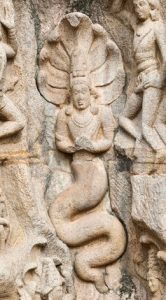
“the great exploit of Indra is the slaying of the dragon Vritra, which had shut up the waters.”– A. Berriedale Keith, The Religion and Philosophy of the Veda and Upanishads
Keith interpreted the conflict as fundamentally tied to the release of the pent up waters, with Indra acting as the divine power that breaks the obstruction and restores their flow.
Yet India also shows why the comparison can only be pushed so far.
Lord Of The Rings: Mysteries Surround The Ancient Saturnian Cult
The Nāgas could inhabit waters, underground realms and sacred locations. Depending on the tradition, they might be dangerous, benevolent or protective.
Scholar Wendy Doniger captures the contradiction perfectly.
“Snakes are a sacred and sinister presence throughout the history of Hinduism”– Wendy Doniger, The Triumph of the Snake Goddess
Doniger also describes Hindu serpents as beings that blur the line between animals, humans, gods and demons.
Shesha pushes that ambiguity even further because Vishnu rests upon the cosmic serpent rather than fighting it.
In India, the serpent can threaten divine order or become part of it.
Jörmungandr Circles the World
Norse mythology pushes serpent symbolism to a cosmic scale.
Jörmungandr becomes so enormous that the Midgard Serpent encircles the world.
Thor becomes its great opponent, and their final confrontation takes place during Ragnarök when the existing cosmic order is collapsing. 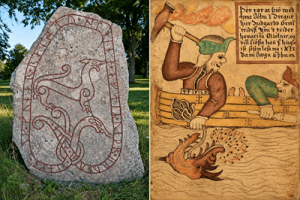
Thor eventually kills the serpent but dies from its venom shortly afterward.
“the encounter between the god Þórr (Thor) and his cosmic enemy, the World serpent, a beast that encircles the earth, in the deep sea. In this myth, Þórr fishes up the serpent, and depending on the variant, Þórr may or may not kill the serpent.”– John Lindow, Old Norse Mythology
Once again, familiar ingredients appear together with an enormous serpent, the sea, a powerful divine opponent and a confrontation connected with the fate of the world.
The image of a serpent surrounding itself also brings to mind the broader Ouroboros tradition, in which a snake consumes its own tail.
Apollo, Python and the Serpents of Healing
Greek mythology has more than its fair share of dragons and serpents.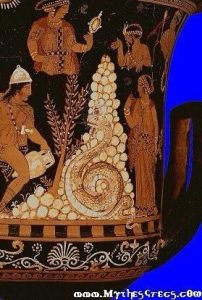
Apollo defeats Python at Delphi, while other major Greek myth cycles include the Hydra, the serpent guarding the Golden Fleece and the dragon protecting the apples of the Hesperides.
Classicist Daniel Ogden notes just how widespread the pattern became.
“almost every major myth cycle of the Greek and Roman worlds featured a dragon-fight at its heart”– Daniel Ogden, Drakōn
Ogden also points to the serpent’s opposite role in Greek religion.
Asclepius, the god of healing, was closely associated with snakes and could even appear in serpent form.
Sacred snakes were kept at healing sanctuaries and became linked with protection, health and good fortune.
So even in Greece, the serpent could be either a monster guarding sacred ground or a divine presence within it.
The Serpent Beneath the Oracle of Delphi
Delphi’s connection with the serpent went deeper than Apollo simply killing Python.
In Greek tradition, Python guarded the oracle before Apollo took possession of the sanctuary.
Older traditions also connected Delphi with Earth and Themis, giving the serpent a strong link with the site’s earlier chthonic and prophetic character. 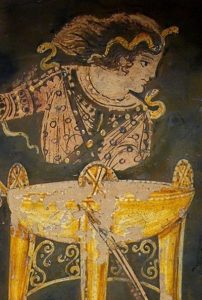
Related: Did The Celestial Planets Rule Our Ancient Skies As Old Suns?
Scholar L. Maurizio described the Pythia as a priestess through whom Apollo’s presence was experienced and his response delivered.
“one of Apollo’s servants imagined, heard, intuited, or feigned Apollo’s presence and then uttered Apollo’s divine response to the human client who made inquiry of the god.”– L. Maurizio, Anthropology and Spirit Possession
Even after Apollo became the dominant god of Delphi, the serpent never disappeared from the sanctuary’s identity.
His priestess was called the Pythia, a name tied to Pytho and Python, while Apollo’s victory over the serpent remained part of Delphic religious tradition.
Classicist Joseph Fontenrose emphasized just how central Python remained to the mythology of Delphi.
“Python was the guardian of the Delphic shrine before Apollo came. Apollo slew him and took possession of the oracle, but the old serpent remained deeply embedded in the tradition of the place.”– Joseph Fontenrose, Python
Why the Serpent Keeps Coming Back
Researchers have linked serpent symbolism to its unsettling appearance, liminal nature and associations with healing, renewal and chaos.
Snakes disappear underground, move through water, carry venom and shed their skin, making them natural symbols of death, rebirth, danger and protection.
Quetzalcoatl bridges earth and sky, Shesha supports divine order, Apophis threatens it and Jörmungandr circles the world.
Different cultures told different stories, but the serpent kept appearing where one world met another.
References:
Springer Mythology and Zoosemiotics
Cal Poly Humboldt The Stranglehold of the Serpent
Taylor & Francis Snakes in the Ritual Systems of Various Peoples
University of Chicago Ancient Scientific Basis of the Great Serpent
JSTOR The Triumph of the Snake Goddess