
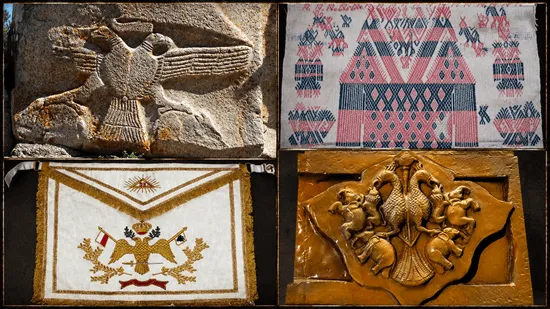

The Two Headed Bird Symbol in Ancient Mythology
Two heads face opposite directions while a single body spreads its wings.
Ancient artists carved this strange creature into sacred gateways, embroidered it onto burial garments and placed powerful figures above it.
From Anatolia to Peru, the two headed bird entered very different worlds of belief.
Follow its trail and an ordinary bird becomes something far more extraordinary.
The Hittites Placed It Beneath Gods
One of the most striking examples survives at Alacahöyük in Turkey, where a double headed eagle appears on the inner face of the monumental Sphinx Gate.
Its wings spread outward while its talons grip prey, identified in scholarly discussions as hares. 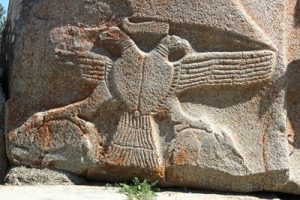
Surrounding reliefs depict religious ceremonies, hunting and royal participation, placing the creature within a setting where sacred power and kingship met.
Related: Ancient Handbag Symbols Found Worldwide
At nearby Yazılıkaya, a rock sanctuary associated with the Hittite capital, the image takes another turn.
A double headed eagle supports two goddesses in the carved divine procession.
“The double-headed eagle supporting a figure is a new element in Hittite art.” Chariton explains that animals commonly represented deities throughout the ancient Near East, reflecting their divine attributes. The double-headed eagle also appeared supporting human figures, suggesting its use as a personal or family emblem.” – Jesse David Chariton, The Mesopotamian Origins of the Hittite Double-Headed Eagle
The bird could hold prey below while supporting divine figures above.
That arrangement gives us a concrete starting point for interpreting its power, although the reason for its two heads remains harder to pin down.
Peru Wove Two Headed Birds Into Burial Clothing
Thousands of miles away, ancient Peru preserved the same basic arrangement in cloth.
A Paracas headband in the Cleveland Museum of Art, dated around 300–100 BCE, repeats birds with two heads shown in profile, joined to one frontal body with outstretched wings. 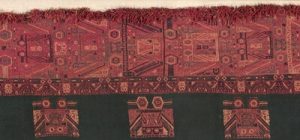
A related tunic and mantle carry similar imagery.
The museum suggests that these three garments may have formed a matching ensemble worn by a socially prominent man.
The mantle brings the motif into a funerary setting, where richly decorated textiles accompanied the dead.
“Its double-headed bird motifs— embroidered in vivid red, blue, yellow, and green yarns—likely had symbolic significance, although the specific meaning remains unknown.” – Cleveland Museum of Art, Mantle
The Metropolitan Museum’s exhibition commentary also connects the tunic’s linear style with representations of supernatural beings.
Related: Ancient Twin Symbolism Throughout The World
These birds belonged to clothing that expressed status and carried elaborate imagery into the grave.
Their original meaning has slipped through our fingers, but the surviving garments establish the design in Peru centuries before European contact.
India Gave the Bird Extraordinary Strength
India’s Gandabherunda adds another dramatic version of the two headed creature.
Depictions show a bird whose strength overwhelms other powerful animals.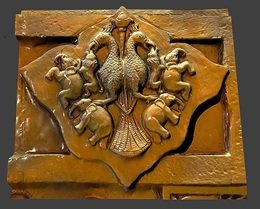
A carved box in the British Museum preserves the Mysore emblem with an especially striking arrangement.
“The central panel on the lid shows the Mysore emblem of a double-headed eagle grasping elephants and eating lions (gandabherunda).” – British Museum, Box
Elephants and lions make formidable opponents, yet this bird handles them as prey.
That imagery takes us back to the Hittite carving, where an eagle also grips animals beneath its spread wings.
The shared visual theme invites comparison, while the creatures and cultural settings differ.
The Indian example pushes the message of overwhelming strength into spectacular territory.
Two heads belong to a being whose abilities exceed those of an ordinary animal, making it a fitting image for extraordinary power.
China Preserved the Bird in Clay and Paint
The Smithsonian’s National Museum of Asian Art holds a small clay figure from Shaanxi province identified as a double headed bird.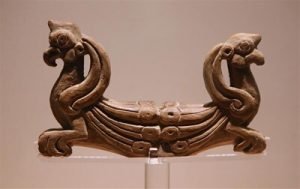
Dated to the seventh or eighth century CE, during the Tang dynasty, it preserves the motif in a Chinese setting.
Related: Cosmic Egg Told By Ancient Cultures Around The World
The catalogue associates the object with Buddhism, although it doesn’t explain the figure’s precise religious role.
Farther west, Kizil Cave 167 in present day Xinjiang adds another compelling example.
“The image in Cave 167 reveals Indo-Iranian influence alongside a local reworking typical of the Kucha region.” – Luca De Fabritiis, The Depiction of the Double-Headed Eagle Fighting Snakes
Its murals include a double headed eagle fighting snakes, the subject of a 2024 study by scholar Luca De Fabritiis.
The setting matters because Kizil belonged to the Buddhist world of the Silk Road.
Here, the two headed bird appears within a scene of combat.
Its presence opens another line of inquiry into how artists carried, adapted and reinterpreted powerful creatures across interconnected religious and artistic worlds.
Later Rulers Claimed Its Wings
By the medieval period, the double headed eagle appeared in ceramics, textiles and emblems of authority.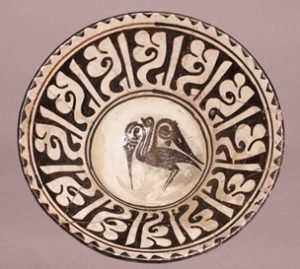
A twelfth century Persian bowl in the Nelson Atkins Museum of Art carries the bird, while Seljuq successor states adopted it as a standard.
“The double-headed eagle was adopted as the standard of the Seljuq successor states in Anatolia and the Jazira.” – The Metropolitan Museum of Art, Court and Cosmos
The image also entered Byzantine contexts and later European heraldry.
An embroidered Byzantine example from the late fourteenth century probably belonged to an altar cloth or a textile displayed beneath an icon.
Religious use and royal associations could therefore coexist within the bird’s later history.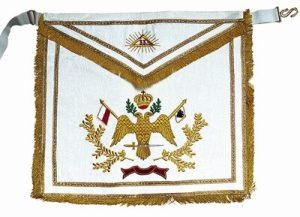
Freemasonry eventually gave it another home.
The Scottish Rite adopted the double headed eagle as a recognizable emblem, placing an ancient visual formula on regalia used by a much later institution.
The bird kept finding new roles as its surroundings changed.
Why Give One Bird Two Heads?
The most obvious feature is also the most puzzling.
One body holds two heads looking in different directions, combining division and unity in a single creature.
Related: Serpents Symbolism Keep Slipping Into Ancient Cultures
That makes duality a compelling interpretation to explore, especially where a culture supplies its own explanation.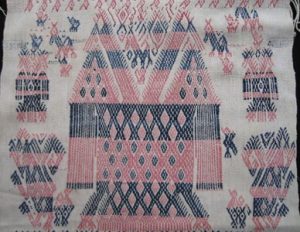
A K’iche’ Maya altar cloth from Chichicastenango, Guatemala, dated 1890, provides one such case. Emory’s museum describes the local interpretation of the bird.
“one head looking at the sky and the other looking at the earth.” – Michael C. Carlos Museum, Altar Cloth with Double Headed Eagles
The museum connects this with the Maya concept of “skyearth,” while also identifying the Spanish Habsburg associations of the emblem.
This later example gives the two heads an explicit relationship with two realms.
It offers a useful comparison for exploring metaphysical meanings, without supplying the lost explanation for every ancient bird.
Elsewhere, supporting gods, gripping prey and appearing on prestigious garments point toward different expressions of sacred power, authority and protection.
A Symbol With More Than One Life
Perhaps the greatest mystery isn’t why ancient cultures imagined a bird with two heads.
It’s why such a peculiar image kept finding its way into sacred art, royal emblems and spiritual traditions.
Was it simply a powerful design that different cultures reinvented, or did those two opposing heads express something deeper about how humanity understood the world?
For now, the answer remains soaring through the air.
References:
https://www.ancient-origins.net/artifacts-other-artifacts/double-headed-eagle-everlasting-symbol
https://www.medievalists.net/2025/04/double-headed-eagle-byzantium/
https://portal.lvc.edu/vhr/articles/2015-Krause%20Mesopotamian%20Originsedited.pdf
https://www.researchgate.net/publication/Double-Headed_Eagle_at_Yazilikaya
https://www.researchgate.net/publication/366398269_Chapter_cultura