

The Seven-Pointed Star Ancient Symbolism
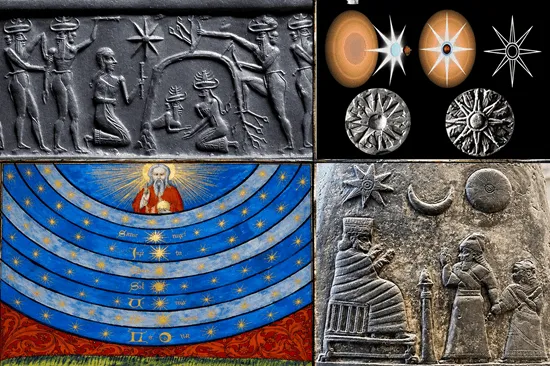
Seven points arranged around a mysterious celestial symbol, carved into ancient seals thousands of years before the rise of modern occult traditions.
The seven-pointed star, also known as the heptagram or septagram, appears in ancient Mesopotamian imagery and later magical traditions, where the number seven became closely associated with planetary powers, celestial order and hidden knowledge.
But what did this unusual star originally represent, and could its seven points conceal a connection to Saturn?
Ancient Seven-Pointed Stars in Mesopotamia
Some of the earliest examples of seven-pointed star imagery come from Mesopotamia, where celestial symbols frequently accompanied gods, mythological creatures and royal figures.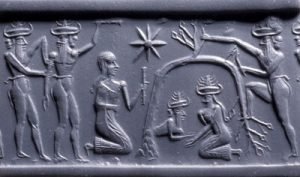
An Akkadian cylinder seal dated approximately 2350–2150 BCE, preserved in the Walters Art Museum, depicts a seated deity receiving three approaching figures beneath a seven-pointed star.
Centuries later, a Neo-Assyrian rock-crystal cylinder seal from the eighth or seventh century BCE depicted a scorpion-man confronting a lion-griffin, accompanied by a crescent moon, fish and another seven-pointed star.
“This scene depicts a seated deity receiving a procession of three figures. The standing individuals include a god followed by an interceding goddess who leads a man. The deities all wear horned headdresses, and a seven-pointed star is also included in the scene.” – The Walters Art Museum, Cylinder Seal with a Presentation Scene (2350–2150 BCE)
A Phoenician bronze bowl discovered at Nimrud also features a prominent seven-pointed star surrounded by decorative lotus flowers and animal imagery.
Related: 7 Gates of The Underworld Myth Ancient Symbolism
These artifacts reveal that seven-pointed celestial designs existed long before their appearance in later European magical traditions.
The Seven Planets and the Mystery of Saturn
One interpretation connects the seven-pointed star with the seven classical planetary bodies recognized in ancient astronomy.
These consisted of the Sun, Moon, Mercury, Venus, Mars, Jupiter and Saturn.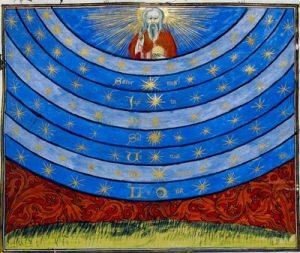
In later astrological cosmology, each occupied a celestial sphere, with Saturn traditionally representing the seventh and outermost planetary boundary.
The Renaissance occult philosopher Heinrich Cornelius Agrippa connected Saturn directly with the mystical significance of seven:
“It is also applyed to Saturn, which ascending from the lower, is the seventh Planet, which betokens rest, to which the seventh day is ascribed” – Heinrich Cornelius Agrippa, Three Books of Occult Philosophy
Saturn also became associated with time, limitation, mortality and the boundaries separating the material world from higher spiritual realms.
Could the seven-pointed star have represented these seven celestial powers, with Saturn marking the final threshold?
The Seven Stars and the Pleiades
Another possible connection leads to the Pleiades, the famous star cluster traditionally known as the Seven Sisters.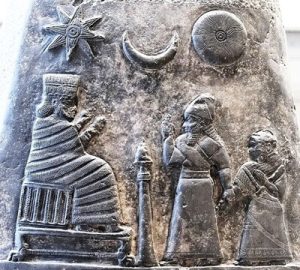
Ancient Mesopotamian astronomy recognized this celestial grouping, which appeared in astronomical texts and religious symbolism.
Agrippa also connected the Pleiades with the mystical significance of seven:
“There are seven Stars about the Articke Pole, greater, and lesser, called Charls Wain also seven Stars called the Pleiades, and seven Planets” – Heinrich Cornelius Agrippa, Three Books of Occult Philosophy
Seven-dot arrangements representing the Pleiades appear among Mesopotamian celestial emblems, while a Babylonian astronomical tablet preserved in the British Museum depicts the constellation among other recognizable star groups.
Related: Ancient Winged Symbolism Throughout The World
Were some ancient seven-pointed designs intended to evoke this celestial grouping rather than the seven planetary powers?
The Seven-Pointed Star in Occult Traditions
The seven-pointed star eventually acquired new meanings in Western ceremonial magic, where planetary symbolism became deeply intertwined with astrology, alchemy and spiritual initiation. 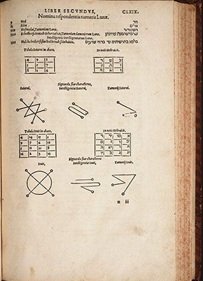
Agrippa described a universe governed by celestial intelligences, each associated with planetary forces.
“So we receive from many of the ancient Fathers of the Hebrews the names of angels set over the planets and signs” – Heinrich Cornelius Agrippa, Three Books of Occult Philosophy
In planetary magic, the seven classical planets could be arranged around a heptagram, creating a geometric relationship between the celestial bodies and the traditional sequence of weekdays.
The symbol also appears in modern Thelemic traditions, particularly in association with Babalon, a mystical figure central to Aleister Crowley’s esoteric teachings.
Elsewhere, the heptagram became known as the Fairy Star or Elven Star, representing spiritual mysteries and connections with otherworldly realms.
David Talbott and the Saturnian Star Theory
An intriguing interpretation of ancient celestial symbols comes from comparative mythologist David Talbott, author of The Saturn Myth.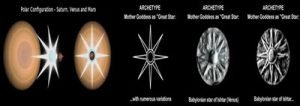
Talbott proposed that ancient civilizations preserved memories of a dramatically different sky, one dominated by Saturn, which he believed once appeared as an enormous celestial body positioned near the north celestial pole.
He called this arrangement the Polar Configuration, suggesting that recurring symbols in ancient mythology represented actual planetary formations witnessed by early civilizations.
“Saturn did not move on its present remote orbit, but ruled as the central sun around which the other heavenly bodies visually revolved.” – David N. Talbott, The Saturn Myth (1980)
According to Talbott, ancient stars, circles, radiating forms and other celestial emblems may preserve memories of this lost planetary arrangement.
Related: Saturn First Primal Sun Worship
Could the seven-pointed star be another surviving fragment of a forgotten astronomical tradition, its original meaning preserved in symbols long after the celestial events that inspired them?
Seven Points, One Ancient Mystery
Connections with the seven heavens, planetary powers, Saturn and the Pleiades offer several possible explanations for its enduring significance.
Perhaps the greatest mystery is whether these traditions independently embraced the symbolism of seven or inherited fragments of a much older celestial understanding.
Whatever its original meaning, the seven-pointed star remains a symbol whose mysteries extend far beyond its geometry.
References:
https://www.ebsco.com/research-starters/religious-symbolism-and-mathematics
https://globalmeaninglibrary.com/symbols/heptagram
https://www.thunderbolts.info/thunderblogs/origins-of-myth.htm