

The Cochno Stone and Its Mysterious 5,000 Year Old Symbols
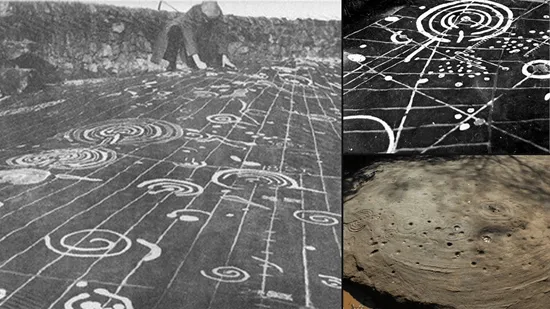
Hidden beneath a Scottish hillside lies the Cochno Stone, an enormous prehistoric monument covered in mysterious circles, spirals and geometric symbols.
Carved roughly 5,000 years ago, its markings have inspired theories involving astronomy, sacred rituals and forgotten knowledge.
Yet their original meaning remains a mystery.
An Ancient Discovery in the Scottish Hills
The Cochno Stone lies near Faifley in West Dunbartonshire, overlooking the River Clyde on the outskirts of Glasgow. 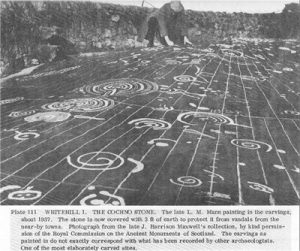
Measuring approximately 13 meters long and 8 meters wide, the enormous sandstone outcrop contains hundreds of prehistoric markings dating to the late Neolithic or early Bronze Age.
Reverend James Harvey brought the monument to archaeological attention in 1885, revealing an extraordinary arrangement of symbols carved directly into the natural bedrock.
Harvey recognized their mysterious nature.
“more of these mysterious hieroglyphics may be brought again to the light of day, and perhaps the veil that shrouds from us their meaning may be withdrawn” – James Harvey, Notes on Some Undescribed Cup Marked Rocks at Duntocher, Dumbartonshire
More than a century later, that veil remains firmly in place.
Strange Circles, Spirals and Four Toed Footprints
The most recognizable features of the Cochno Stone are its cup and ring markings.
These consist of circular depressions surrounded by concentric rings, sometimes connected by narrow channels extending outward.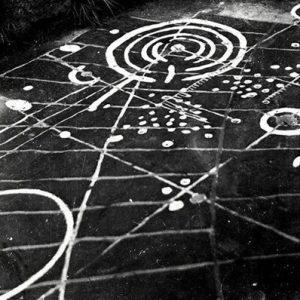
Similar carvings appear throughout prehistoric Britain and Ireland, suggesting the symbols belonged to a much wider artistic or ceremonial tradition.
Related: Glozel Tablets, Real Or a Hoax?
However, the Cochno Stone contains several unusual features, including two pairs of carved footprints displaying only four toes.
Archaeologist John Bruce documented these peculiar markings in 1896.
“a sculpturing resembling two pairs of footprints, which, curiously enough, show only four toes each” – John Bruce, Notice of Remarkable Groups of Archaic Sculpturings in Dumbartonshire and Stirlingshire
A cross enclosed within an oval and several unusual geometric arrangements also appear among the circular designs.
The footprints and cross may represent later additions, while overlapping symbols and differences in carving depth suggest the stone was modified across multiple periods.
Could successive generations have returned to this location, adding new symbols to an already sacred landscape?
The Archaeologist Who Believed the Stone Predicted Eclipses
One of the most unusual interpretations emerged during the 1930s through Scottish archaeologist Ludovic Maclellan Mann.
Mann believed the carvings represented an astronomical system connected to celestial movements. 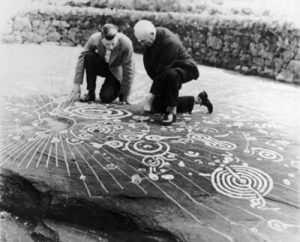
In 1937, he painted the symbols in bright colors and added an extensive geometric grid, proposing that prehistoric observers used the monument to predict solar and lunar eclipses.
“The sculpturings cover an area of 2000 sq. ft., and represent an extraordinary diversity of symbol pictures relating to important episodes in the heavens” – Ludovic Maclellan Mann, The Druid Temple Explained
Mann also connected the carvings with ancient beliefs about a supernatural creature devouring the Sun during eclipses.
Could the concentric circles represent celestial cycles, while the connecting grooves recorded relationships between astronomical events?
Although his theory was never established, it introduced the intriguing possibility that the carvings preserved ancient astronomical knowledge.
Why Was the Cochno Stone Buried in 1965?
By the middle of the twentieth century, the Cochno Stone had become increasingly vulnerable to damage. 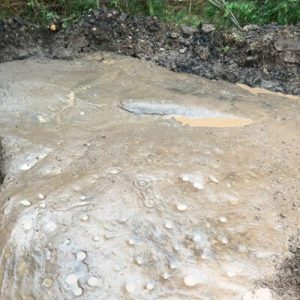
Visitors walked across its delicate surface, while vandals carved names, initials and other markings into the ancient rock.
Related: 5 Mysterious Ancient Sites Still Scratching Heads
In 1965, authorities took an extraordinary step. They buried the entire monument beneath protective soil.
University of Glasgow archaeologist Dr. Kenny Brophy later recalled its disappearance.
“It was last fully open to the elements and the public up until 1965.” – Dr. Kenny Brophy, University of Glasgow, 5,000 Year Old Prehistoric Art Panel Uncovered
For decades, the enormous carved surface remained hidden, known primarily through historical photographs and archaeological records.
A monument that had survived thousands of years was deliberately concealed to ensure its continued survival.
The Remarkable Rediscovery of 2016
In September 2015, archaeologists from the University of Glasgow and specialists from the Factum Foundation began investigating the buried monument.
A preliminary excavation revealed that the stone remained in relatively good condition.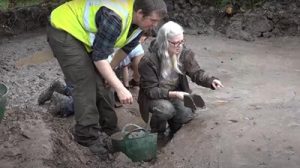
Researchers returned in September 2016, exposing the entire protected surface for the first time in approximately 51 years.
Using high-resolution photography, photogrammetry and laser scanning, the team created a detailed digital record.
“When the 3D data layers were processed and merged at Factum Foundation’s studios in Madrid, an accurate, complete and high-resolution viewer of the Cochno Stone was created for study and dissemination purposes.” – Factum Foundation, The Cochno Stone
Remarkably, much of Mann’s colorful paint from 1937 had survived beneath the soil, alongside modern graffiti.
Researchers also documented overlapping symbols, variations in carving depth and different techniques, suggesting the markings may have developed over an extended period.
After completing their investigation, the team buried the monument again, preserving its mysterious carvings for future generations.
What Do the Mysterious Symbols Actually Mean?
The greatest mystery surrounding the Cochno Stone concerns the purpose of its elaborate carvings.
Some interpretations associate the markings with prehistoric ceremonies, suggesting the monument served as a sacred gathering place. 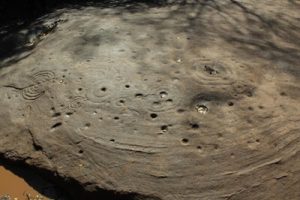
Others propose that the designs represented natural features such as water sources, hills or pathways, potentially forming a symbolic map of the surrounding landscape.
Related: The Ancient 7 Pointed Star Symbol
Astronomical theories suggest the circles expressed celestial movements, seasonal cycles or the passage of time.
During a 2020 Scottish Parliament discussion, Gil Paterson highlighted the unanswered questions.
“Are the markings ritual, religious or astronomical? Do they describe a place or are they good, old-fashioned graffiti?” – Gil Paterson, Scottish Parliament Official Report, 19 February 2020
The stone’s elevated position overlooking the Clyde valley adds another intriguing possibility, suggesting it once occupied an important place within the prehistoric landscape.
Perhaps its symbols combined several meanings, changing as generations returned to the site.
;
A Prehistoric Message Still Waiting to Be Understood
Five thousand years later, the Cochno Stone’s mysterious carvings remain undeciphered despite modern archaeological investigations.
For now, their secrets remain set in stone.
References:
https://factumfoundation.org/the-bbc-reports-the-unearthing-of-the-cochno-stone/