


Simon the Magus vs Jesus: Miracle Worker or Master Illusionist?
I’ll admit, when I first stumbled onto the story of Simon the Magus, I paused and thought this dude is a replica of Jesus.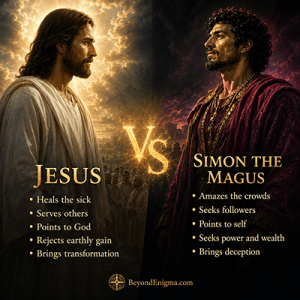
Here was a man who, at first glance, seemed to mirror Jesus in strange and unsettling ways.
Let’s step into this ancient crossroads where belief, power, and perception collide.
Who Was Simon the Magus Anyway?
Simon the Magus, also known as Simon Magus, appears most famously in the Book of Acts.
He doesn’t appear like a prophet, nor a savior, but as a sorcerer who captivated crowds.
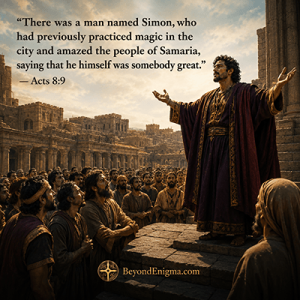
“There was a man named Simon, who had previously practiced magic in the city and amazed the people of Samaria, saying that he himself was somebody great.”
(Acts 8:9, New Testament)
That line alone sets the stage, because Simon had already amazed people and built a reputation for himself, claiming greatness in a way that might sound strangely familiar.
“They all paid attention to him, from the least to the greatest, saying, ‘This man is the power of God that is called Great.’”
(Acts 8:10)
Jesus and Simon: Parallel Paths or Opposite Roads?
Both figures performed acts that left people stunned, with Jesus becoming known for healing the sick while Simon amazed crowds with displays that earned him a powerful reputation. 
- Jesus performed miracles as acts of compassion and divine authority
- Simon performed wonders that were perceived as magic or spectacle
They’re in contrast with each other, because while one heals the blind, the other dazzles the eye with acts that leave people dumbfounded.
One points upward toward something greater than himself, while the other draws attention inward toward his own power and reputation.
Authority and Intention
Jesus never sold his power and rejected worldly gain repeatedly. But Simon, on the other hand, made moves that would define his legacy forever.
“Give me also this power, that anyone on whom I lay my hands may receive the Holy Spirit.”
(Acts 8:19)
He offered money for spiritual authority and that moment gave birth to the term simony, the buying of sacred power.
Peter’s response cuts like a blade.
“May your silver perish with you, because you thought you could obtain the gift of God with money!”
(Acts 8:20)
The Gnostic Twist: Simon as a Divine Figure 
Things become even more intriguing when we look beyond the canonical Bible, where Simon emerges as a much different and more mysterious figure.
Early Christian writers like Irenaeus describe Simon as the founder of a sect, but some Gnostic traditions elevate him even further.
“This man is the supreme power, that is, the one who is over all.”
(Irenaeus, Against Heresies, Book 1, Chapter 23)
A Mirror Image of Christ?
Some Gnostic interpretations suggest Simon embodied a form of divine knowledge.
Not salvation through faith, but enlightenment through hidden truth.
Compare that to Jesus:
- Jesus offers salvation through belief and transformation
- Simon, in Gnostic thought, offers knowledge and awakening
The Apocryphal Stories: Legends That Blur the Line
In later traditions, particularly in texts like the Acts of Peter, Simon becomes almost mythic.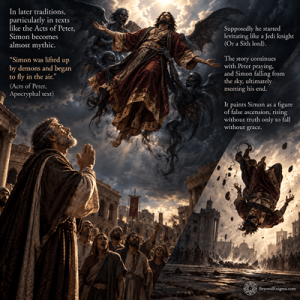
“Simon was lifted up by demons and began to fly in the air.”
(Acts of Peter, Apocryphal text)
Supposedly he started levitating like a Jedi knight (Or a Sith lord).
The story continues with Peter praying, and Simon falling from the sky, ultimately meeting his end.
It paints Simon as a figure of false ascension, rising without truth only to fall without grace.
So What Makes Them Comparable and Different?
Let us break it down in a way that makes this comparison crystal clear.
- Both gathered followers who believed in their power
- Both were seen as channels of something divine
- Both operated in the same historical window
- Both challenged existing systems of belief
But then comes the crucial fork in the road.
Jesus transforms hearts and Simon captivates minds.
One builds a path, while the other creates a spectacle.
References:
- Book of Acts 8:9–24 (New Testament):
https://www.biblegateway.com/passage/?search=Acts+8%3A9-24&version=NRSV - Irenaeus, Against Heresies, Book 1, Chapter 23:
https://www.newadvent.org/fathers/0103123.htm - Acts of Peter (Apocryphal Text):
http://www.earlychristianwritings.com/text/actspeter.html - Justin Martyr, First Apology, Chapter 26:
http://www.earlychristianwritings.com/text/justinmartyr-firstapology.html