
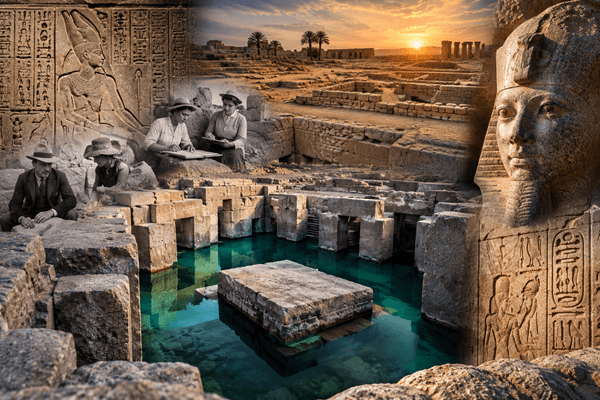

The Osirion at Abydos: Egypt’s Mysterious Underground Monument
Behind the magnificent Temple of Seti I at Abydos lies an Egyptian monument that seems determined to play by its own rules. 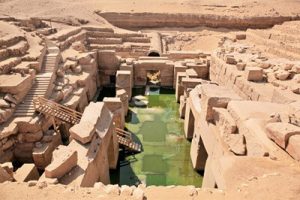
Known as the Osirion, the structure sits considerably lower than the temple beside it and was constructed using enormous blocks of stone, including massive granite pillars and lintels.
At its center is an island-like platform surrounded by a channel that today can contain groundwater.
The monument is generally associated with Seti I, the 19th Dynasty pharaoh who ruled during the 13th century BC.
Yet when archaeologists first uncovered it, some wondered whether they were looking at something considerably older.
That question has followed the Osirion ever since.
Something Was Hiding Behind the Temple
The story began during excavations at Abydos in the early 1900s.
Archaeologist St. George Caulfeild was investigating the enclosure surrounding Seti I’s temple when excavations revealed a subterranean passage buried beneath enormous quantities of sand.
Related: Yahweh And Saturn Ancient Sun Cult?
Further work was undertaken in 1902 and 1903 by Margaret Murray and Hilda Petrie, working as part of Flinders Petrie’s archaeological program. 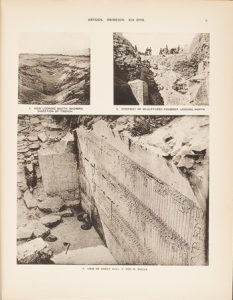
What emerged wasn’t another ordinary room belonging to Seti’s temple, but an enormous underground complex.
Murray described how the builders excavated downward before lining spaces with huge blocks of stone.
Once completed, much of the structure was hidden beneath the ground.
“The building was then completely hidden from the outside.”– Margaret Murray, The Osireion at Abydos, 1904
The deeper archaeologists dug, the stranger the architecture became.
Abydos had been hiding something substantial up its sleeve.
Stonework That Plays No Games
The central hall of the Osirion is dominated by enormous red granite pillars and lintels arranged around a rectangular central platform.
These aren’t delicate columns covered from top to bottom in hieroglyphs.
Related: Giza Pyramids, Ancient Hydraulic Power Plants?
They’re massive, heavy and surprisingly austere. 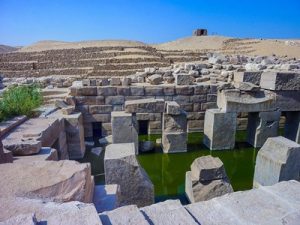
Around the central area runs a channel or basin, while steps descend from the platform toward the lower level.
When the Egypt Exploration Fund returned to Abydos in 1913 and 1914, archaeologist Édouard Naville cleared much more of the structure.
What he uncovered knocked his superman socks off 🧦.
“They have revealed an edifice of high antiquity built of enormous materials, and which, up to the present, has no parallel in Egypt.” –Édouard Naville, report on the Abydos excavations, 1914
Those enormous materials helped ignite a debate that still follows the Osirion today.
Did the Archaeologists Think It Was Older?
Here’s where the plot thickens.
Early excavators didn’t all immediately regard the Osirion as a straightforward 19th Dynasty monument.
Naville believed its gigantic masonry resembled much earlier Egyptian architecture and compared it with structures associated with the pyramid age. 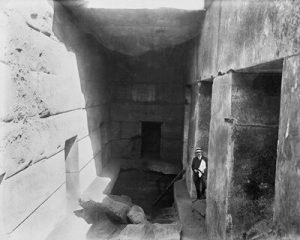
He argued that the building could be considerably older than Seti I’s temple.
Related: Sphinx Considered Much Older Than The Giza Pyramids
That idea wasn’t cooked up on the internet a century later.
It came from an Egyptologist standing inside the freshly excavated monument.
Put photographs of the Osirion and Seti’s temple side by side and they hardly look like peas in a pod.
Seti Left His Dirty Little Fingerprints
Evidence discovered within and around the Osirion strengthened the connection with Seti I and the 19th Dynasty.
Parts of the monument contain religious texts associated with the Egyptian afterlife.
Other inscriptions belong to Merneptah, Seti’s grandson, suggesting that decoration continued after Seti’s reign.
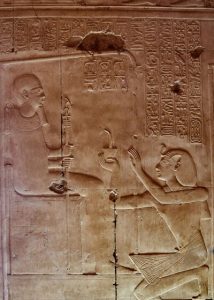
The passage toward Seti’s temple was decorated with material from the Book of the Dead, while other sections contained underworld texts.
Related: Astronomical Tomb For The Ancient Irish Gods
Murray also recorded inscriptions naming Merneptah and addressing Osiris directly.
“I come before thee, Lord of the Sacred Land, Osiris, Ruler of Eternity.”–Inscription of Merneptah recorded by Margaret Murray
Later archaeological interpretation therefore placed the Osirion within the religious program surrounding Seti I.
The strange architecture remained, but the timeline became less mysterious than some early excavators suspected.
A Tomb for a God
Abydos was one of Egypt’s most sacred landscapes and a major center of the cult of Osiris, god of death and resurrection.
Naville eventually interpreted the Osirion as a symbolic tomb of Osiris.
Its underground setting, religious texts and central platform surrounded by water all fit themes of death, creation and renewal.
Yet the mystery never completely went away…
References:
Digi.ub.uni-heidelberg.de/diglit/murray1904
Egyptartefacts.griffith.ox.ac.uk/abydos/
Ees.ac.uk/resource/the-cemeteries-and-temples-of-abydos.html