
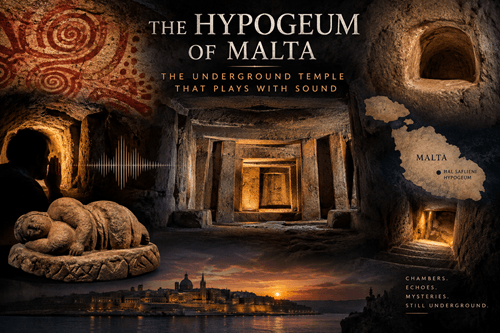

The Hypogeum of Malta: The Underground Temple That Plays With Sound
Beneath the streets of Paola, Malta, lies a prehistoric complex that seems to belong to another world. 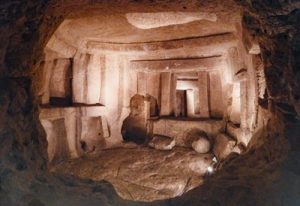
The Ħal Saflieni Hypogeum is a network of chambers, corridors and halls carved directly into limestone.
Its earliest sections date to around 4000 BC, making the site roughly 6,000 years old.
Inside are architectural features modeled after Malta’s megalithic temples, ceilings painted with red spirals and chambers once used in rituals surrounding the dead.
Stranger still, parts of the Hypogeum have unusual acoustic properties capable of making a human voice resonate through the stone.
Nobody left behind instructions explaining what happened down there.
Archaeologists have the chambers, artifacts, paintings and echoes.
Putting those Lego pieces together is where the plot thickens.
Building a Temple From the Inside Out
The Hypogeum returned to the modern world almost by accident in 1902, when construction workers digging foundations for houses broke through into underground chambers. 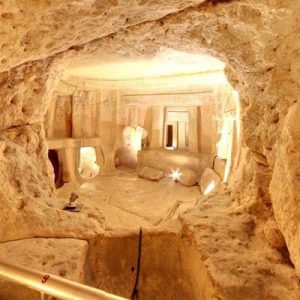
Archaeologists eventually uncovered a prehistoric complex spread across several levels and descending roughly 11 metres beneath the modern street.
UNESCO dates its use from approximately 4000 BC to 2500 BC.
“It is a unique prehistoric monument. It seems to have been conceived as an underground cemetery.”– UNESCO World Heritage Centre
The builders weren’t simply taking advantage of natural caves.
They removed enormous quantities of limestone and carved doorways, pillars, lintels and curved architectural forms directly into the rock.
Some features resemble Malta’s above ground megalithic temples.
Instead of stacking massive blocks to create a building, however, the Hypogeum’s builders flipped the script and removed stone until the architecture emerged around them.
7,000 People Beneath Malta
Whatever else happened at the Hypogeum, death was clearly part of the picture.
Excavators recovered an enormous quantity of human remains from its chambers.
UNESCO estimates that approximately 7,000 individuals were eventually deposited within the complex. 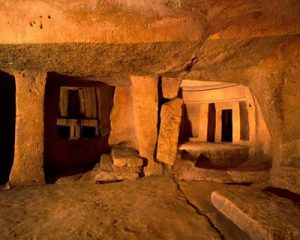
Evidence suggests these weren’t always straightforward burials.
Related: Ancient Pyramid Indonesia
Bodies may first have been allowed to decompose before the bones were collected and moved underground.
Pottery, beads, amulets and other objects accompanied some of the remains.
Red ochre was also found among the bones, suggesting that burial involved more than simply disposing of the dead.
The pigment may have carried symbolic associations with blood, life or regeneration, although its actual meaning remains unknown.
Whatever these ceremonies represented, somebody was putting a lot of thought into the journey underground.
This was clearly more than a matter of putting the dead out of sight and out of mind.
The Woman Who Never Woke Up
Among the artifacts recovered from the Hypogeum was a small clay figure that became one of Malta’s most famous prehistoric discoveries.
Known as the Sleeping Lady, the figure shows a woman lying peacefully on her side with her head resting against one arm.
Beneath her appears to be some type of couch or bed. 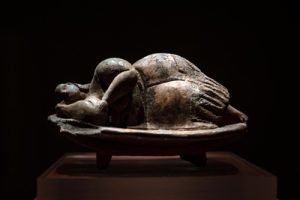
Heritage Malta considers the statuette an unusually rare prehistoric depiction of furniture.
The bigger mystery is what the woman herself represents.
She may simply be sleeping, but interpretations have also connected her with death, ritual sleep or passage into another state.
Related: Is The Sphinx Much Older Than We Think?
There’s no surviving inscription to settle the matter, leaving the Sleeping Lady to keep her cards close to her chest.
Finding such a peaceful figure in a place so closely connected with death only adds another wrinkle to the mystery.
When the Walls Joined the Conversation
On the middle level sits one of the Hypogeum’s strangest spaces.
Traditionally called the Oracle Room, the chamber contains a carved niche capable of producing a striking acoustic effect.
When certain sounds are directed into it, the voice resonates through the surrounding stone. 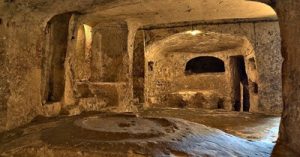
The phenomenon isn’t simply a modern legend.
UNESCO acknowledges the effect and raises the possibility that prehistoric people incorporated it into ceremonies.
“There is a small niche which echoes when someone speaks into it. This effect may well have been exploited as part of rituals.”– UNESCO World Heritage Centre
Researchers interested in archaeoacoustics have attempted to measure what the ear already notices.
Experiments have reported strong resonances around 70 Hz and 114 Hz, with low male voices and percussion capable of stimulating acoustic responses within parts of the complex.
Imagine experiencing that 1000’s of years ago!
A flame provides the only light as somebody begins chanting and the voice suddenly seems larger than the person producing it.
That could’ve packed quite a punch 👊.
Did They Build It That Way?
The obvious question is whether the acoustics were deliberately engineered.
In 2017, archaeoacoustics researcher Rupert Till published a systematic investigation of the Hypogeum in Antiquity. 
His experiments supported some earlier claims about the site’s sound properties while finding that others didn’t hold up under closer examination.
“The results confirm some, but not all, prior observations. The acoustics must have had particular significance and ritual power.”- Rupert Till, Antiquity, 2017
Deliberate use of acoustics wouldn’t require the builders to understand sound in modern scientific terms.
Related: Richat Structure Be The Center Of Ancient Atlantis?
If a chamber made the hairs on the back of your neck stand up, you probably remembered which chamber it was.
If certain shapes strengthened that effect, those shapes could be repeated.
The ear may have been all the measuring equipment they needed.
Spirals in the Darkness
Sound wasn’t the only unusual feature waiting underground.
Red ochre spirals, dots and honeycomb patterns decorate portions of the Hypogeum’s ceilings and walls.
UNESCO identifies them as the only known prehistoric wall paintings surviving on the Maltese Islands. 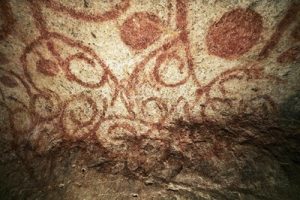
Similar spiral designs appear elsewhere in Malta’s prehistoric temple culture, suggesting the symbol carried some significance beyond simple decoration.
The spirals may have represented cycles, movement, regeneration, life and death or something completely different.
Without written records, every interpretation eventually runs into a brick wall.
Pigments had to be prepared, chambers illuminated and designs carefully applied inside spaces permanently cut off from daylight.
Whatever message the spirals carried, they weren’t meant for casual passersby.
Going Deeper
Farther inside lies another remarkable chamber traditionally known as the Holy of Holies.
Its entrance resembles the monumental architecture found in Malta’s above ground temples.
Once again, what appears to be constructed architecture is actually solid limestone carved to look that way. 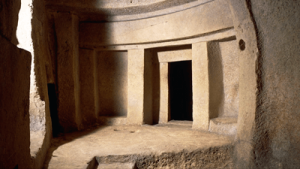
Nearby, steps descend toward the deepest portion of the complex.
Related: Ancient Sphinx In Pakistan With Statue Figure
At that depth, sunlight was completely out of the picture.
Prehistoric visitors would’ve depended upon flames for illumination while footsteps, voices and percussion echoed through enclosed spaces.
Architecture, darkness and sound were all working on the senses at once.
Whether these conditions were used for funerals, ancestor ceremonies, initiation rites or several different practices remains unknown.
Whatever happened down there, atmosphere was hardly in short supply.
An Underground World With No Instructions
6,000 years later, we can measure the chambers and analyze their contents, but when it comes to understanding exactly what their builders intended, we’re still feeling our way through the dark.
Chanting may have accompanied ceremonies, or the unusual echoes may have been discovered and incorporated into rituals over time.
There’s also the possibility that sound influenced the architecture more than we currently realize.
The Hypogeum still refuses to tip its hand.
All we can do is descend into the same chambers, speak into the darkness and listen to what comes back.
References:
Whc.unesco.org/Documents&criteria=Hypogeum&
Cambridge.org/archaeoacoustic-study-of-the-hal-saflieni-hypogeum-on-malta/
Um.edu.mt/library/oar/handle/16629