
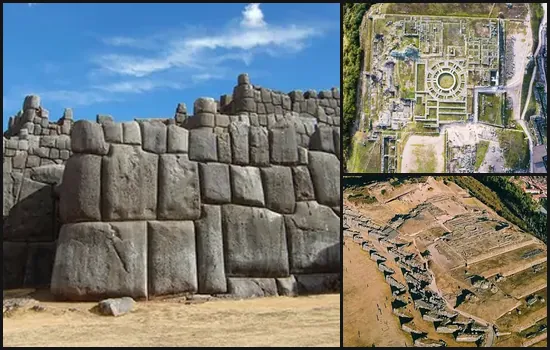

Sacsayhuaman Walls Perfectly Fitted Megalithic Stones
High above Cusco, three tiers of giant zigzag walls snake across a hilltop, built from stones heavier than a loaded freight truck.
Some blocks fit together so tightly that it’s hard to see where one ends and the next begins.
The Inca built it without iron tools, wheels or mortar.
So how did they shape and stack these stones, and why does the site still invite theories of giants, lost empires and enchantment?
Stones Too Big to Make Sense
Sacsayhuamán was begun in the mid-1400s under the Inca ruler Pachacuti and completed by his successors.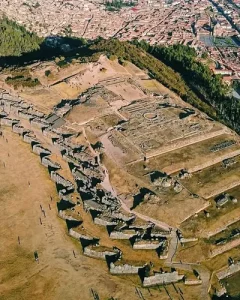
Its three terraced walls zigzag for roughly 720 meters east to west.
The largest blocks stand over 27 feet high, and estimates of their weight run from about 120 tons to as much as 200.
Related: How Were The Egyptian Pyramids Built
Yet the polygonal stones, with their many sides and odd angles, lock together without a drop of mortar.
Because no joint runs in a straight line, the walls can shift and resettle in an earthquake instead of sliding apart, which may be why they have survived five centuries of tremors that toppled later colonial buildings.
“The incredible size of the stones used is astonishing… What is even more wonderful is that they have no mortar, neither sand, nor lime, nor plaster” – Garcilaso de la Vega, Royal Commentaries of the Incas
Garcilaso, who grew up in Cusco in the shadow of these walls, added that you could barely slip a knife point between the stones.
He was so impressed that he ranked the site above the ancient world’s most famous monuments.
“This fortress surpasses the constructions known as the Seven Wonders of the World.” – Garcilaso de la Vega, Royal Commentaries of the Incas
What the Stones Themselves Reveal
In the 1980s, architect Jean-Pierre Protzen of UC Berkeley found river cobbles scattered through the Inca quarries and concluded these simple hammerstones were the main tools.
Larger hammerstones split the rock, and smaller ones pounded it into shape.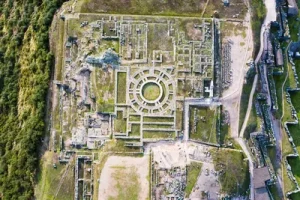
Testing the idea himself, he reproduced Inca-style cuts with the same kind of tools in about 90 minutes.
The secret to the fit, he found, was patience.
Masons cut the stones already in the wall to receive the next one, testing and trimming again and again.
“The fitting of one stone to another was done by cutting the already laid stones to receive the next ones in a trial-and-error fashion. Experiments show that with this process stones can be mined, cut, dressed, and fit with little effort and in a short time.” – Jean-Pierre Protzen, Inca Quarrying and Stonecutting
Enchantment, Giants and a Lost Empire
The stones were so many and so huge, more boulders than stones, that people couldn’t imagine how they had been cut from the quarries.
Alternative researchers like Brien Foerster claim a lost megalithic civilization built the lower walls, and accuse archaeologists of looking away.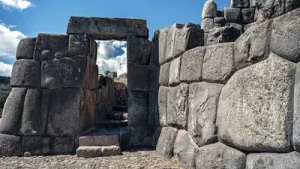
“They completely ignore the idea that there was anyone before the Inca doing megalithic work. How is a Bronze Age people supposed to do this type of work using only copper chisels?” – Brien Foerster
Others suggest stone-softening solvents or giants. None has hard evidence.
There is a real pre-Inca builder, though: the Killke, who lived in the area from about 900 to 1200 AD.
They raised some of the site’s earliest structures, which the Inca later expanded.
Their pottery still litters the hill.
“It’s from both the Inca and pre-Inca cultures; it has a sequence.” – Washington Camacho, director of the Sacsayhuamán Archaeological Park
The House of the Sun and Its Vanished Towers
The Spanish called it a fortress, but the people who built it saw it differently. Writing in 1553, chronicler Pedro Cieza de León recorded the split.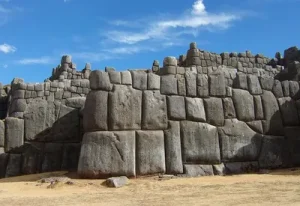
“the natives called the [it] House of the Sun, but which we named the Fortress. The living rock was excavated for the foundation, which was prepared with such solidity that it will endure as long as the world itself – Pedro Cieza de León, Chronicle of Peru
Garcilaso called it a house of the sun god Inti, closed to outsiders. It also stored weapons, food and precious metals.
Related: 5 Ancient Sites That Still Don’t Give Up Their Secrets
Juan Pizarro died storming it in 1536. Colonists later stripped its smaller stones for churches and buried the rest.
Many came to doubt Garcilaso’s three towers. Then in 1934, Luis E. Valcárcel uncovered two of their foundations, Muyucmarka and Sallacmarca. The third has never been found.
The Walls That Outlasted an Empire
The colonists carried off the small stones, but the giants stayed exactly where the Inca put them.
We know about the hammerstones and the trial and error. What we still don’t know is how human hands moved mountains of rock into place and made them fit like they grew there.
References
Sacsayhuaman – World History Encyclopedia
Sacsayhuamán – Wikipedia (Cieza de León passage)
Archeologists discover structures described in important colonial text – Peruvian Times