
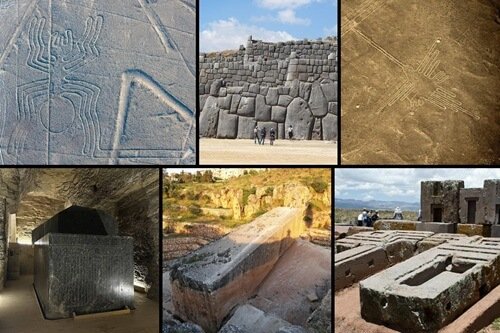

5 Ancient Sites That Still Don’t Give Up Their Secrets
Ancient builders left behind monuments that still make us scratch our heads.
From stones weighing hundreds of tons to enormous images carved across a desert, their achievements can make the ancient world seem anything but primitive.
Archaeology has solved many pieces of these puzzles, but questions about construction, purpose, and symbolism remain.
Here are five ancient sites that still don’t give up all their secrets.
1. Puma Punku
High on the Bolivian Altiplano sits Tiwanaku, one of the great archaeological complexes of South America.
Within it lies Puma Punku, a field of enormous sandstone slabs and intricately shaped andesite blocks that today looks almost as though somebody dismantled a gigantic stone structure and scattered the pieces across the ground.
The site’s destruction has contributed heavily to that appearance.
Yet among the debris are stones containing recessed surfaces, grooves, right angles, repeated geometric features, and the famous components commonly called H blocks. 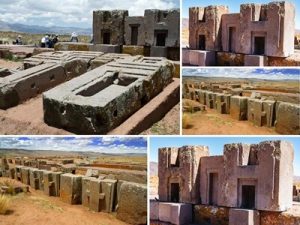
Some pieces appear almost modular, which has helped Puma Punku acquire a reputation for impossible precision.
Related: Mystery Of Newgrange Tomb
Archaeologists Jean Pierre Protzen and Stella Nair found something arguably more interesting.
By studying the surviving fragments, they concluded that Tiwanaku stoneworkers used recurring geometric principles that allowed architectural elements to be planned and reproduced.
“The builders of Tiwanaku were fully aware of the geometric properties of the right triangle.”- Jean Pierre Protzen and Stella Nair, The Stones of Tiahuanaco
That doesn’t make the craftsmanship any less impressive.
Puma Punku was constructed without iron tools or powered machinery, yet its builders quarried, transported, measured, shaped, and assembled large quantities of stone with remarkable consistency.
The real story may therefore be hiding in plain sight.
Rather than evidence of some vanished super technology, Puma Punku could preserve evidence of an indigenous engineering tradition considerably more sophisticated than people once assumed.
2. The Nazca Lines
If Puma Punku makes you stare at stones, the Nazca Lines make you stare at an entire landscape.
Across the dry plains of southern Peru stretch enormous lines and geoglyphs depicting geometric shapes, plants, animals, and humanlike figures.
Among them are the famous monkey, spider, hummingbird, condor, and hundreds of other designs. 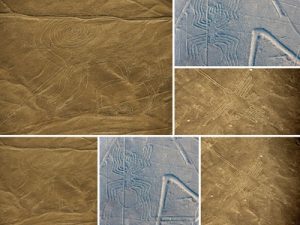
Some straight lines continue across the desert for extraordinary distances (Like a Landing Strip).
Their makers removed dark surface stones to expose the lighter ground underneath.
The extreme dryness of the region then helped preserve the resulting designs for centuries.
Their meaning is considerably harder to pin down.
UNESCO describes the Nazca landscape as displaying an extraordinary concentration of geoglyphs whose purpose has remained an archaeological puzzle.
“They are the most outstanding group of geoglyphs anywhere in the world and are unmatched in their extent, magnitude, quantity, size, diversity and ancient tradition.”– UNESCO World Heritage Centre
Religious processions, sacred pathways, fertility, water rituals, astronomy, and communication with supernatural forces have all entered the discussion.
Related: Theories Of How The Pyramids of Giza Were Built
Some explanations probably aren’t mutually exclusive either.
A landscape modified over generations could have accumulated different meanings and functions rather than serving one grand purpose.
That may be why attempts to find a single key capable of unlocking every Nazca figure have repeatedly fallen short.
3. Baalbek
At Baalbek in modern Lebanon, the stones wander into absurd territory.
The Roman sanctuary of Jupiter contains the famous Trilithon, 3 enormous blocks measuring about 19 meters long each.
Their extraordinary size has earned them a remarkable distinction from the German Archaeological Institute. 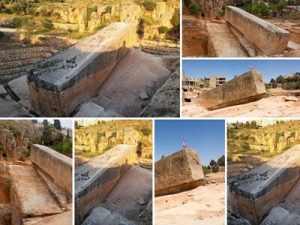
“The three largest known building stones in human architecture.”– German Archaeological Institute
Nearby, the ancient quarry contains even larger unfinished blocks, including the famous Stone of the Pregnant Woman.
Excavations also revealed another enormous monolith beneath it, estimated to weigh around 1,650 tons.
Archaeologist Margarete van Ess described the discovery simply
“The largest block ever cut in antiquity.”– Margarete van Ess
Evidence from the quarry connects these stones with ancient building activity at Baalbek.
The real marvel isn’t whether ancient engineers could work on this scale. The ruins prove they could.
What’s remarkable is just how far they pushed it.
4. Sacsayhuamán
Above Cusco in Peru stand walls that almost look organic.
Instead of neat rows of identical rectangular blocks, Sacsayhuamán contains enormous stones cut into irregular polygons and fitted tightly against their neighbors.
One block might have five sides while another bends around it, yet the masonry continues upward without mortar holding everything together. 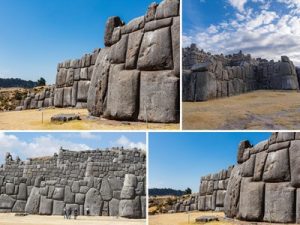
The Inca weren’t simply carving stones.
They had to quarry them, transport them across difficult terrain, maneuver them into position, and repeatedly work adjoining surfaces until neighboring blocks fitted together.
Spanish chronicler Garcilaso de la Vega was already astonished by the site in the 16th century.
“The stones are so large and so many that they cause amazement to anyone who examines them carefully.”– Garcilaso de la Vega, Royal Commentaries of the Incas
That amazement hasn’t entirely disappeared.
Experiments and archaeological evidence indicate that ropes, ramps, levers, hammerstones, abrasion, and large organized workforces could accomplish feats that initially seem impossible.
5. The Serapeum of Saqqara
Deep beneath Saqqara in Egypt lies a place seemingly designed to fuel archaeological mysteries.
The Serapeum of Saqqara consists of underground galleries containing side chambers occupied by enormous stone sarcophagi.
Over centuries, the burial complex expanded until monumental stone sarcophagi became part of the tradition. 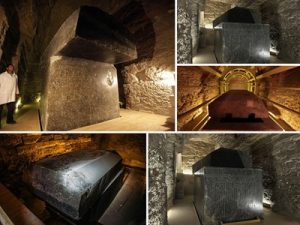
Some of these boxes are enormous.
Related: Ancient Humanoid Reptilian Figurines
Estimates commonly place the bodies of the largest examples around 40 tons, with lids adding considerably more weight.
They were transported, finished, and positioned underground in chambers where maneuvering space was limited.
French archaeologist Auguste Mariette rediscovered the Serapeum in 1850 after noticing part of an avenue of sphinxes protruding from the desert.
His excavations eventually opened the underground galleries.
“I had before me an avenue of sphinxes.”– Auguste Mariette, describing his discovery at Saqqara
From there, the excavation became considerably stranger.
Engineering principles involving sledges, rollers, levers, ropes, and controlled use of sand provide plausible ways of moving extremely heavy objects in ancient Egypt.
But concentrating only on engineering misses half the story.
The Mystery Isn’t Always What We Think
These sites don’t need lost technology to be mysterious.
Archaeology can explain many of the tools and techniques involved, but reconstructing exactly how these monuments were built and what they meant is another matter.
Ancient craftspeople possessed generations of knowledge that disappeared with them.
Perhaps the strangest thing about these sites isn’t that ancient people supposedly couldn’t have created them.
References:
Baalbek German Archaeological Institute
Serapeum of Saqqara Egyptian Ministry