

The Devil’s Arrows and the Forgotten Giants of Prehistoric Britain
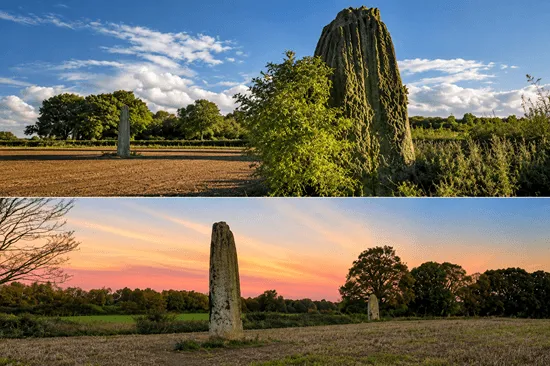
Three enormous stone pillars rise from the countryside near Boroughbridge, North Yorkshire.
Known as the Devil’s Arrows, these prehistoric megaliths have stood for thousands of years, their original purpose lost to history.
The tallest reaches nearly 23 feet, yet these towering giants may be all that remains of a much larger ancient monument.
Who erected them, and what forgotten purpose did they serve?
Three Mysterious Giants of Prehistoric Yorkshire
The Devil’s Arrows consist of three massive standing stones stretching across approximately 174 meters near Boroughbridge.
Unlike Stonehenge’s circular arrangement, these megaliths form a roughly north-to-south alignment. 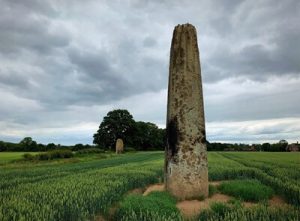
Their weathered surfaces feature deep vertical grooves, once believed to be deliberate carvings but now attributed to natural erosion.
“This stone alignment includes three of the largest stones of any alignment in Britain.” – Historic England, National Heritage List for England
The stones are recognized as a protected prehistoric monument, but their original arrangement and purpose remain uncertain.
Related: Weird Ancient Cochno Stones And Their Unknown Purpose
Even their familiar appearance today may be misleading.
Historical records suggest that several additional megaliths once stood alongside them.
The Lost Stones and a Forgotten Monument
The earliest surviving descriptions reveal that the Devil’s Arrows originally numbered at least four, and possibly five or more.
During the sixteenth century, antiquarian John Leland recorded four standing stones near Boroughbridge.
Camden also reported that one stone had been pulled down by people searching for buried treasure.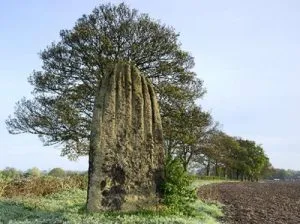
For centuries, the whereabouts of the missing stone remained an intriguing mystery.
“The two Pyramids in the middle, whereof the one was lately pulled down by some that hoped, though in vain, to find treasure, did almost touch one another.” – William Camden, Britannia
In September 2026, researchers from the University of York and Curtin University identified a surviving fragment of a missing megalith.
The stone had been repurposed as a commemorative cross in nearby Aldborough.
The discovery revealed that one of the forgotten giants had survived in plain sight for centuries.
But how much of the original prehistoric monument has disappeared without a trace?
An Extraordinary Journey Across Ancient Britain
For generations, researchers debated where the enormous monoliths originated.
One theory suggested that ancient people transported the stones from nearby geological formations. 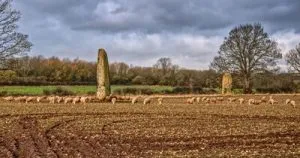
Another proposed that glaciers deposited them naturally during the Ice Age.
In 2026, a geological investigation provided a major breakthrough.
Related: Ancient Astronomical Adams Calendar
Researchers examined mineral age signatures within the stones and identified their source as Brimham Rocks, approximately 18 kilometers away.
Dr. Jim Leary of the University of York described the implications of the discovery.
“We have now proved Neolithic communities moved several 25-tonne stones” – Dr. Jim Leary, University of York
The findings confirmed that prehistoric communities transported these enormous stones across Yorkshire without modern machinery, likely relying on coordinated labor, timber sledges, and ropes.
Raising the megaliths presented another challenge.
Excavations in 1709 revealed that the central stone had been secured in a deep pit packed with clay, grit, and cobbles.
The monument demanded remarkable planning, manpower, and determination.
A Sacred Landscape of Forgotten Rituals
One theory connects the Devil’s Arrows to a vast prehistoric ceremonial landscape near the River Ure, surrounded by ancient earthworks, burial mounds, and ritual enclosures.
Nearby stand the famous Thornborough Henges, three enormous circular monuments often called the Stonehenge of the North.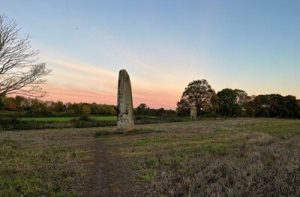
Archaeologists have identified seven Late Neolithic henges across the region, suggesting the area held considerable ceremonial significance.
Historic England also recognizes the monument’s connection to this ancient landscape.
“The stones are part of a wider prehistoric complex concentrated around the River Ure” – Historic England, National Heritage List for England
The Devil’s Arrows may have marked sacred territory, ceremonial pathways, or ancient gathering places.
Their alignment also suggests a possible connection to the Moon’s southernmost rising point, hinting at astronomical significance.
These towering stones may have belonged to a much larger sacred complex whose purpose remains unknown.
The Devil’s Arrows and Their Sinister Folklore
Long after its builders vanished, the Devil’s Arrows inspired supernatural legends.
According to folklore, the Devil hurled three enormous stone arrows from How Hill toward Aldborough, but missed, leaving them near Boroughbridge.
Related: Osirion At Abydos Mysterious Underground Monument
Other tales claim the stones mysteriously emerged from the earth overnight.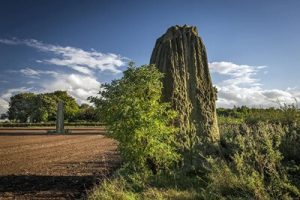
An account published in The Geologist in 1860 preserved one such belief.
“Another individual told me that it was believed by some that the stones sprung up one night” – The Geologist, Notes and Queries, October 1860
Another legend claims that walking twelve times around the stones in an anticlockwise direction will summon the Devil himself.
The monuments have also been known as the Devil’s Bolts, the Three Greyhounds, and the Three Sisters.
Such stories reflect how these ancient giants continued to inspire fascination long after their builders and original traditions had been forgotten.
Their enormous size, strange grooves, and isolated positions made them natural subjects for supernatural folklore.
What Were the Devil’s Arrows Really Built For?
Despite centuries of investigation, the Devil’s Arrows remain an enduring mystery.
Theories surrounding their purpose range from ancestor worship and astronomical observations to ceremonial processions and displays of power. 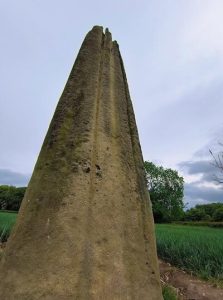
Their proximity to other prehistoric monuments suggests they may have marked a sacred boundary within a much larger ceremonial landscape.
Boroughbridge historian Ronald Walker captured the uncertainty surrounding their origins.
“Where they came from, how many there were originally, what their purpose is” – Ronald Walker, Boroughbridge Historical Society
Recent geological research has answered one of those questions, revealing where the enormous stones originated and how far their builders transported them.
Yet the deeper mystery survives.
The Giants That Still Guard Their Secrets
Thousands of years later, the Devil’s Arrows remain standing in the Yorkshire countryside.
Although researchers have uncovered their geological origins and evidence of missing stones, their original purpose remains a mystery.
Whatever compelled their builders to raise these enormous monuments, the ancient giants have kept their secrets to this day.
References:
https://historicengland.org.uk/listing/the-list/list-entry/1014705
https://historicengland.org.uk/listing/the-list/list-entry/1014705
https://www.themodernantiquarian.com/post/55852/folklore/devils-arrows