
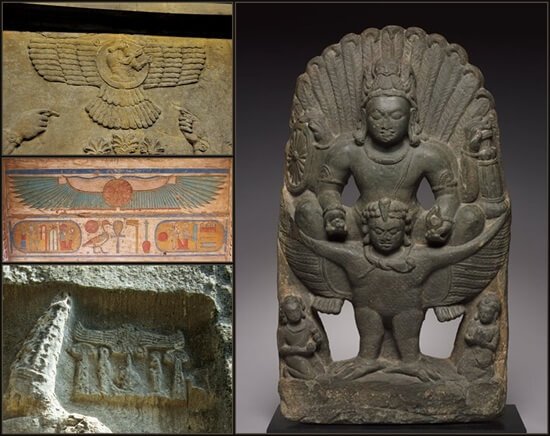

Ancient Winged Symbols and Their Hidden Meanings
A sun with wings, a divine figure hovering above a king, a gold face framed by sweeping feathers.
Across several ancient cultures, wings surrounded something sacred, turning a familiar creature’s anatomy into an emblem of extraordinary power.
Egypt, Anatolia, Mesopotamia and the Americas preserved different versions of this striking arrangement.
Follow the feathers and the story takes flight through divine kingship, celestial protection and journeys beyond the ordinary world.
1. Egypt Gave the Sun Wings
Egypt offers one of the clearest examples, a solar disc framed by two broad wings.
A limestone block from the pyramid temple of Senwosret I, dated around 1961–1917 BCE, preserves part of this emblem.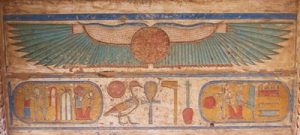
Its original position matters because it stood above a doorway, placing the winged image over people entering the temple.
“Below is part of a winged sun disk representing Horus, whose epithets are inscribed at the left.” – The Metropolitan Museum of Art, Relief From the Pyramid Temple of Senwosret I
Above the entrance, Horus occupied the boundary between the space outside and the sacred interior.
The visual combination is memorable because a disc alone suggests the sun, while wings give it the form of a living celestial power.
Egypt put that power over a threshold, where worshippers would pass beneath it.
2. The Hittite King Stood Beneath a Winged Sun
At Yazılıkaya in modern Turkey, a winged sun crowns the hieroglyphic name and titles beside a relief of King Tudhaliya IV.
The king’s monumental image belongs to the thirteenth century BCE.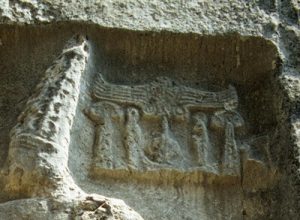
The emblem above his extended hand combines broad wings with an arrangement of signs identifying royal authority, and the winged sun accompanies the royal designation “My Sun.”
Related: Twin Holding Symbolism In The Ancient World
That title packs some power because the solar association helped Hittite kings rise above the crowd.
Researchers studying the sanctuary place its imagery within a wider celestial framework.
“An interest in astral phenomena is also reflected in Hittite documents, architecture and art.” – Eberhard Zangger, E. C. Krupp, Serkan Demirel and Rita Gautschy, Celestial Aspects of Hittite Religion Part 2
Their interpretation of Yazılıkaya connects its divine processions with cosmic regions and recurring astronomical cycles.
Against that background, the king’s winged solar emblem belongs to a sanctuary where earthly authority and the heavens meet.
3. Mesopotamia Placed Divine Power in the Disc
Assyrian art supplies another close comparison, a winged disc associated with Ashur, Assyria’s chief god.
On a palace relief from Nimrud, even the bucket carried by a supernatural protector bears a miniature sacred scene.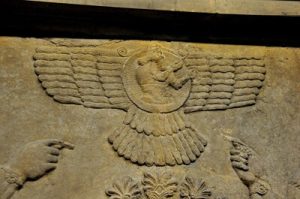
Winged beings face a central tree beneath Ashur’s winged emblem, repeating the larger palace world in tiny detail.
The surrounding imagery belongs to a setting designed to protect and glorify the king.
“The inscription is thought to have had a magical function, contributing to the divine protection of the king and the palace.” – The Metropolitan Museum of Art, Relief Panel From Nimrud
That quotation concerns the palace inscription, but it reveals the religious purpose woven through the setting.
The British Museum identifies the winged disc on a Babylonian royal stela with Shamash, alongside the star of Ishtar and the crescent of Sin.
4. Persia Kept the Wings and Changed the Setting
Achaemenid Persian art continued the striking image of a human figure rising from a winged disc.
On the seal commonly associated with Darius, the figure hovers above a royal lion hunt.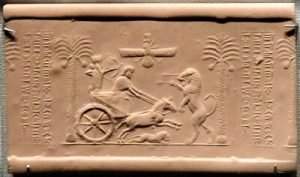
It wears a crown, raises one hand and holds a ring in the other.
Related: Serpents Keep Slipping Throughout The Ancient World
The scene puts celestial presence directly over the king’s display of power.
“The identity of the figure in the winged disk remains a major topic of scholarly discussion.” – The Metropolitan Museum of Art, Achaemenid Bulla
The museum discusses two prominent interpretations, Ahura Mazda or a divine aura or spirit associated with the Persian king.
It favors the identification with Ahura Mazda and points to Assyrian precedents for depicting a god inside a winged disc.
5. Greece Gave a Goddess Sweeping Wings
Ancient Greek goldwork sends the motif soaring in another direction, with a winged goddess standing at the center of a symmetrical arrangement.
A pendant from Rhodes, dated around 650–600 BCE, depicts Potnia Theron, the Mistress of Animals.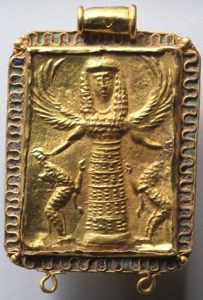
She faces forward with a feline on either side, each held by a leash.
“The goddess stands in a frontal pose with upswept wings, one curving above each shoulder.” – Cleveland Museum of Art, Daedalic Pendant With Potnia Theron
The solar disc disappears, while a commanding sacred figure remains between paired wings.
The goddess controls living forces on both sides, combining winged anatomy with mastery over beasts.
It’s a useful bridge between wing symbolism and the ancient twin holding motif, where one central power brings two surrounding creatures under its authority.
6. Chimú Gold Combined Wings With a Sacred Face
Across the Atlantic, a Chimú gold headdress from Peru creates another arresting composition.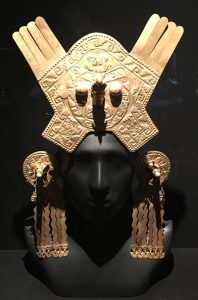
Its center contains a feline face with a bird’s beak, while broad lateral elements resemble bird crests or wings.
The accompanying ear ornaments introduce serpents into the ensemble.
“The main design of the headdress is composed of a feline face with a bird’s beak. Serpents hang from the ear ornaments.” – Museo Larco, Chimú Gold Headdress and Ear Ornaments
Museo Larco dates the ensemble to 1300–1532 CE and interprets its feline, bird and serpent combination as three sacred animals of ancient Peru.
It also associates the adornments with the supreme power of elite lords.
Related: The World Tree Sprouting Throughout Ancient Cultures
A person could wear this supernatural combination directly on the body, giving human authority wings through animal and sacred features.
The central face framed by winglike extensions makes it a strong visual counterpart to the Old World examples, with its own identity.
7. Colombia Connected the Bird Form With Sacred Flight
A Late Cauca pendant from Colombia takes the comparison into explicitly spiritual territory.
Dated by the British Museum to 900–1600 CE, it depicts a human headed bird with outstretched wings and a tail. 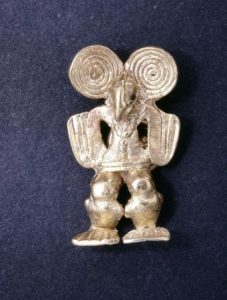
Craftspeople cast it in tumbaga and enriched its surface with gold.
Its curator’s interpretation goes beyond resemblance.
“These pendants, common in the Popayan area, probably alluded to the shamanic flight.” – The British Museum, Late Cauca Human Headed Bird Pendant
The human and bird combination may express a passage beyond ordinary human limits.
In this reading, flight belongs to ritual experience, with the bird form providing a way to represent that movement.
That gives the wings a different role from the royal solar emblems.
They become part of a transformed human identity, allowing the wearer to spread their wings into the spiritual world.
8. Garuda Carried Divine Power on His Wings
South Asia adds another powerful figure to the comparison, Garuda, the human and bird hybrid who carries Vishnu.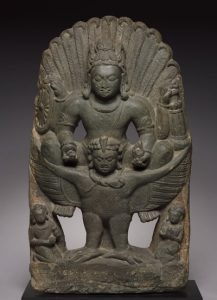
A sculpture from Bihar in eastern India, dated to the fourth century CE, shows Vishnu riding above Garuda’s human head and outstretched wings.
Tail feathers fan outward behind the god, creating an effect the museum compares with rays of light.
“Garuda is the enemy of serpents, and a subjugated serpent is tied around his neck.” – Cleveland Museum of Art, Vishnu Riding on Garuda
The carving combines flight with victory over a serpent, giving the winged figure an active role in the divine scene.
Garuda supports Vishnu while tiny worshippers kneel below them.
Related: 7 Gates Of The Underworld Occult Theories Behind Them
Here, the symbolism takes flight through a living divine carrier.
The central human features and paired wings preserve a familiar arrangement, while the struggle with serpents gives it a distinctly Indian story.
A Sacred Form That Keeps Rising
Across temples, royal reliefs and gold ornaments, wings repeatedly frame something extraordinary.
Sometimes they surround the sun, sometimes a god, and sometimes a being that crosses the boundary between human and animal.
The meanings shift, but the image keeps giving earthly life wings to reach powers beyond it.
References:
https://menasymbolism.wordpress.com/2019/05/23/the-winged-disk
https://www.clevelandart.org/art/1961.46
https://www.britishmuseum.org/collection/object/E_Am-5803?