
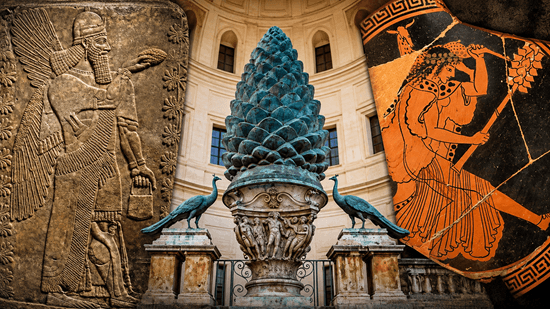

Pine Cone Symbolism: The Mysterious Motif Across Ancient Civilizations
From the ancient temples of Mesopotamia to the ceremonial staffs of Greece, the pine cone appears in some unexpected places.
Its distinctive shape adorned religious objects, monumental sculptures and ancient artwork, while pine itself played a role in sacred ceremonies.
Why did this ordinary object find its way into so many different cultures?
The Mysterious Pine Cone of Ancient Mesopotamia
Among the most intriguing examples are the winged supernatural figures carved into the palace walls of ancient Assyria.
Reliefs from Nimrud, dating to the ninth century BCE, depict human-headed and bird-headed figures holding a cone-shaped object in one hand and a small bucket in the other. 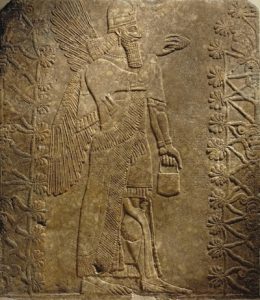
These figures are commonly identified as apkallu, supernatural sages associated with wisdom, protection and ritual purification.
The cone-shaped implement is often called a mullilu, while the accompanying bucket is known as a banduddu.
Related: World Tree Myth Ancient Times
Some interpretations identify the object as a pine cone, although others suggest it represents a date-palm spathe.
“The cone is described in Assyrian texts as a purifier and was presumably used to sprinkle liquid from the bucket.” – Ashmolean Museum, Protective Spirit
The figures frequently direct the object toward a sacred tree or the king, apparently performing a ritual act of purification or protection.
The resemblance to a pine cone is striking, but whether the Assyrians intended to depict one remains uncertain.
Dionysus and the Sacred Pine Cone of Ancient Greece
Thousands of miles west of Mesopotamia, another ancient religious tradition placed the pine cone at the end of a sacred staff.
Dionysus, the Greek god of wine, vegetation, fertility and ecstatic religious experience, carried a ceremonial wand known as the thyrsus.
The staff was commonly fashioned from a fennel stalk, wrapped in ivy or vine leaves and crowned with a pine cone.
Ancient Greek vase paintings and sculptures depict Dionysus, satyrs and maenads carrying the thyrsus during religious processions and celebrations.
“The pinecones, representing prosperity and fertility, topped the god’s thyrsus, or staff.” – The Metropolitan Museum of Art, Tunic
The thyrsus became an emblem of divine presence, religious ecstasy and the transformative powers associated with Dionysus.
The Giant Pine Cone of Ancient Rome
One of the most extraordinary surviving examples of pine cone imagery stands in Vatican City.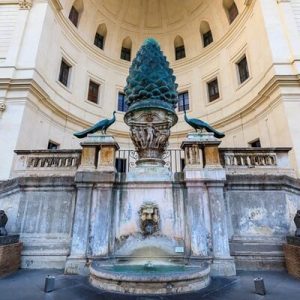
Known as the Pigna, the enormous bronze sculpture measures approximately four meters tall and dates to ancient Roman times.
Today, it dominates the Cortile della Pigna, or Pinecone Courtyard, within the Vatican Museums.
The sculpture originally stood elsewhere in Rome and is believed to have formed part of a monumental fountain.
“The colossal bronze pinecone dominating the courtyard of this terrace, originally a Roman fountain from the second century A.D., was discovered in Campo Marzio and subsequently positioned in the four-porticoed atrium of the old St. Peter Basilica. In 1608 it was transported to the courtyard to which it lends its name.” – Vatican Museums, Terrace of the Niche
Its overlapping scales reproduce the natural appearance of a pine cone on an extraordinary scale.
Related: Ancient Wing Symbolism Soaring Through Different Cultures
Although its original religious significance remains uncertain, its monumental proportions demonstrate the prominence of pine cone imagery in Roman public art.
Pine Cone Glyphs in Ancient Mexico
Across the Atlantic, pine cones also appear in Indigenous Mexican pictographic traditions.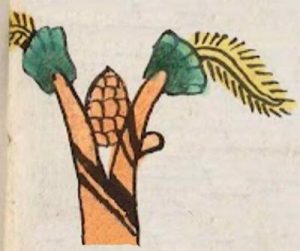
An example survives in the Matrícula de Huexotzinco, an early colonial manuscript dating to approximately 1560.
A place-name glyph for Ocotlan depicts an ocote pine tree bearing three recognizable pine cones.
“This black-line drawing of the simplex glyph for the personal name Ocotlan (‘[Person from?] Ocotlan,’ attested here as a man’s name or place of origin) shows a frontal view of an ocote tree with three pine cones and lots of pine needles.” – Stephanie Wood, Visual Lexicon of Aztec Hieroglyphs
Another example appears in the Codex Mendoza, compiled around 1541.
The glyph for Ocoapan depicts a pine tree with a small object that may represent a pine cone.
These illustrations demonstrate that pine cones were recognizable features of Indigenous Mexican pictographic writing.
Their primary function was geographical identification rather than documented religious symbolism.
Sacred Pine Rituals Among the Ancient Maya
The ancient Maya provide another fascinating connection through archaeological evidence of ceremonial pine burning.
Researchers discovered pine charcoal in sacred caves and ritual deposits throughout the Maya Lowlands.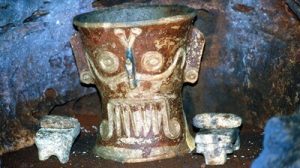
A 2005 study titled Wood of the Gods: The Ritual Use of Pine by the Ancient Lowland Maya examined the significance of these discoveries.
“The recovery of pine (Pinus spp.) charcoal remains from ceremonial contexts at sites in the Maya Lowlands suggests that pine had a significant role in ancient Maya ritual activities.” – Christopher T. Morehart, David L. Lentz and Keith M. Prufer, Wood of the Gods
Caves occupied an important place in Maya cosmology, associated with supernatural beings, the underworld and communication with divine powers.
Related: The Ancient 2 Headed Bird Found World Wide
Burning pine within these sacred spaces may have served purposes beyond illumination, possibly functioning as an offering to deities.
Although the discoveries do not establish that Maya priests used pine cones specifically, they confirm the ritual importance of pine in ancient Mesoamerica.
The Pine Cone and the Mysteries of the Pineal Gland
One of the more unusual interpretations of pine cone symbolism concerns the pineal gland, a small organ deep within the human brain.
Its name derives from the Latin pinea, meaning pine cone, because of its distinctive shape.
The philosopher René Descartes famously associated the gland with the human soul.
“My view is that this gland is the principal seat of the soul, and the place in which all our thoughts are formed.” – René Descartes, Letter to Marin Mersenne, January 29, 1640
Later esoteric interpretations connected the pine cone with the third eye, spiritual awakening and higher consciousness.
Why Did the Pine Cone Become a Sacred Symbol?
Across distant civilizations, the pine cone and its distinctive form appeared in religious art, ritual traditions and sacred imagery.
Its association with fertility, renewal and divine power offers possible explanations for its enduring appeal.
Perhaps its deeper meaning remains hidden beneath the scales.
References:
https://pinealglandboost.com/ancient-cultures-and-the-mystery-of-the-pineal
https://www.jonathanchambers.uk/2026/07/11/the-symbol-of-the-pine-cone/