
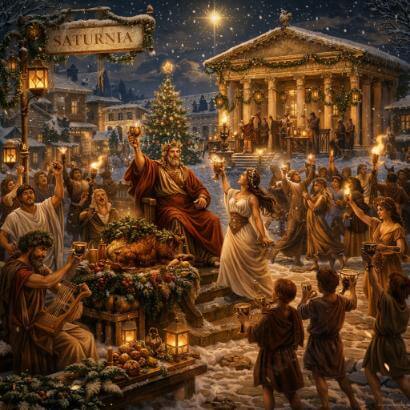

Saturnalia and Christmas Comparison: Ancient Pagan Religious Transformation
A Forgotten Festival Beneath the Snow
Every December, lights glow in windows. Trees sparkle. Gifts pile up under branches that once stood in quiet forests.
Families gather around tables and sing songs older than they realize.
But here’s the strange part.
The Bible never tells us the date when Jesus was born.
That question always made me press pause.
So what’s the hype with December 25? Why candles? Why feasts? Why gifts?
To answer that, we have to travel back to ancient Rome.
Long before Christmas trees or Santa hats, Romans shouted a very different greeting in the streets.
Io Saturnalia!
And trust me. It was chaos.
The Roman Holiday That Shook the Empire
Saturnalia was one of the most popular festivals in ancient Rome.
It honored the god Saturn, a deity tied to agriculture, time, and a mythical Golden Age when humans supposedly lived without hardship.
The celebration started on December 17. Over time it stretched into a week long party that could run until December 23.
Imagine Rome at its peak with massive temples and crowded markets.
Stone streets echoing with the sound of sandals and carts.
The entire system suddenly came to a halt.
The courts closed while schools shut down and business paused.
The strict order of Roman life flipped upside down and the streets filled with celebration.
The historian Mark Cartwright describes the atmosphere like this: 
“Saturnalia became one of the most popular celebrations in the Roman calendar, marked by gift giving, feasting, and role reversals.”
— Mark Cartwright, World History Encyclopedia (World History Encyclopedia)
Related: Was Jesus Real? Or Just Another Myth?
Role reversals? Yeeaap. You read that correctly.
During Saturnalia, slaves could speak freely to their masters. In some homes the master even served dinner to the slave!
Ancient Rome ran on strict hierarchy and order was everything.
Yet for a few wild days the entire machine loosened its grip and turned the world upside down like a carnival mirror.
It was as if society hit the pause button and decided to breathe.
The Strange Traditions of Saturnalia
When I first heard about Saturnalia I had a strange feeling like I’ve seen this movie before.
Many of the customs feel oddly close to modern Christmas traditions.
Here are a few of the most famous ones:
• Gift giving between friends and family
• Feasting and drinking for days
• Decorating homes with greenery
• Lighting candles to symbolize returning light
• Singing and public celebration
• Gambling and games
Romans even exchanged small figurines and candles as gifts during the closing days of the festival. (Encyclopedia Britannica)
The poet Catullus once described the celebration with surprising enthusiasm (Gitty as a school boy).
“Saturnalia, the best of days.”
— Catullus, Roman poet (History.com)
Related: Nag Hammadi Lost Ancient Christian Scripts
It was loud, joyful and completely unrestrained.
If modern Christmas is a polished holiday postcard, Saturnalia was the rowdy ancestor kicking open the door.
The Winter Solstice Connection
There is another piece of the puzzle.
Timing.
Saturnalia happened close to the winter solstice. That is the shortest day of the year when the sun begins its slow return.
Ancient cultures feared the darkness. Winter meant cold, hunger, and uncertainty.
When the sun started climbing back into the sky it felt like the universe had decided to give humanity another chance.
Evergreens especially fascinated ancient people because they stayed alive when everything else died.
That symbolism eventually seeped into later winter traditions. Even today Christmas trees echo this ancient idea of life surviving the darkness.
Enter Christianity
Now here is where history gets interesting.
Early Christians did not celebrate Christmas at all.
The first followers of Jesus focused mostly on his death and resurrection. The birth of Christ simply was not the center of the calendar yet.
Even more surprising?
The Bible never gives a date for Jesus’ birth.
Many scholars believe it likely happened in the spring based on clues in the nativity story about shepherds tending sheep outdoors.
So why December 25? 
By the 4th century Christianity had spread across the Roman Empire. The problem was obvious.
People obsessed over Saturnalia.
Trying to erase a beloved festival is like trying to stop a river with your hands.
So church leaders made a strategic decision.
They placed the celebration of Christ’s birth right in the middle of the winter festival season.
A historian writing for National Geographic explains it clearly:
“The New Testament does not identify the date of Jesus’ birth. The December 25 celebration developed later as Christianity spread through the Roman world.”
— National Geographic History (National Geographic)
Instead of destroying the existing traditions, Christianity slowly reshaped them.
The river changed course.
When Two Holidays Collide
Over time Saturnalia faded while Christmas grew stronger.
But the transition was not like flipping a switch. It happened gradually across centuries.
Ancient traditions blending like colors in paint. 
Some Saturnalia customs simply slipped into the new celebration.
For example:
• Feasting during winter festivals became Christmas dinners
• Gift giving survived almost unchanged
• Candles and lights remained symbols of hope
• Green decorations evolved into wreaths and trees
Related: Dionysus, The Greek God Who Turned Water Into Wine Before Jesus
The Roman practice of giving small gifts near the end of Saturnalia called Sigillaria may even resemble modern Christmas gift exchanges. (Encyclopedia Britannica)
It was cultural evolution in real time and the old bones remained, but the meaning shifted.
A Whisper of Yule in the Winter Air
Before Christmas took shape and even as Saturnalia echoed through Rome, another tradition flickered in the cold north. 
Yule.
Among the Germanic and Norse peoples, Yule marked the deep heart of winter and the return of the sun. Fires burned through the longest nights.
Evergreen branches filled homes as symbols of life refusing to die.
Feasts stretched on as families gathered against the darkness.
Different cultures with coincidentally uncanny resembling traditions, go figure!
Hold onto light when the world goes dark.
Yule did not become Christmas outright, but its spirit quietly wove itself into the season we celebrate today.
Wrapping It Up
So did Saturnalia literally become Christmas?
It metamorphized like a caterpillar to a butterfly.
Christian leaders placed the celebration of Christ’s birth during an already popular winter festival season.
Over time old customs blended with new beliefs until something entirely different emerged.
The result is the holiday billions celebrate today.
A strange mixture of Roman celebration, Christian theology, winter symbolism, and centuries of cultural change.
If history teaches anything, it is this. Traditions rarely disappear.
They transform like robots in disguise.
References:
World History Encyclopedia
https://www.worldhistory.org/Saturnalia/
History.com
https://www.history.com/articles/saturnalia
Encyclopaedia Britannica
https://www.britannica.com/topic/Saturnalia-Roman-festival
National Geographic History
https://www.nationalgeographic.com/history/article/christmas-jesus-birthday-ancient-rome-saturnalia-sol-invictus