

Royston Caves and the Mysterious Chamber Hidden Beneath England
In 1742, workers digging beneath the English town of Royston stumbled upon something nobody expected.
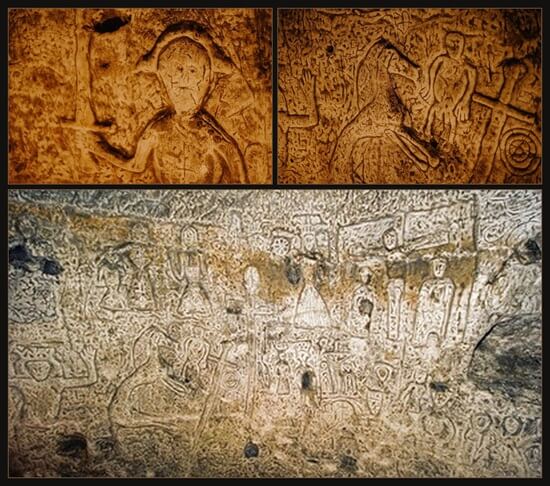
Hidden underground was a strange chamber covered in medieval carvings of saints, religious figures and mysterious symbols.
Nobody knew who built it or what went on inside.
Nearly 300 years later, the possibility that it once served as a secret meeting place still hangs over Royston Cave.
A Strange Discovery Beneath Royston
The discovery came in August 1742, when workers preparing a bench for the local butter market uncovered a millstone buried beneath the ground.
Lifting it revealed a narrow vertical shaft descending into darkness.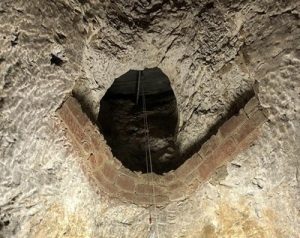
A young boy was sent down to investigate, followed by a man carrying a candle.
They discovered an underground cavity packed with earth and debris.
Hoping to strike gold, workers cleared the chamber and exposed something far stranger.
Related: The Devils Bible Codex
A bell-shaped room carved into solid chalk, measuring roughly 8 meters high and 5 meters across, with elaborate figures covering its lower walls.
Unfortunately, the excavation destroyed much of the original archaeological context.
Among the objects reportedly recovered were human bones, pottery fragments and a small piece of brass.
“Royston Cave is a remarkable man-made feature without parallel, in structural terms, either in England or in Western Europe. Despite intensive study, the reasons for the construction or elaboration of the chamber in the medieval period remain open to debate.” – Historic England
Mysterious Carvings Into the Walls
The chamber’s walls reveal an extraordinary collection of medieval religious imagery.
Carvings depict the Crucifixion, St. Catherine, St. Lawrence and St. Christopher, alongside figures tentatively identified as medieval kings, knights and other religious personalities.
Stranger still, disembodied heads, hands marked with hearts and circular symbols appear between the figures.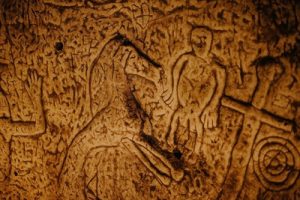
Some of the carvings even retained traces of their original coloring, suggesting the chamber once presented a much more striking appearance.
“Its walls are decorated with low-relief wall carvings which are mostly Christian in depiction and medieval in style. They include representations of the Crucifixion and notable saints such as St Catherine and St Christopher.” – Royston Museum
The carvings generally date to the thirteenth century, although the chamber itself could be older.
Whoever decorated the walls clearly went to considerable lengths, but left no inscription explaining what the chamber was actually used for.
The Knights Templar Connection
One theory points toward the Knights Templar, the powerful medieval religious order whose members fought in the Crusades.
The Templars maintained a presence around Royston, and researchers have identified similarities between some of the cave’s obscure symbols and carvings found at the Castle of Chinon in France.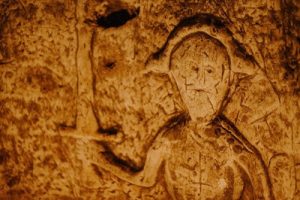
That castle once imprisoned members of the order following their arrests in 1307.
Could Royston Cave have served as a private chapel or even a refuge for Templars escaping persecution?
“It may follow that a group from the order, which was quite prominent in the locality, used the cave as a place of worship and perhaps a refuge in which to avoid persecution.” – Historic England
The theory certainly raises eyebrows, particularly because no surviving medieval document identifies the chamber’s owners or purpose.
Related: Mysterious Arthur Seats Underground Chambers Ritual Practice?
However, the Templar connection remains unproven, leaving the door open to other possibilities.
A Secret Meeting Place Beneath the Town?
Why would someone carve an elaborate religious chamber underground, accessible through a narrow shaft, instead of building a conventional chapel?
The original entrance descended approximately 4.8 meters, with footholds cut into the chalk to help visitors climb down.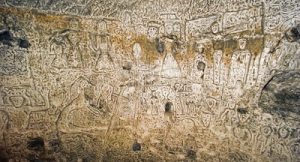
Archaeological evidence also suggests the chamber once contained an elevated wooden platform, effectively dividing the interior into two levels.
That arrangement could have accommodated religious observances or private gatherings away from public view.
“The choice of a subterranean location and the difficulty of access clearly points to a ritual rather than purely functional purpose. Structural evidence within the cave suggests an elaborate internal framework and flooring.” – Historic England
Other interpretations include a hermit’s sanctuary or private chapel, while speculation has also connected the chamber to secret societies and early Freemasonry.
The secret meeting theory remains a possibility rather than a documented fact.
Still, its secluded construction, elaborate carvings and unusual interior arrangement make it difficult to dismiss the idea of private ceremonial gatherings out of hand.
The Mystery That Remains
Nearly three centuries after its rediscovery, Royston Cave continues to guard its secrets.
Was it a hidden chapel, a hermit’s sanctuary or a meeting place for a mysterious medieval brotherhood?
Someone carved an extraordinary chamber beneath England, filled its walls with sacred imagery and left behind no clear explanation.
Whatever happened down there, the mystery is still lingering.
References:
https://historicengland.org.uk/listing/the-list/list-entry/1015594
https://www.roystoncave.co.uk/discover