
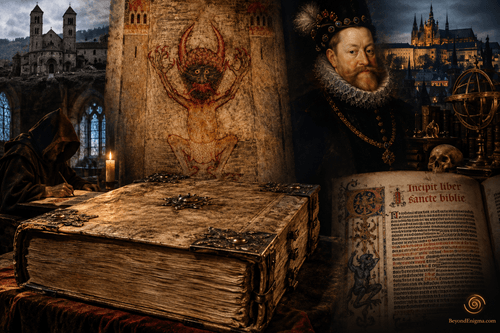

The Devil’s Bible Codex: The Medieval Book Too Strange to Ignore
Some medieval manuscripts are famous for their beautiful illustrations, while others survive because of their historical importance. 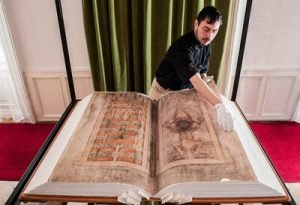
Then we got the big bad wolf Codex Gigas, better known as the Devil’s Bible.
Created in Bohemia during the early 13th century, the Codex Gigas is believed to be the largest surviving medieval manuscript in the world.
The surviving volume contains more than 300 enormous parchment leaves and is so large that moving it’s hardly a one person job.
The National Library of Sweden dates the manuscript to approximately 1210 to 1220.
Hidden among 100’s of pages of Christian scripture, history, medicine and medieval knowledge is a full page portrait of the Devil, an image that helped give birth to one of the strangest legends surrounding any medieval manuscript.
A Library Disguised as a Book
Calling the Codex Gigas a Bible does not quite do it justice.
Its anonymous creator seems to have thrown everything but the kitchen sink into the manuscript.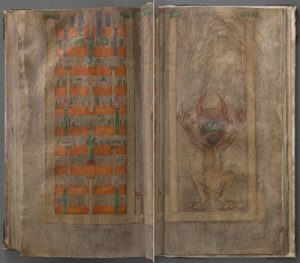
Alongside the Old and New Testaments are works by the Jewish historian Flavius Josephus, the Etymologies of Isidore of Seville, medical writings, a calendar and the Chronicle of the Bohemians by Cosmas of Prague.
Related:Ancient Nag hammadi Lost Christian Texts
It was essentially a medieval library squeezed between two enormous covers.
The Library of Congress describes just how much material was packed into the manuscript.
“The Codex Gigas contains a complete Latin translation of the Bible as well as five other major texts. It begins with the Old Testament and continues with Antiquities of the Jews and The Jewish War by Flavius Josephus.”– Library of Congress, Devil’s Bible: Codex Gigas
That alone makes the manuscript remarkable because producing books before the printing press required enormous amounts of labor.
Every line had to be copied by hand onto prepared parchment, while initials and illustrations were created separately.
The Codex Gigas took that challenge and turned the dial to eleven.
Its sheer scale naturally raises the question that has followed the manuscript for centuries.
Who could’ve possibly made it?
The Monk Who Made a Deal With the Devil
According to the most famous legend, the manuscript was created by a monk who had committed a terrible violation of his monastic vows.
His punishment was supposedly horrifying.
He was to be walled up alive.
With his back against the wall in more ways than one, the monk offered his superiors an extraordinary bargain. 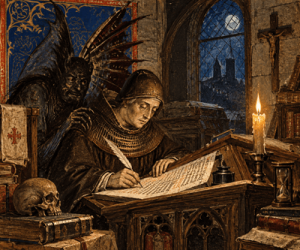
He would create a book containing all human knowledge that would glorify the monastery forever, and somehow he promised to finish the impossible task in a single night.
As midnight approached, the monk supposedly realized he had bitten off far more than he could chew.
Related: Demiurge God Old Testament Real Deceiver?
With death waiting for him in the morning, he turned somewhere a monk certainly was not supposed to turn and prayed to the Devil for help.
According to the legend, Satan agreed to complete the manuscript in exchange for the monk’s soul.
In gratitude, the monk painted an enormous portrait of his new collaborator inside the finished book.
The National Library of Sweden recounts the legend surrounding its creation.
“According to the legend, the scribe was a monk who broke his monastic vows and was sentenced to be walled up alive. To avoid this harsh penalty he promised to create in one night a book to glorify the monastery forever, including all human knowledge.”– National Library of Sweden, Codex Gigas — The Devil’s Bible
Face to Face With the Devil
The famous portrait remains one of the manuscript’s most striking features.
The Devil stands alone against a dark background, staring directly outward with horns, claws and a strange green face, while an ermine like garment covers part of his body.
Unlike the smaller demons scattered through countless pieces of medieval art, this Diablo gets the entire stage with a spotlight. 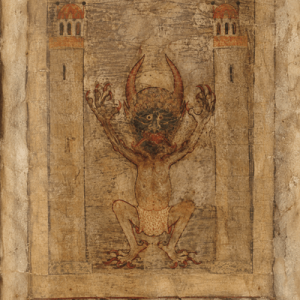
The figure occupies a complete page and immediately grabs the eye when the manuscript is opened to it.
The National Library of Sweden describes the unusual portrait.
“The Devil is shown alone, in an empty landscape, framed by two large towers. He is crouching with his arms raised and has only four fingers and four toes ending in large claws.”– National Library of Sweden, Codex Gigas — The Devil’s Portrait
Across from the Devil is a representation of the Heavenly City, placing the two images face to face and creating a dramatic contrast between salvation and damnation.
The Devil was not secretly slipped into the manuscript as an act of Satanic devotion.
Medieval Christian art regularly depicted demons, Hell and Satan as part of religious teaching, but few manuscripts gave the Devil quite this much real estate.
It’s easy to see how the image became the spark that blew the fuse.
Add an enormous mysterious book, an unknown creator and a gigantic portrait of Satan, and the legend practically writes itself.
One Man, One Gigantic Book
The single night story begins to unravel when the manuscript itself is examined closely.
Producing 100’s of giant parchment leaves, preparing pigments and writing such an enormous quantity of text would have required far longer than one evening.
Related: Corpus Hermetic, 1900 Hellenistic Esoteric Text
Yet the more ordinary explanation has a mystery of its own. 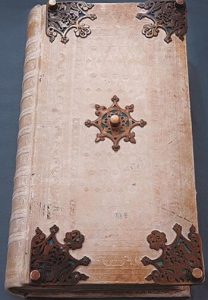
The handwriting throughout the Codex Gigas is remarkably consistent, and researchers have concluded that the manuscript appears to have been produced primarily by one scribe rather than generations of monks gradually adding to it.
The National Library of Sweden points to the remarkable consistency of the writing.
“The manuscript includes illuminations in red, blue, yellow, green and gold. Capital letters are elaborately illuminated, frequently across the entire page. The Codex has a unified appearance as the nature of the writing is unchanged throughout.” – National Library of Sweden, Codex Gigas — The Devil’s Bible
That changes the mystery rather than eliminating it.
Somebody may really have devoted an extraordinary portion of his life to creating this monster of a book.
Exactly how long the work took is difficult to establish because estimates depend on assumptions about how many hours a day the scribe worked and whether he had other monastic responsibilities.
Whatever the number, this was no weekend project.
An unknown man apparently sat down in medieval Bohemia with an extraordinarily ambitious idea and stuck to his guns.
Page after page, year after year, one of the largest manuscripts Europe had ever seen slowly took shape.
The Missing Pages
The Codex Gigas has another mystery tucked inside its binding.
Several leaves were removed from the manuscript sometime during its long history, and nobody can say with certainty who removed them or exactly why.
Naturally, the missing pages have opened the floodgates to speculation. 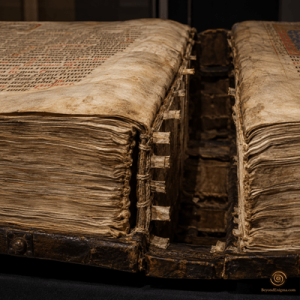
Because this is the Devil’s Bible, stories have connected them with forbidden knowledge, secret rituals and darker material supposedly too dangerous to preserve.
Related: Piri Reis Forgotten Map Of The Ancient World
The likely explanation is less dramatic, although still intriguing.
Scholars generally believe at least some of the missing material contained the Rule of Saint Benedict, the guidelines governing Benedictine monastic life.
The National Library of Sweden notes what researchers believe disappeared.
“Several pages have been removed from the manuscript. It is believed that these pages contained the Rule of St Benedict, which regulated life in the monastery.”– National Library of Sweden, Codex Gigas — The Devil’s Bible
Why anyone would deliberately remove those pages remains uncertain…
Whenever pieces disappear from a manuscript already surrounded by legends, however, mystery has a way of filling in the blanks.
A Book With Nine Lives
The Codex Gigas did not simply sit quietly in one monastery for the next 800 years.
Its journey across Europe gave the manuscript another layer of history and eventually placed it in the hands of one of Europe’s most unusual rulers.
By the end of the 16th century, the Codex Gigas had entered the collection of Holy Roman Emperor Rudolf II in Prague. 
Rudolf was famously fascinated by astronomy, astrology, alchemy and other unusual subjects, making the Devil’s Bible an almost perfect addition to his collection.
Then history came knocking.
In 1648, Swedish forces captured treasures from Prague during the final stages of the Thirty Years’ War, and the Codex Gigas was taken as war booty and transported to Stockholm.
“In 1648, at the end of the Thirty Years’ War, the entire collection was taken by the Swedish army as war booty. Since 1649, the manuscript has been kept in the Swedish Royal Library in Stockholm.”– Library of Congress, Devil’s Bible: Codex Gigas
It has remained in Sweden ever since and today belongs to the National Library of Sweden, where the manuscript has been digitized for anyone curious enough to explore its enormous pages.
More than 800 years after its creation, the Devil’s Bible is still staring back at us.
The legend of the desperate monk and his midnight bargain may belong to folklore, but removing Satan from the equation hardly makes the manuscript ordinary.
In some ways, the reality gives the legend a run for its money.
References:
worldhistory.org/image/13449/the-devil/