

The Arthur’s Seat Coffins and the 17 Tiny Bodies Hidden Beneath Edinburgh, Scotland
In the summer of 1836, a group of boys went hunting for rabbits on Arthur’s Seat overlooking Edinburgh and stumbled across something that would’ve been difficult to explain even today.
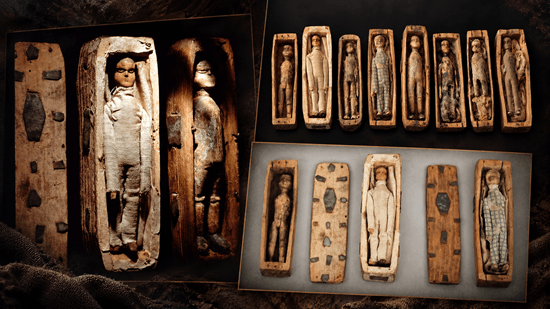
Hidden inside a small recess in the rocks were 17 miniature wooden coffins, each only a few inches long.
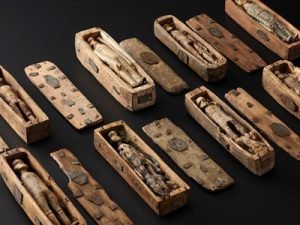
Nearly 200 years later, 8 of the original coffins still survive.
Nobody knows who made them or who the 17 tiny bodies were supposed to represent.
A Tiny Graveyard in the Rocks
Arthur’s Seat rises above Edinburgh as part of the ancient volcanic landscape of Holyrood Park.
At the end of June 1836, several boys were hunting rabbits along the northeastern side of the hill when they noticed a small opening among the rocks.
Related: The Hulk Sized Devils Bible
3 thin pieces of slate had been positioned across its entrance, apparently protecting whatever had been placed behind them from the weather.
The first known newspaper account appeared in The Scotsman on July 16, 1836 and described the discovery in remarkable detail.
“The mouth of this little cave was closed by three thin pieces of slate-stone, rudely cut at the upper ends into a conical form, and so placed as to protect the interior from the effects of the weather.”– The Scotsman, July 16, 1836
Once the slate was removed, these good ol boys discovered an opening measuring roughly 12 inches square.
Packed inside were the miniature coffins, arranged in 2 rows of 8 with another apparently beginning a 3rd row. 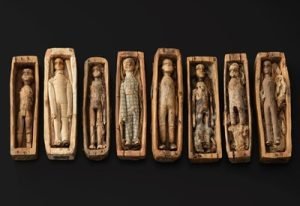
The Scotsman called them “seventeen Lilliputian coffins.”
Each was roughly 3 to 4 inches long and contained a small carved human figure.
The figures wore tiny pieces of clothing, while the coffins had separate lids secured with small nails or pins and decorated with pieces of metal.
Whatever the explanation, someone had gone through a surprising amount of trouble for something intended never for the eyes to feast upon.
Some Coffins Looked Older Than Others
The discovery became stranger because the coffins didn’t all appear to be in the same condition.
Those in the lowest row were reportedly badly deteriorated, while the coffins positioned above them appeared progressively better preserved.
Related: Strange Ancient Lizard Humanoid Figurines
The coffin at the top looked remarkably fresh.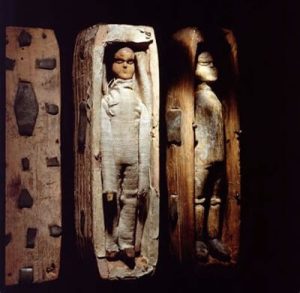
A report published shortly after the discovery described the difference.
“In the first tier, the coffins were quite decayed, and the wrappings had moldered away. In the second tier, the effects of age had not advanced so far. And the top coffin was quite recent looking.”– The Times, July 20, 1836
That raised the possibility that someone had returned to Arthur’s Seat over time, adding another tiny burial whenever a particular event occurred.
Moisture entering the recess could have damaged the lower coffins more severely than those above them, creating the appearance of different ages.
Later examination of the clothing would also suggest that the miniature burials were considerably more recent than early observers suspected.
The Bad Boyz In Da Hood Didn’t Exactly Preserve the Evidence
Unfortunately, nobody in 1836 knew that these strange little objects would still be mind-boggling researchers almost two centuries later.
The boys apparently began throwing some of the coffins at one another.
The Scotsman described the objects as being treated as “unmeaning and contemptible trifles,” and several were damaged or destroyed.
“As before stated, there were in all seventeen of these mystic coffins, but a number were destroyed by the boys pelting them at each other as unmeaning and contemptible trifles.”– The Scotsman, July 16, 1836
It’s one of those moments in history where valuable evidence slipped through everyone’s fingers before anyone realized what they had.
The survivors eventually entered the collection of Edinburgh jeweler and antiquarian Robert Frazier, who displayed them in his private museum.
The Coffins Finally Give Up a Few Secrets
For more than a century, explanations ranged from witchcraft and folk magic to symbolic funerals for people who died far from home.
In the 1990s, researchers Samuel Pyeatt Menefee and Allen Simpson took a much closer look at the surviving objects. 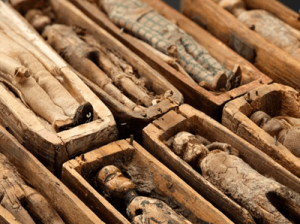
Their examination suggested that whoever created the collection hadn’t simply carved 17 little corpses.
“The open eyes of the figures suggest that they were not carved to represent corpses.”– Menefee and Simpson, The West Port Murders and the Miniature Coffins from Arthur’s Seat
The figures are remarkably similar in size and proportions and were probably produced as a matching set.
Their posture, feet, and other physical details point toward an unexpected original purpose.
They could’ve been toy soldiers.
Someone seems to have taken an existing collection of figures and turned them into the dead.
Someone Dressed the Bodies
The transformation didn’t stop with placing the figures inside wooden boxes.
The surviving figures wear carefully fashioned clothing made from different textiles and threads. 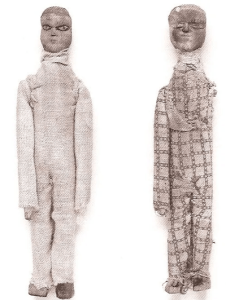
Examination of those materials became one of the most useful clues for determining when the mysterious burial took place.
Related: A Poltergeist Scientists Couldn’t Explain
The National Museum of Scotland explains what researchers found.
“The fabric the little bodies are dressed in dates from the early 1830s, so they hadn’t lain buried for more than six years.”– National Museums Scotland
That finding puts a serious dent in the idea that the different levels of deterioration represented burials separated by decades.
The figures themselves may have existed earlier, but their transformation into miniature corpses appears to have happened relatively close to their discovery in 1836.
And that date opens another door.
Was the Coffin Maker a Shoemaker?
The coffins provide a clue about the person who made them.
They’re elaborate enough to show considerable effort, but their construction doesn’t suggest the hand of an accomplished carpenter. 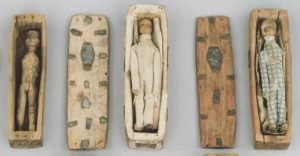
Menefee and Simpson noticed that some of the materials and techniques looked more at home in another trade.
One particularly interesting feature was the metal decoration attached to them.
“The most striking visual feature of the coffins is the use of applied pieces of tinned iron as decoration.”- Menefee and Simpson, The West Port Murders and the Miniature Coffins from Arthur’s Seat
The metal resembled material associated with contemporary shoe buckles.
Researchers also found evidence consistent with the use of a sharp hooked knife of the sort employed in leatherworking.
That raised the possibility that the person responsible was a shoemaker or leatherworker rather than a carpenter.
Such a person would’ve possessed the tools and dexterity needed to cut fabric, manipulate small pieces of metal, and fashion tiny objects.
Seventeen Coffins and Seventeen Bodies
Once the coffins were dated to around the early 1830s, one detail became difficult to ignore.
Only a few years earlier, William Burke and William Hare had supplied bodies to Edinburgh anatomist Robert Knox at a time when the demand for cadavers had created a thriving trade in stolen corpses. 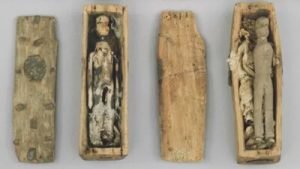
Burke and Hare took things much further.
Over the course of their activities, 17 bodies were delivered for dissection. One belonged to a lodger who died naturally, while the other sixteen were murder victims.
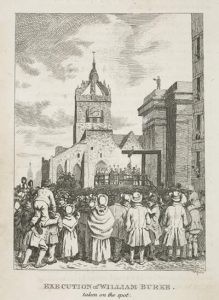
The crimes were exposed in 1828, Hare testified against Burke, and Burke was publicly hanged the following year before his own body was dissected.
The number eventually caught the attention of researchers Menefee and Simpson.
“What we seek is an Edinburgh-related event or events, involving seventeen deaths, which occurred close to 1830 and certainly before 1836. One obvious answer springs to mind.”– Menefee and Simpson, The West Port Murders and the Miniature Coffins from Arthur’s Seat
Were They Burials for Burke and Hare’s Dead?
Menefee and Simpson proposed that the connection might explain not only the number but the entire ritual.
The people supplied by Burke and Hare hadn’t received ordinary funerals.
Their bodies ended up on dissecting tables instead.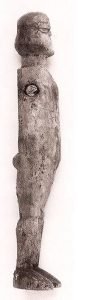
Perhaps somebody believed they deserved burials after all.
Related: A Fake Ghost Conjuring Which Started To Get Creepy
If their bodies couldn’t be buried, symbolic bodies could take their place.
The researchers approached the mystery by asking what Edinburgh event near 1830 could account for precisely seventeen miniature burials.
“In the absence of the seventeen dissected bodies,” someone may have wanted to give the dead “a form of burial to set their spirits at rest.” – Menefee and Simpson, The West Port Murders and the Miniature Coffins from Arthur’s Seat.
Under this interpretation, the coffins weren’t sinister objects at all.
It could’ve been an act of compassion intended to provide symbolic funerals for people whose real bodies had been dissected.
There’s a Problem With Burke and Hare
No letter, inscription, diary, or eyewitness testimony has ever connected the Arthur’s Seat coffins directly to Burke and Hare.
There’s another wrinkle too.
Most of Burke and Hare’s murder victims were women, while all the surviving figures are dressed as men.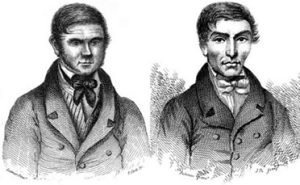
Menefee and Simpson acknowledged the problem themselves.
“The most obvious objection to our theory is that twelve of the seventeen victims were female, whereas the surviving figures are all dressed as males.”– Menefee and Simpson, The West Port Murders and the Miniature Coffins from Arthur’s Seat
The figures may simply have been convenient stand-ins, especially if they began life as toy soldiers, but there’s no evidence proving that’s what their maker intended.
Was It Witchcraft or Sympathetic Magic?
Witchcraft entered the conversation almost immediately.
The original Scotsman report wondered whether the discovery represented “an ancient custom which prevailed in Saxony, of burying in effigy departed friends who had died in a distant land.”
Related: Voynich Manuscript No One Can Decode
Other contemporary speculation went in a darker direction.
“There are still some of the old women amongst us who would shake their heads and look mysterious if asked their opinion of the meaning of this.”– The Scotsman, July 16, 1836
Effigies certainly had a place in European folk magic, but the Arthur’s Seat figures show no obvious signs of being pierced, burned, or otherwise attacked.
Eight Coffins and No Answer
Today, 8 of the original 17 coffins remain in the collection of the National Museum of Scotland.
The museum sums up the problem rather neatly.
“Who made the coffins and why they were placed on Arthur’s Seat remains a mystery.”- National Museums Scotland
References:
National Museums Scotland Arthur’s Seat Coffins
Menefee and Simpson The West Port Murders and the Miniature Coffins PDF
Smithsonian Edinburgh’s Mysterious Miniature Coffins
National Galleries of Scotland Execution of William Burke, 1829