

The Priests Of Dagon And The Catholic Connection (The Mitre)
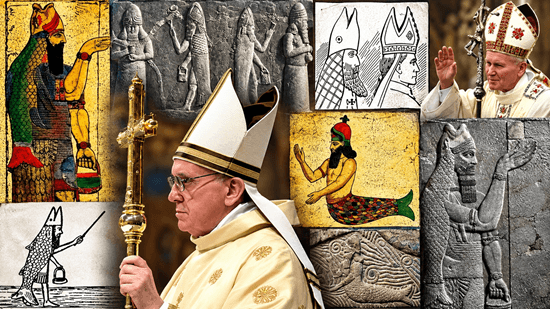
The Catholic mitre has a shape that seems to carry an older story.
Its two raised points resemble the jaws of a fish, recalling ancient Near Eastern priests and sacred figures dressed in fish skins.
Could this be a Babylonian symbol absorbed into a Catholic ceremony?
The visual match, the eastern history of papal headwear and the early accounts of Dagon’s fish headdress make a striking case for adoption.
Mesopotamia Put the Fish on the Priest
Ancient Mesopotamian art repeatedly shows human figures wearing a fish skin over the head and down the back.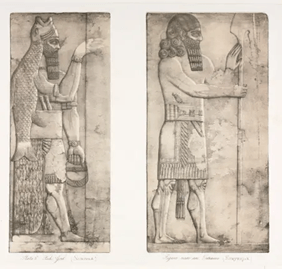
The image belonged to a world where sacred knowledge and ritual protection were linked with water and the divine realm beneath it.
The Metropolitan Museum of Art describes an Assyrian figure from the ninth or eighth century BCE whose fish-skin garment was associated with priests and ancient sages.
“His tall rounded headdress indicates that he is wearing a fish-skin cloak, a garment associated with Assyrian priests that likely connects them with the ancient sages of Mesopotamian mythology who lived in the Apsu, a subterranean realm of fresh water. A thousand years later, during the Neo-Assyrian period, practitioners of magic had developed techniques for protecting interior spaces of buildings by means of a ritual that involved depositing an assemblage of figurines beneath the room’s floor.” – The Metropolitan Museum of Art, “Apkallu Figure: Male with a Fish-Skin Hood” The Metropolitan Museum of Art
The name apkallu is often applied to these figures today, while older writers connected the fish-cloaked image with Dagon and Oannes.
Either way, the fish hood was more than decoration.
It marked a sacred figure, a bearer of protection and knowledge.
Layard Saw Dagon’s Headdress at Nineveh
In the nineteenth century, archaeologist Austen Henry Layard described fish-cloaked figures uncovered at Nineveh and identified them with Dagon, the fish god, and Oannes, the Babylonian man-fish teacher. 
Related: Ancient Mysterious Sea People And Myths About Them
He drew attention to the detail that makes the comparison hard to ignore, with the fish’s head rising above the human face like a bishop’s mitre.
“The head of the fish formed a mitre above that of the man, whilst its scaly back and fanlike tail fell as a cloak behind, leaving the human limbs and feet exposed. The figure wore a fringed tunic, and bore the two sacred emblems, the basket and the cone.” – Austen Henry Layard, Discoveries Among the Ruins of Nineveh and Babylon
Layard’s description joins the fish hood to a priestly robe and sacred objects.
The ancient figure and the Christian bishop appear in different worlds, yet the same striking outline rises above both heads.
The mitre may have changed in material and shape, but its silhouette still calls to mind this older ceremonial image.
The Papal Cap Came Through the East
The Church’s own historical account offers a possible route for that inheritance.
The Catholic Encyclopedia traces the papal camelaucum, an earlier ceremonial cap, to Byzantine court dress. 
Related: Ancient Twin Symbolism Throughout The World
Popes adopted this eastern imperial headwear in the seventh or eighth century, and the mitre developed from the papal cap centuries later.
“The earliest name of the papal cap, camelaucum, as well as the Donation of Constantine, clearly point to the Byzantine East; it is hardly to be doubted that the model from which the papal cap was taken is to be found in the camelaucum of the Byzantine court dress. The adoption by the popes of the camelaucum as an ornament for the head in the seventh or at the latest in the eighth century is sufficiently explained by the important position which they had attained just at this period in Italy and chiefly at Rome.” – Joseph Braun, The Catholic Encyclopedia, “Tiara”
Religious symbols rarely move intact from one civilization to another.
They travel through empires, courts and priesthoods, changing their names and functions along the way.
A Babylonian fish-priest image could pass through later Near Eastern and Byzantine ceremonial traditions before becoming part of papal dress.
The resemblance then becomes more than a visual coincidence.
The Mitre of Dagon
Alexander Hislop made the case directly in The Two Babylons.
Comparing Layard’s Nineveh figures with the papal mitre, he argued that Rome had adopted Dagon’s ancient fish headdress.
Hislop saw the two raised points as the surviving fish jaws, detached from the full fish costume and carried forward as a bishop’s emblem.
“The gaping jaws of the fish surmounting the head of the man at Nineveh are the unmistakable counterpart of the horns of the Pope’s mitre at Rome. Thus was it in the East, at least five hundred years before the Christian era.” – Alexander Hislop, The Two Babylons
The Church’s mitre took its formal shape in medieval Europe, but ceremonial clothing can preserve older images through gradual adaptation.
A papal cap passed through Byzantine hands, then developed into a distinct Christian vestment.
Related: Ancient Wide Eye Relics Throughout The World
Behind it stands the ancient fish-priest tradition, whose sacred headpiece already carried the same unusual profile.
The Fish Still Wears a Crown
The mitre may be a Christian emblem today, yet its shape points toward a much older religious world.
From Babylonian fish sages to eastern imperial costume and papal ceremony, the image could have crossed centuries by changing form while keeping its essential outline.
The old fish head may still be perched above the bishop’s brow.
References:
https://www.auricmedia.net/why-is-the-popes-mitre-shaped-like-a-fish/
https://v666.wordpress.com/2007/02/22/dagon-cybele-sibyl-and-roman-catholicism-the-popes-mitre/
https://www.biblelightinfo.com/dagon.htm
https://www.bibliotecapleyades.net/vatican/esp_vatican138.htm