
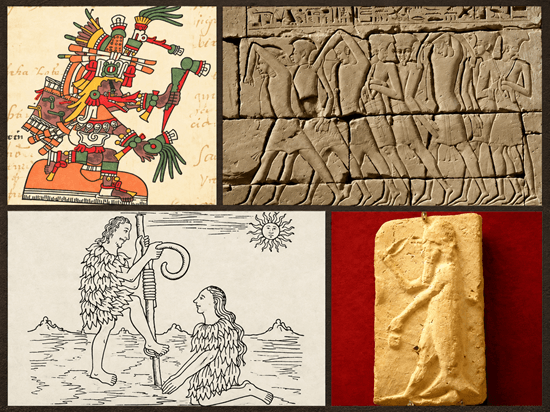

Ancient Sea People and the Strange Myth of Civilization Coming From the Sea
Ancient cultures repeatedly tell of strangers, teachers and gods who arrived from the water carrying knowledge with them.
Mesopotamia had Oannes, while Mesoamerica remembered Quetzalcoatl.
The Andes had Viracocha, and Egypt recorded real groups arriving by sea during the collapse of the Bronze Age.
Manly P. Hall and other occult writers believed these traditions might preserve fragments of something older.
Oannes and the Teachers From the Sea
The Babylonian priest Berossus recorded the story of Oannes, a strange amphibious being who emerged from the waters bordering Babylonia.
He appeared partly human and partly fish, spoke with a human voice and spent his days among the people before returning to the sea at night. 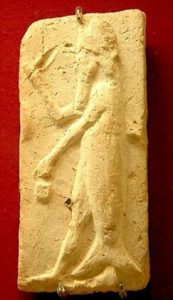
He taught writing, mathematics, agriculture, law, temple building and the foundations of organized society.
“He gave them an insight into letters and sciences, and arts of every kind. He taught them to construct cities.”– Berossus, preserved through Alexander Polyhistor
The story connects with the older Mesopotamian tradition of the Apkallu, seven sages linked with Enki or Ea, the god of wisdom and freshwater.
Related: Serpent Symbolism Keeps Echoing Throughout The Ancient World
Mesopotamian art sometimes depicted these figures wearing fish-like garments, tying sacred knowledge directly to beings associated with water.
The first Apkallu, Uanna, appears closely related to the later Oannes tradition.
The symbolism couldn’t be much clearer. Civilization arrives from beyond the shore.
Manly P. Hall Connects the Dots
Manly P. Hall noticed the same pattern and made it one of the stranger passages in The Secret Teachings of All Ages.
Hall compared traditions from Mesopotamia and the Americas, focusing on figures who appeared from the water and introduced knowledge to humanity. 
“The mythologies of many nations contain accounts of gods who ‘came out of the sea.’ Certain shamans among the American Indians tell of holy men dressed in birds’ feathers and wampum who rose out of the blue waters and instructed them in the arts and crafts.”Manly P. Hall, The Secret Teachings of All Ages
He placed Oannes in the same family, then turned toward Quetzalcoatl and the stories surrounding his connection with the sea.
Hall didn’t beat around the wild bush.
He suggested these culture heroes might preserve memories of Atlantean priests who traveled by ship, taught distant populations and eventually passed into legend.
Sailors became gods, voyages became supernatural journeys and distant homelands slipped into the realm of myth.
Quetzalcoatl and the Journey to the Sea
The traditions surrounding Quetzalcoatl muddy the waters even further.
The Feathered Serpent occupied a major place in Mesoamerican religion and later became associated with a legendary ruler and culture hero.
Stories credited him with religious instruction, knowledge, craftsmanship and social order.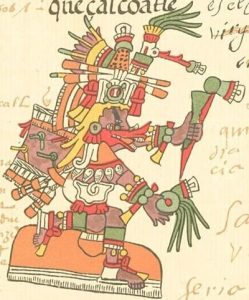
Several later accounts describe Quetzalcoatl leaving Tollan, traveling east and reaching the coast.
In one version, he departed upon a raft made of serpents.
“He constructed a raft of serpents, and seating himself on it as in a canoe, he moved out to sea. No one knows how or in what manner he reached Tlapallan. The legend which appears to have been prevalent in Cholula was somewhat different.”– Daniel G. Brinton, American Hero-Myths
That detail caught the eye of Hall and later comparative writers because it fit a familiar pattern.
A teacher appears, reshapes society and eventually returns toward the water.
Related: Ancient Planetary Alignments Gives Rise To World Wide Myths?
He linked Quetzalcoatl with Poseidon and Atlas and treated them as surviving pieces of an older Atlantic culture.
“Indeed the myths of Poseidon and Quetzalcoatl are practically identical. In Atlantis in America I have adduced proof that the personalities of Atlas and Quetzalcoatl are the same.”– Lewis Spence, The History of Atlantis
Spence believed Quetzalcoatl represented a genuine culture-bringer whose story preserved traces of contact across the Atlantic.
His conclusions went far beyond conventional archaeology, but his comparison shows how strongly the sea-teacher motif shaped early esoteric interpretations of mythology.
Viracocha and the Water
Viracocha appears in Andean tradition as a creator and organizer of humanity closely associated with Lake Titicaca.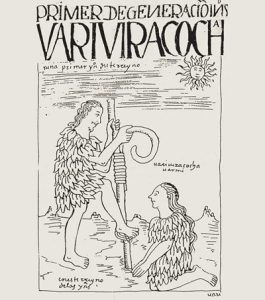
Accounts collected after the Spanish conquest describe him bringing order, traveling through the land and instructing people before continuing westward.
Some traditions eventually carry him toward the Pacific, where he disappears across the water.
“Having said this he went to sea with his two servants, and went travelling over the water as if it was land, without sinking. For they appeared like foam over the water and the people, therefore, gave them the name of Viracocha.”- Pedro Sarmiento de Gamboa, History of the Incas.
Egypt and the Real Sea Peoples
Egypt brings the story down to earth.
During the final centuries of the Bronze Age, Egyptian rulers encountered groups known collectively as the Sea Peoples.
Related: Primordial World Being Born From a Body Ancient Mythologies Recycled
Egyptian inscriptions name groups including the Peleset, Tjeker, Shekelesh, Denyen and Weshesh.
Merneptah fought some of these peoples during the late thirteenth century BCE.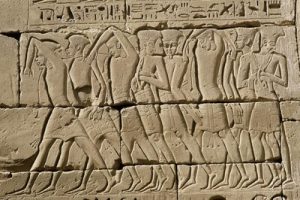
Several decades later, Ramesses III faced another major wave during a period when kingdoms across the eastern Mediterranean were falling apart.
His inscriptions at Medinet Habu describe enemies advancing through the region toward Egypt.
“The foreign countries made a conspiracy in their islands. All at once the lands were removed and scattered in the fray. No land could stand before their arms, from Hatti, Qode, Carchemish, Arzawa and Alashiya on, being cut off at one time.”
“They were coming forward toward Egypt, while the flame was prepared before them. Their confederation was the Peleset, Tjeker, Shekelesh, Denyen and Weshesh, lands united.”– Medinet Habu inscription of Ramesses III
The reliefs show ships, armed warriors and large movements of people.
Other scenes include women, children and carts, suggesting something more complicated than a simple raiding party.
Related: The Cosmic Egg, a Recycled Myth Told By Different Ancient Cultures
Around the same period, the Hittite Empire collapsed, major cities burned and trade networks broke apart across the eastern Mediterranean.
The Sea Peoples became part of that storm.
When Sailors Become Gods
That historical reality flooded the gates for later writers such as Ignatius Donnelly.
In Atlantis, the Antediluvian World, Donnelly returned to Oannes and argued that the fish-man story preserved the memory of technologically advanced sailors arriving among a less developed population.
He pointed to early encounters between Europeans and Indigenous peoples as an example of how unfamiliar ships and technology could acquire supernatural qualities. 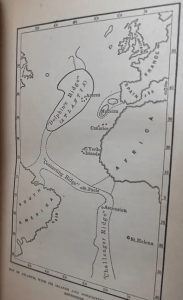
And here we see the same tendency to represent the ship as a living thing, which converted the war vessels of the Atlanteans into men with one blazing eye in the middle of the forehead.”– Ignatius Donnelly, Atlantis, the Antediluvian World
Donnelly believed Atlantis supplied the missing civilization.
Hall later drifted into the same current 🌊.
Strip Atlantis out of the equation, though, and the underlying idea still packs a punch.
Sea travelers carried technology, religion, agricultural knowledge, navigation, symbols and stories wherever they went.
That possibility sits at the heart of the sea people mystery.
Blavatsky and the Keepers of Ancient Knowledge
Helena Blavatsky took the comparison deeper into occult philosophy.
In The Secret Doctrine, she connected Oannes with a wider network of serpent beings, aquatic sages and ancient teachers.
Water, dragons, serpents and hidden wisdom repeatedly crossed paths in her interpretation of ancient religion.
“As the culture-god was represented as coming from the sea, it was possible that the culture of which Eridu was the seat was of foreign importation.”- Quoted by H. P. Blavatsky in The Secret Doctrine
Oannes therefore represented more than a Babylonian curiosity.
He belonged to a larger class of beings who carried knowledge from one age into another.
Different cultures used different names and symbols, yet wisdom kept washing ashore.
The Sea People Across Cultures
Oannes, Quetzalcoatl and Viracocha all carry knowledge through stories tied to water, while Egypt records real peoples arriving by sea during the Bronze Age collapse.
Hall, Donnelly and Spence believed those echoes pointed to forgotten sea teachers whose memory hardened into myth.
Whatever the answer, the sea keeps leaving its wet trail on the oldest stories of civilization.
References:
Gnosticlibrary.org/en/authors/manly-p-hall/books/the-secret-teachings-of-all-ages
https://www.theosociety.org/pasadena/sd/sd2-1-12.htm