
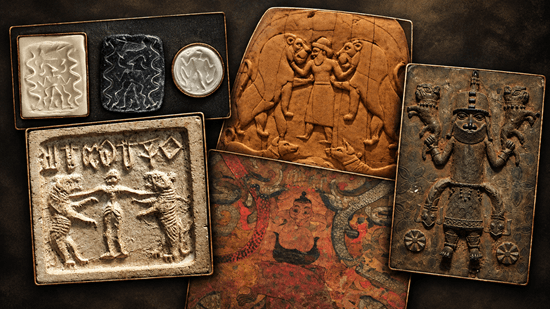

Ancient Twin Holding Symbolism Found Across Ancient Cultures
Across the ancient world, artists kept returning to one oddly specific image.
A god, hero or supernatural figure stands in the middle gripping 2 animals, serpents or sacred creatures.
Lions, birds, crocodiles and bizarre hybrid beasts all took their turn.
The cultures changed and so did the meanings, but the same basic symbolism kept showing its face.
The Hero Between Two Beasts
Some of the oldest clear examples appear in Mesopotamia, where cylinder seals show powerful figures wrestling or restraining animals on both sides of the body.
Akkadian and Sumerian contest scenes place nude heroes and bull men among lions, bulls and gazelles, often arranging them into mirrored confrontations.
Related: Ancient Serpents Popping Up In Every Culture, Why?
One Akkadian seal from the mid 3rd millennium BCE shows a naked hero grasping a standing gazelle in each hand while lions attack from either side.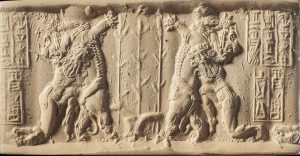
Another later seal shows a hero fighting 2 rearing winged beasts, gripping one in each hand.
“War in the divine realm is revealed through scenes of combating gods. Man’s domination of the wild beasts is expressed in the hunt.”– The Metropolitan Museum of Art
The Met argues that these scenes weren’t necessarily snapshots of literal combat.
They could express something bigger, especially the struggle to control destructive forces and restore balance in nature.
He’s standing between 2 wild forces and keeping both in check.
Was the Figure Gilgamesh
This is where things get slippery as a snake.
You’ll often see these muscular Mesopotamian figures identified as Gilgamesh, especially when they’re shown standing between 2 animals or gripping a creature in each hand. 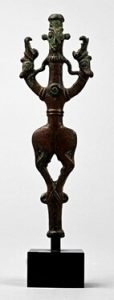
Gilgamesh became Mesopotamia’s most famous hero, so later viewers naturally attached his name to similar scenes of a central figure overpowering paired beasts.
Some Iranian bronzes with the same basic twin holding arrangement were even labeled “Gilgamesh finials” by collectors.
Archaeologists aren’t nearly as certain.
“Attempts to identify Gilgamesh in art are fraught with difficulty. Cylinder seals showing nude heroes with beards and curls cannot be identified with Gilgamesh.” – The Metropolitan Museum of Art
Some of these figures may instead represent Lahmu or other protective heroes.
Related: Wide Eyed Relics Found Throughout The Ancient World
That uncertainty actually makes the symbolism more interesting because it suggests the pose mattered beyond one particular character.
The symbolism had legs of its own.
The Symbolism Travels to Cyprus
By around the 14th century BCE, the same arrangement shows up on cylinder seals from Cyprus.
One surviving example depicts a horned hero standing between 2 lions with both arms extended.
2 birds mirror each other beside his head, while a griffin and a creature known as a Minoan Genius crowd the surrounding scene.
“A hero with outstretched arms is flanked by two lions. Two facing birds flank the hero’s head.”- The Metropolitan Museum of Art
That isn’t just a loose connection involving animals.
The whole image is built around symmetry, with the hero planted in the middle and matching creatures arranged around him.
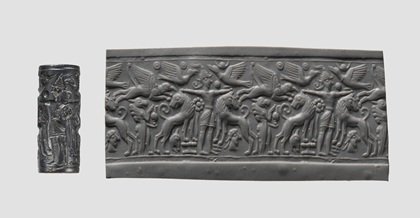
Cyprus was plugged into trade networks connecting the Near East, Egypt and the Aegean, so cultural influence is hardly a bolt from the blue.
In fact, another Late Bronze Age seal from the eastern Mediterranean shows a nude hero standing between 2 lions while a second hero is flanked by dogs.
The symbolism could travel because the people carrying it traveled too.
Greece Turns the Master Into a Mistress
In Greece, the same basic image often appears with a female deity at its center.
The Greeks knew one form as Potnia Theron, the Mistress of Animals.
Related: Egyptian Sun Gods, Planetary Alignments Of Mars, Venus, Saturn
An Early Corinthian vase from around 620 to 590 BCE shows winged Artemis holding 2 swans, one in each hand. 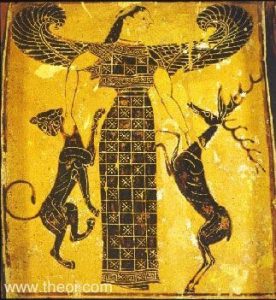
Other Greek images replace those birds with lions, deer and different animals without throwing away the symmetrical pose.
“The goddess Artemis was mistress of animals, potnia theron. She appears with her hands firmly gripping a pair of lions, deer, or other animals.”– The Metropolitan Museum of Art
Now the symbolism has switched gears.
The muscular male hero of Near Eastern contest scenes has become a goddess, while fighting gives way to calm control.
The visual bones remain surprisingly familiar.
A powerful supernatural figure occupies the center and holds a creature on either side.
Egypt Grips the Dangerous Creatures
Egypt gives us another version, and this one gets downright strange.
A scarab dating to roughly 1080 to 900 BCE shows a standing figure holding a large animal on either side.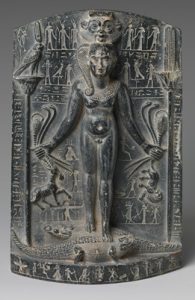
The object belongs to a wider group of seal amulets found in Egypt and the southern Levant whose exact origin is still debated.
Related: Ancient Myths About The World Born From a Body From Different Cultures
Egyptian cippi of Horus push the symbolism even further.
These magical stelae show the child god standing on crocodiles while clutching snakes, scorpions, lions, oryxes and other dangerous animals.
“In each hand he holds a wild desert animal and either a scorpion or a snake. He is controlling these dangerous creatures.”– The Metropolitan Museum of Art
The Egyptians believed water poured over some of these images could become a curative remedy against snake or scorpion venom.
Luristan Makes It Even Stranger
Ancient Iran produced some of the wildest versions of the symbolism.
A bronze standard from Luristan shows a double faced central figure grappling with 2 stylized lions.
The animals rise on either side and bite the figure’s oversized ears, while their elongated bodies fuse into the central bronze tube. 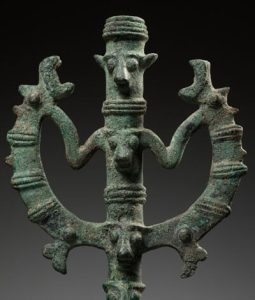
“It represents an unarmed Janus figure grappling a pair of rampant stylised lions. The bodies of each are fused into the central tube.”– The British Museum
Collectors once called objects like this everything from idols and talismans to Gilgamesh finials.
Whatever the precise identity of the figure, the British Museum notes that the hero overcoming wild beasts remained popular across much of the ancient Near East for several millennia.
Related: Christianity Takes Myths From Paganism Adds Their Own Twist
By this point, the creatures have practically become part of the central figure itself.
Why The Twin Symbolism?
Mesopotamian scenes have been linked with restoring balance, Horus dominates dangerous animals through protective magic, and Assyrian guardian figures restrain beasts on either side.
Something powerful occupied the center while forces on both sides were controlled, balanced or brought under authority.
One power in the middle, 2 forces in its grasp.
References:
https://www.metmuseum.org/art/collection/search/327819
https://www.britishmuseum.org/collection/object/W_1854-0401-30
https://www.thearchaeologist.org/blog/the-master-of-animals-a-universal-motif-across-cultures
https://blog.sciencemuseumgroup.org.uk/the-symbols-of-medicine