
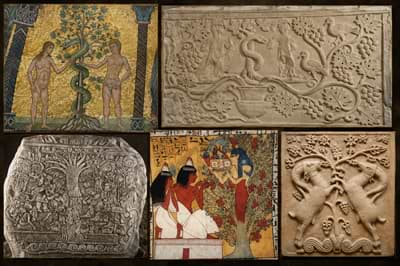

The World Tree Myth Across Ancient Cultures
Ancient cultures kept planting a tree in one mighty strange place.
Its roots, trunk and branches connected worlds, guarded divine knowledge and sometimes offered a path toward immortality.
The Norse, Indians, Maya and others all placed sacred trees at the heart of their myths.
Many cultures told different stories, yet the same strange motif kept sprouting up.
Mesopotamia Put the Sacred Tree Between Gods and Kings
Some of the oldest surviving sacred tree imagery comes from ancient Mesopotamia, where Neo Assyrian artists repeatedly carved an elaborate tree surrounded by kings and supernatural beings.
Reliefs from the palace of Ashurnasirpal II at Nimrud show the king standing beside a stylized tree while winged figures perform ritual actions around it.
Other examples place a winged divine figure directly above the tree.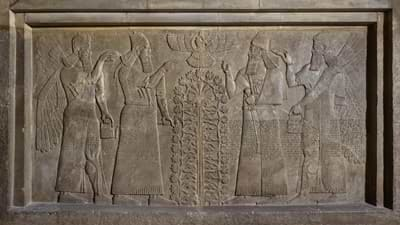
Whatever these scenes represented, the tree wasn’t just background decoration.
“In front of him there is a Sacred Tree, possibly symbolising life, and he makes a gesture of worship to a god in a winged disc. The god, who may be the sun god Shamash, has a ring in one hand.” — The British Museum
Scholars still debate exactly what the Assyrian sacred tree represented.
Ideas range from fertility and divine order to kingship and a symbolic representation of the structure of the world.
Related: Ancient Serpent Motifs Keeps Slipping Into Different Cultures World Wide
The tree repeatedly occupies the center while human and supernatural figures gather around it.
Divine power above, earthly authority below and a mysterious tree bridging the two.
Yggdrasil Held the Norse Cosmos Together
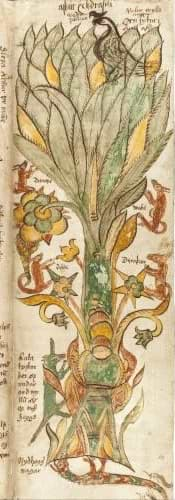
The Norse took the cosmic tree idea and grew it to enormous proportions.
Yggdrasil wasn’t simply a sacred tree growing somewhere in the world.
Its enormous roots and branches stretched through the structure of existence itself, linking different regions of the Norse cosmos.
Gods gathered around it, strange creatures inhabited it and mysterious wells existed beneath its roots.
“An ash I know there stands, Yggdrasill is its name, a tall tree, showered with shining loam. From there come the dews that fall in the valleys. It stands forever green over Urðr’s well.” — Völuspá, Poetic Edda
Knowledge also clung to Yggdrasil like bark.
One root extended toward Mímir’s well, associated with extraordinary wisdom, while Odin sacrificed himself upon a tree for nine nights to obtain knowledge of the runes.
Tree, cosmos, sacrifice and hidden knowledge all became tangled together.
India’s Cosmic Tree Grew Upside Down
India gives us one of the strangest versions of the motif because its cosmic tree grows the wrong freakin way.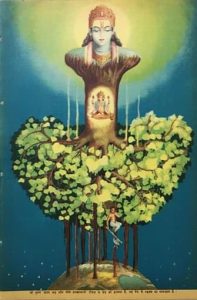
The Bhagavad Gita describes an eternal Ashvattha whose roots exist above while its branches descend into the world below.
“They speak of an eternal Ashvattha rooted above and branching below whose leaves are the Vedas. He who knows it, is a Veda knower.” — Bhagavad Gita 15.1, translation by Swami Swarupananda
Instead of growing toward heaven, the Ashvattha begins above and reaches down into our world.
Related: Ancient Handbag Symbolism Throughout The World
Its roots and branches become tangled with human existence, almost like a diagram of reality itself.
Humanity is caught among the branches while the tree’s true source remains above.
The Maya World Tree Connected Different Realms
Thousands of miles away, ancient Mesoamerican cultures developed another version of the World Tree.
Maya imagery repeatedly shows trees functioning as vertical cosmic structures, and researchers have linked the motif with the ceiba or kapok tree.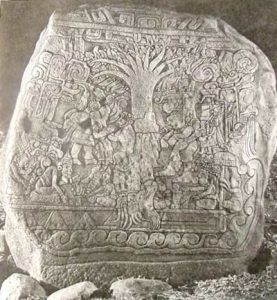
“This Tree was the conduit of communication between the supernatural world and the human world. — David Freidel, Linda Schele and Joy Parker, Maya Cosmos
These trees could symbolically connect different layers of existence, stretching between the heavens, earthly world and the realm below.
Ancient Maya art also combines the tree with celestial imagery, supernatural creatures and rulers, strengthening its connection with a larger cosmic order.
The souls of the dead fell into the underworld along its path, while the sun, moon, planets and stars followed its trunk.”— David Freidel, Linda Schele and Joy Parker, Maya Cosmos
Now we’re a long way from Mesopotamia and Scandinavia, yet the same strange idea has somehow branched across the ancient world.
Ancient Iran Had a Plant of Immortality
Ancient Iranian tradition brings immortality directly into the picture.
Zoroastrian cosmology describes Gaokerena, the great healing plant growing within the cosmic sea.
Later Zoroastrian traditions connect it with the final restoration of creation and the defeat of death. 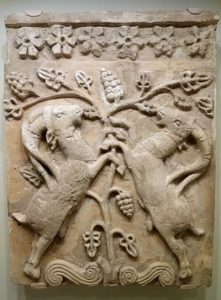
At the end of cosmic history, humanity would achieve renewed existence and immortality, and the sacred plant becomes part of that process.
“From it they will prepare ambrosia at Frašigird. They will give it to all men, and all men will become immortal forever and everlasting.” — Bundahišn
Iranian tradition also preserved stories of supernatural forces threatening sacred cosmic vegetation, turning the plant into something that had to survive the struggle between destructive and life giving powers.
Over in another ancient tradition, humanity gets kicked out of paradise specifically so it can’t eat from a tree and live forever.
Genesis Put Knowledge and Immortality in Trees
Genesis doesn’t give us one supernatural tree, but two.
The Tree of the Knowledge of Good and Evil and the Tree of Life stand within Eden, with humanity eventually caught between knowledge, mortality and the possibility of eternal life.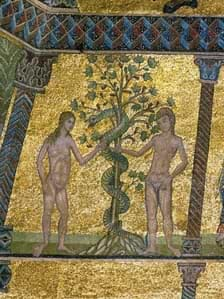
Related: Twin Symbolism Motif Spanning Through The Ancient World
Adam and Eve eat from the Tree of Knowledge after the serpent approaches Eve. God then specifically prevents humanity from reaching the other tree.
“And now, lest he put forth his hand, and take also of the tree of life, and eat, and live for ever… Therefore the Lord God sent him forth from the garden of Eden.” — Genesis 3:22–23, KJV
Cherubim and a flaming sword guard the way back to the Tree of Life.
That’s an important detail because access to immortality itself becomes restricted.
The Eden story ties together several motifs we’ve already bumped into elsewhere.
Nag Hammadi Turned Eden on Its Head
Several texts discovered at Nag Hammadi preserve alternative interpretations of Genesis where acquiring knowledge isn’t necessarily humanity’s great mistake.
In On the Origin of the World, the Tree of Knowledge plays an almost opposite role.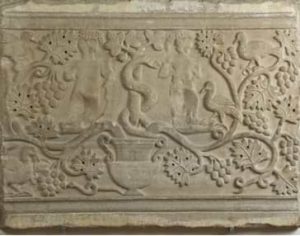
“This tree is to the north of Paradise, so that it might arouse the souls from the torpor of the demons, in order that they might approach the tree of life.” — On the Origin of the World
Instead of knowledge simply bringing ruin, the tree helps awaken humanity from ignorance.
The Hypostasis of the Archons also reworks the Eden story and portrays the rulers involved in humanity’s creation very differently from the straightforward reading of Genesis.
Egypt’s Sacred Trees Reached Beyond Death
Ancient Egypt adds another twist because sacred trees could reach across the boundary of death.
The sycamore became particularly associated with goddesses such as Nut and Hathor.
Tomb scenes sometimes depict a goddess emerging from a tree and providing water or nourishment to the deceased. 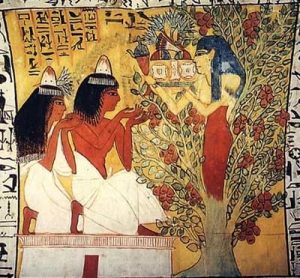
The tree itself became a point where the divine world reached toward the dead.
“The sycamore was regarded as a manifestation of the goddesses Nut, Isis and especially Hathor, who was given the title ‘Lady of the Sycamore.’” — Richard H. Wilkinson, The Complete Gods and Goddesses of Ancient Egypt
Other Egyptian traditions show divine figures recording the names of kings upon sacred trees, connecting trees with destiny, divine authority and continued existence.
Related: Cosmic Egg Mythology Told By Different Ancient Civilizations
Egypt’s version doesn’t function exactly like Yggdrasil or the Maya World Tree, but it lands in the same strange neighborhood.
Why Does the Cosmic Tree Keep Showing Up?
These traditions aren’t identical, but the pattern is hard to miss.
Across cultures, sacred trees repeatedly connect worlds, divine knowledge, death and immortality.
Maybe a tree was simply the perfect ancient symbol for the structure of existence.
Or maybe the roots of the Cosmic Tree reach much deeper than we know.
References:
British Museum Assyrian Sacred Tree and Ashurnasirpal II
World History Encyclopedia Yggdrasil
Internet Sacred Text Archive Bhagavad Gita Chapter 15
Metropolitan Museum of Art The World of the Ancient Maya
Encyclopaedia IranicaGaokerena