


Karahan Tepe: An 11,000 Year Old Sculpture Is Raising New Questions About Civilization
Something unusual has come out of the ground at Karahan Tepe, and considering what archaeologists have already found there, that is saying something. 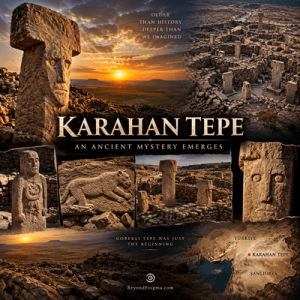
During the 2026 excavation season in southeastern Turkey, archaeologists uncovered an approximately 11,000 year old stone sculpture depicting a human figure sitting on the back of a leopard.
The sculpture stands roughly 70 centimeters tall and was discovered on a stone bench running along the wall of a small circular structure.
Even more remarkably, researchers believe it was found close to its original position, almost as though someone walked away from the room 1000’s of years ago and never returned.
Turkey’s Minister of Culture and Tourism Mehmet Nuri Ersoy called the discovery unlike anything previously encountered at the site.
“We have brought to light an 11,000 year old statue with no known parallel. We discovered a composite figure unlike anything we have encountered before.”– Mehmet Nuri Ersoy, Turkish Minister of Culture and Tourism
On its own, the sculpture would be a remarkable archaeological discovery.
At Karahan Tepe, however, it only adds another twist to the tale.
Older Than the Pyramids by 1000’s of Years
Karahan Tepe lies roughly 60 kilometers east of Şanlıurfa in southeastern Turkey and belongs to a much larger archaeological landscape called Taş Tepeler, or the Stone Hills.
Related: Mystery Of The 1700 Year Old-Roman Dodecahedron
The region includes Göbekli Tepe and numerous other early Neolithic settlements that have forced archaeologists to take another look at what humans were capable of near the end of the last Ice Age. 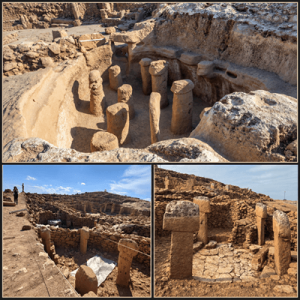
We’re talking about communities living 1000’s of years before Stonehenge and the Egyptian pyramids, yet they were already constructing substantial stone buildings and creating sophisticated sculptures and symbolic art.
Excavations at Karahan Tepe have revealed carved human heads, animal figures, communal structures and hundreds of stone pillars.
Major excavations only began in 2019, so archaeologists may still be scratching the surface.
That is what makes the new discovery so intriguing.
It isn’t an isolated oddity appearing out of nowhere.
It belongs to an entire symbolic world that we are only beginning to understand.
Why Is Someone Sitting on a Leopard?
Leopards were clearly important to the people of prehistoric Anatolia. 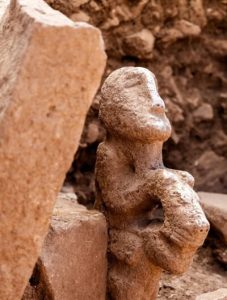
Dangerous animals appear repeatedly throughout the imagery of Taş Tepeler, including snakes, foxes, wild boars and large cats, suggesting that the natural world carried meanings that went far beyond dinner and survival.
The new sculpture is different because of the relationship between the human and the animal.
Instead of depicting a predator attacking a person, the figure appears to be positioned directly on the leopard’s back.
Archaeologist Elizabeth Carter, professor emerita at UCLA, told The Art Newspaper that although animal sculptures have previously been discovered inside structures at Göbekli Tepe, she knew of no comparable example showing a human astride an animal.
So what was the artist trying to say?
Unfortunately, that’s where we hit a brick wall.
Related: 700,000 Year Old Human Skull Found In Greece
These people left no written explanation behind, and assigning modern meanings to prehistoric imagery can quickly become a guessing game.
The leopard might have represented power, danger, hunting, mythology, spiritual transformation or something we no longer have a word for.
Still, somebody went through considerable trouble to carve it in stone.
Whatever the scene meant, it apparently mattered.
A World We Barely Understand
Karahan Tepe becomes even more interesting when viewed alongside Göbekli Tepe and the other sites scattered across Taş Tepeler.
Together, they suggest that sophisticated symbolic culture was flourishing in southeastern Anatolia at an extraordinarily early date. 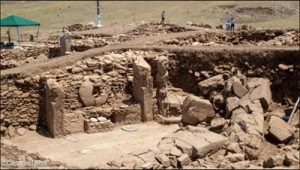
For much of modern history, civilization was presented as something of a staircase.
Humans settled down, developed agriculture, built permanent communities and eventually created temples, organized religions and complex symbolic systems.
Discoveries across Taş Tepeler have complicated that tidy progression because monumental construction and elaborate ritual behavior appear extremely early in the process.
That doesn’t mean an unknown advanced civilization built Karahan Tepe, nor does it overturn everything archaeologists know about prehistory.
What it does show is something arguably more interesting…
Early human communities were socially and symbolically more sophisticated than the simple hunter gatherer stereotype once suggested.
Related: 7,000 Year Old Ostrich Egg With The Map Of Atlantis Engraved On It?
The stones have been telling us that for years. We’re only now learning how to listen.
Karahan Tepe Isn’t Finished Yet
Perhaps the most exciting part of this story is that Karahan Tepe is still actively being excavated.
The leopard sculpture wasn’t rediscovered in some dusty museum collection.
It came out of the ground in 2026, meaning researchers are still studying its archaeological context and trying to determine exactly where it fits into the larger story of the site. 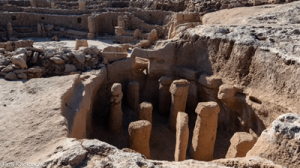
A detailed peer reviewed study of the sculpture hasn’t been published, so some of the bigger questions will have to wait.
But that is also what makes following Karahan Tepe fascinating.
We’re watching the puzzle emerge one piece at a time rather than looking back at a mystery whose evidence disappeared centuries ago.
11,000 years ago, someone carved a human figure sitting upon a leopard and placed it inside a stone structure.
Related: 10 Strong Cases That Point Out The Eye Of Sahara Was Ancient Atlantis
Around it existed pillars, sculptures, carved heads and buildings created by people whose stories and beliefs vanished long before anyone thought to write them down.
We can see pieces of their world again.
The hard part is figuring out what they were trying to tell us.
References: