

Ancient Indian UFO: Vimanas and Ancient Flying Machines
Long before the Wright brothers got off the ground, ancient Indian texts were already telling stories about flying vehicles. 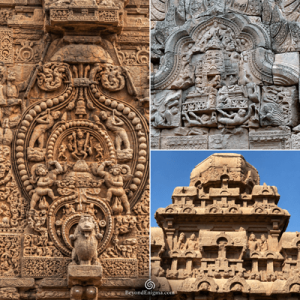
The Sanskrit epics describe celestial chariots, journeys into heavenly realms, powerful weapons, and vehicles carrying passengers across the sky.
Some could apparently travel wherever their occupants desired, while others were used in the heat of battle.
Of course, we shouldn’t put the cart before the horse.
These texts show that ancient Indians described flying vehicles, not that those vehicles physically existed exactly as written.
What Exactly Is a Vimana?
The word vimana doesn’t simply translate as “spaceship.” 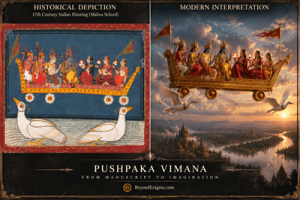
It’s not quite that cut and dried.
Depending on context, it can describe a palace, divine dwelling, celestial vehicle, or chariot.
In some passages, however, the object clearly moves through the sky carrying passengers.
One of the clearest examples comes from the Ramayana, where Ravana possesses the Pushpaka Vimana.
After Ravana’s defeat, Rama takes the reins and uses it to return toward Ayodhya.
“There is an aerial car named Pushpaka, radiant like the sun. It was obtained by Ravana from his brother Kubera after defeating him in battle. That excellent aerial car travels everywhere according to the will of its rider.” — Valmiki Ramayana, Yuddha Kanda
The Mahabharata Opens the Sky
The warrior Arjuna travels into the celestial realm associated with Indra, where he encounters gods, extraordinary weapons, and large numbers of celestial vehicles.
Related:Ufo In Old School Paintings
After reaching the celestial realm, Arjuna doesn’t encounter just 1 divine vehicle. The text describes 1000’s.
“He beheld there celestial cars by thousands, capable of going everywhere at will.” — Mahabharata, Vana Parva, translation by Kisari Mohan Ganguli
The surrounding passage describes celestial vehicles traveling in different directions.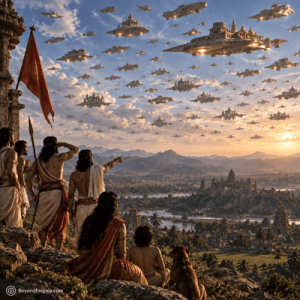
Arjuna’s own transportation is equally striking.
When Indra sends his charioteer Matali to retrieve him, the vehicle approaches through the clouds while illuminating the sky.
“The car endued with great effulgence and guided by Matali, came dividing the clouds and illuminating the firmament.”— Mahabharata, Vana Parva, Section 42, translation by Kisari Mohan Ganguli
A luminous vehicle descending through clouds is an image that sounds surprisingly modern when viewed through a UFO lens.
Vimanas Beyond the Epics
The idea also appears outside the great epics. 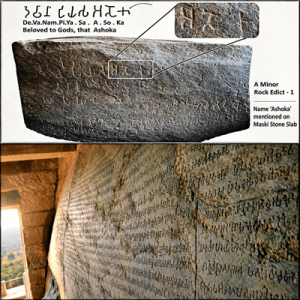
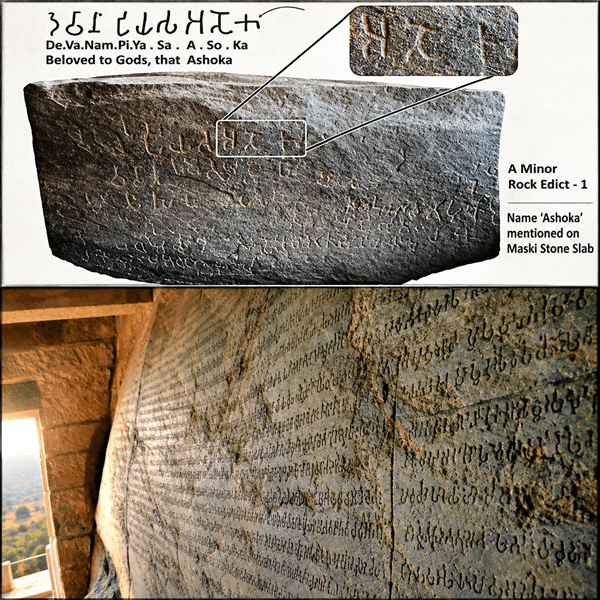
Emperor Ashoka’s Major Rock Edict IV, dating to the 3rd century BCE, refers to representations of vimanas alongside other divine spectacles.
“Spectacles of aerial chariots, spectacles of elephants, masses of fire and other divine representations.” — Emperor Ashoka, Major Rock Edict IV, translation by D. R. Bhandarkar
The inscription doesn’t describe a working aircraft, but it demonstrates the antiquity of celestial vehicle imagery in Indian culture.
There is also historical artwork showing how later Indians pictured these vehicles.
A 17th century Malwa painting, preserved by the National Museum in New Delhi, depicts Rama, Sita, Lakshmana, Hanuman, and others returning to Ayodhya aboard the Pushpaka Vimana, traveling through the sky above the landscape.
Saubha and the Flying City
The Mahabharata also describes Saubha, possessed by King Salva, an enemy of Krishna. Saubha behaves less like a conventional chariot and more like a mobile aerial fortress.
Salva approaches battle aboard it, retreats in it, and uses its mobility while fighting. 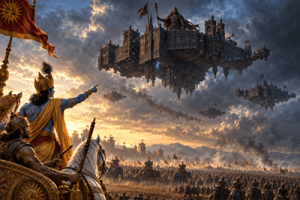
“Salva then approached again with his aerial car Saubha, which could move at will. The mighty king came again to battle, filled with anger and eager for combat. From that extraordinary vehicle he continued his struggle against his enemies.” — Mahabharata, Vana Parva, Book 3, Chapter 17
The related Srimad Bhagavatam describesSaubha as a flying iron city constructed for Salva by Maya Danava.
A flying fortress might be the better description.
Attack From Above
Saubha doesn’t merely transport Salva.
During the attack on Dvaraka, it becomes part of the battle. 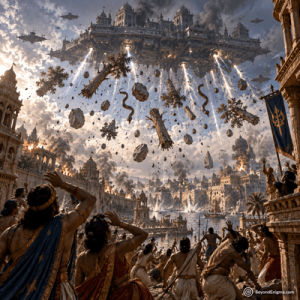
“From his excellent airship he threw down torrents of weapons upon the Yadus. He hurled stones, tree trunks, thunderbolts, snakes and hailstones upon the city. Thus terribly tormented by the airship Saubha, Lord Kṛṣṇa’s city had no peace.” — Srimad Bhagavatam, Canto 10, Chapter 76, Verses 10 to 12, Bhaktivedanta Book Trust translation
“Airship” is modern translation language, but the scene itself involves Salva attacking from above while using Saubha.
Related: Are Crop Circles Legit Or Just Some Jabroni’s Playing A Prank?
Ancient readers saw supernatural warfare.
Modern UFO researchers see something eerily familiar.
Weapons of the Gods
The Indian epics also describe supernatural weapons known as astras capable of unleashing fire, storms, intense light, and enormous destruction.
The Brahmastra is particularly famous because alternative history writers have compared its effects with nuclear weapons.
Together, the texts present celestial beings, flying vehicles, aerial warfare, journeys into heavenly realms, and devastating weapons.
When Flying Machines Become Mechanical
Several centuries later, the Samarangana Sutradhara, generally attributed to King Bhoja and dated to around the 11th century CE, takes the subject in a more mechanical direction.
Chapter 31 discusses yantras, including artificial birds and wooden constructions associated with flight. 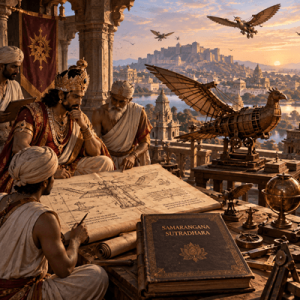
Passages describe a light wooden machine shaped like a large bird, equipped with wings and capable of carrying a person into the air.
Mercury and heat also appear in descriptions associated with these machines.
“The body is made of light wood and shaped like a great bird with a durable and well formed body. Inside it is placed the mercury engine with its heating apparatus beneath. Through the power latent in the mercury, the machine may develop a driving force which carries it through the air.” — Samarangana Sutradhara, Chapter 31
Other passages describe a heavier wooden vimana resembling a temple and containing 4 vessels of mercury positioned above iron heating chambers.
The exact mechanism is debated, but the description is considerably more mechanical than the celestial chariots of the earlier epics.
The important point is simpler.
A medieval Indian text discusses constructed machines associated with artificial flight centuries before modern aviation.
The Vaimanika Shastra Problem
The Vaimanika Shastra is often presented as an ancient Sanskrit aviation manual because it describes aircraft, pilots, metals, instruments, and engines.
However, the material became known through Subbaraya Shastry during the early 20th century, who reportedly claimed it had been psychically transmitted by the sage Bharadvaja. 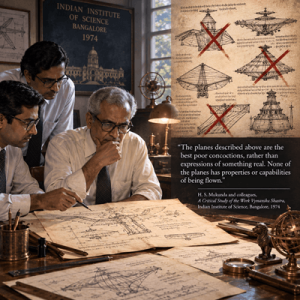
Researchers from the Indian Institute of Science in Bangalore examined it in 1974.
“The planes described above are the best poor concoctions, rather than expressions of something real. None of the planes has properties or capabilities of being flown.”— H. S. Mukunda and colleagues, A Critical Study of the Work Vymanika Shastra, Indian Institute of Science, Bangalore, 1974
Related: Artifacts On Mars Point To An Ancient Advanced Civilization
The researchers concluded that it couldn’t reasonably be considered an ancient aviation text, separating it from the genuinely older material.
Ancient India Was Already Looking Up
The evidence spans different periods and sources.
The Ramayana gives us Pushpaka carrying passengers through the heavens.
The Mahabharata describes 1000’s of celestial vehicles, Indra’s luminous chariot descending through clouds, and Saubha moving at will.
The Srimad Bhagavatam describes a flying iron city used in an attack from above.
Ashoka’s 3rd century BCE inscription preserves references to representations of vimanas. Historical paintings depict Pushpaka in flight.
The later Samarangana Sutradhara discusses wooden flying machines, wings, mercury, and heat.
Whether these accounts represent mythology, speculation about flight, or memories of something stranger remains the question.
References:
https://ramayana.info/story/yuddha/124/
https://www.swaveda.com/texts/mahabharata/3043/
https://puratattva.in/the-mauryas-12/
https://vedapath.app/en/mahabharata-gita-press/vana-parva/43/8