
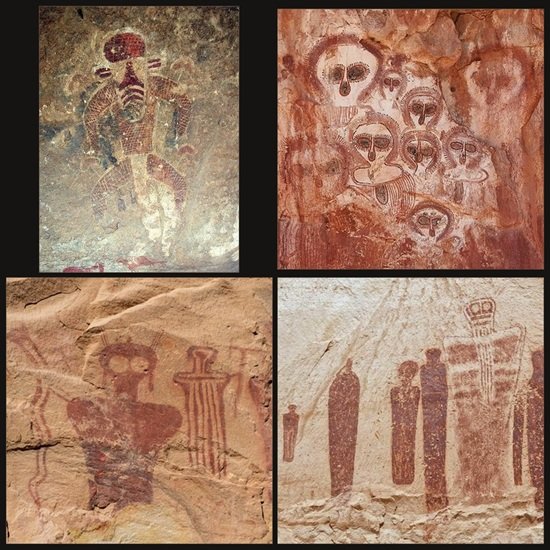

Ancient Cave Paintings Figures Of Strange Otherworldly Beings
Thousands of years ago, ancient artists painted some seriously bizarre figures onto cave walls and rocky cliffs.
Giant humanoids with oversized heads, ghostly beings without limbs and mysterious human-animal hybrids that look like visitors from another world.
From the Sahara Desert to the Australian outback, what exactly were these ancient people depicting?
1. The Giant Round Head Figures of Tassili n’Ajjer
Algeria’s Tassili n’Ajjer contains thousands of prehistoric paintings, including enormous humanoids with circular heads, unusual proportions and nearly featureless faces.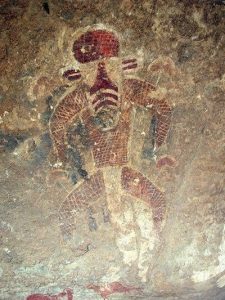
One towering figure, nicknamed the Great Martian God, looks strikingly similar to modern depictions of extraterrestrials.
French explorer Henri Lhote brought these paintings international attention during the 1950s.
Related: Serpent Myth Appears In Almost Every Ancient Civilization
Researchers have since explored possible connections with ceremonies and supernatural beliefs.
“The representations of the Round Heads Period evoke possible magic-religious practices some 10,000 years old.” – UNESCO World Heritage Centre, Tassili n’Ajjer
The artists left no written explanation, and the identities of these strange beings remain a mystery.
2. The Giant Figures of Sierra de San Francisco
Hidden in Mexico’s Baja California mountains, ancient rock shelters preserve enormous humanoids, some several meters tall.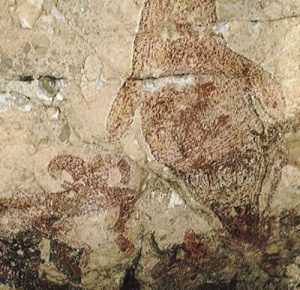
Their elongated bodies, outstretched arms and nearly featureless faces appear in contrasting red and black.
The paintings belong to the Great Mural tradition, which flourished over many centuries.
“They are remarkably well-preserved because of the dry climate and the inaccessibility of the site.” – UNESCO World Heritage Centre, Rock Paintings of the Sierra de San Francisco
Were these towering figures ordinary humans, ceremonial participants or representations of supernatural beings?
3. The Strange Jaguar Being of Juxtlahuaca Cave
Deep inside Mexico’s Juxtlahuaca Cave, ancient Olmec-related paintings depict an imposing humanoid confronting a smaller seated figure.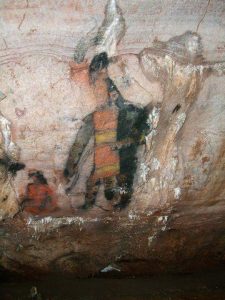
The larger being wears elaborate ornaments and possesses an unusual foot resembling a jaguar’s claw.
Jaguars held powerful religious significance in Olmec culture, often appearing in supernatural imagery.
“The iconography of the paintings confirms several important hypotheses concerning basic concepts of Olmec religion.” – David C. Grove, Olmec Cave Paintings, Science, 1969
Mesoamerican traditions frequently associated caves with entrances to supernatural realms. Was this strange figure a deity, a ritual specialist or a being undergoing transformation?
4. The Wandjina Beings of Ancient Australia
Australia’s Kimberley region preserves extraordinary figures with enormous dark eyes, pale faces, rounded heads and no visible mouths.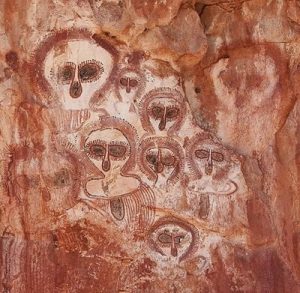
Known as Wandjina, these beings are associated with creation, rain and powerful ancestral forces in Aboriginal traditions.
Related: Squatter Man Glyph Keeps Popping Up In The Ancient World
Traditional custodians have maintained their paintings across generations, preserving a spiritual connection to the figures.
“The Wandjina is the creator spirit that belongs to us, the Wororra, Ngarinyin and Wunumbul people. He is the one that created everything, he also gave us our culture, law and songs and even the dreaming of each child before they are born.” – Mowanjum Aboriginal Art & Culture Centre, Western Australian Museum
Unlike many prehistoric paintings, these mysterious beings belong to a living mythology that continues today.
5. The Ghostly Figures of Sego Canyon
Utah’s Sego Canyon contains eerie prehistoric humanoids with elongated bodies, enormous eyes and strange markings.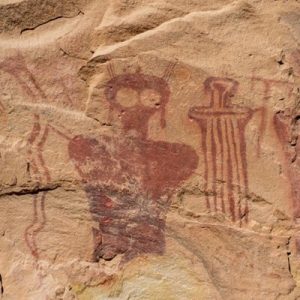
Some lack recognizable limbs, while others have unusual projections surrounding their heads.
The figures belong to the Barrier Canyon style, associated with prehistoric hunter-gatherer communities.
“The figures are typically elongated and tapered, usually without arms or legs.” – Jerry D. Spangler and Lynda M. Zweifel, Deep Roots, Bureau of Land Management
Researchers have proposed connections with rituals, visionary experiences and supernatural beliefs, but the figures’ original meaning remains unknown.
6. The Quinkan Spirit Figures of Queensland
Northern Queensland’s Laura region contains bizarre humanoids with elongated limbs, distorted bodies and unsettling faces. 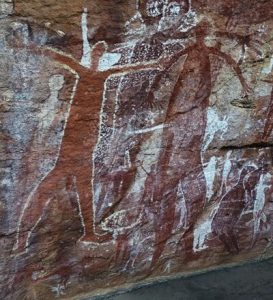
Known as Quinkans, these figures connect directly with Aboriginal supernatural traditions.
Timara are often described as tall, thin spirits, while Anurra are shorter beings associated with troublesome behavior.
“They’re known as the spirits of this land. They’re the protectors. Sometimes the protectors are mischievous, sometimes they’re good and look after you.” – Nash Snider, ABC News, 2016
These strange paintings preserve a world where supernatural beings inhabit the same landscape as humans.
7. The Bird Headed Man of Lascaux
France’s Lascaux Cave contains a strange scene depicting a wounded bison beside a humanoid with a bird’s head.
Nearby stands a staff topped with another birdlike figure, adding to the mystery.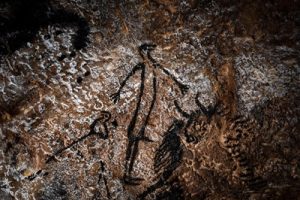
Related: Weird Ancient Reptilian Humanoid Figures
Art historian Jeffrey M. Hurwit explored whether the scene represents a mythological narrative.
“There is only one human figure—exactly one–and it is not even completely human.” – Jeffrey M. Hurwit, The Birdman of Lascaux: A Note, Journal of Rock Art, 2024
No surviving mythology explains why prehistoric artists depicted this strange bird-headed being.
9. The Towering Ghost Figures of Horseshoe Canyon
Utah’s Horseshoe Canyon contains towering prehistoric humanoids with elongated bodies, strange faces and intricate markings.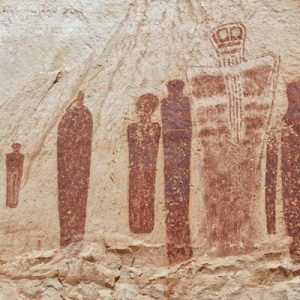
The most famous, called the Holy Ghost, resembles a pale apparition with dark facial features.
These paintings belong to the Barrier Canyon style, whose original symbolism remains uncertain.
“The Great Gallery, the best known pictograph panel in Horseshoe Canyon, includes well-preserved, life-sized figures with intricate designs.” – National Park Service, Horseshoe Canyon
Researchers have suggested ritual and supernatural interpretations, but the beings’ true identities remain unknown.
What Were Ancient Artists Trying to Show Us?
Across deserts, mountains and caves, ancient people painted beings that looked nothing like ordinary humans.
Some had enormous heads, others blended human and animal features, while a few appeared as towering spirits.
Certain paintings have surviving supernatural traditions, while others have lost their stories entirely.
The paintings remain, but the beings behind them are still waiting to be understood.
References: