

The Ubaid Lizard Figurines and the Strange Faces of Ancient Mesopotamia
1,000s of years before the first Egyptian pyramids rose from the desert, people living in southern Mesopotamia were molding small figures from clay. 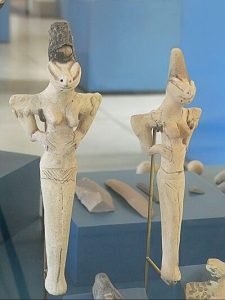
Some were ordinary animals.
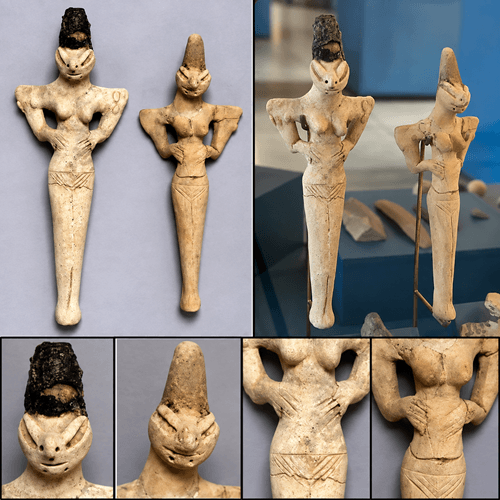
Others depicted beings with slender human bodies, narrow waists, elongated heads, enormous slanted eyes, and faces that look remarkably reptilian.
They’ve become known as the Ubaid lizard figurines.
The nickname sounds like something cooked up on a conspiracy forum, yet the strange appearance isn’t merely an internet invention.
Archaeologists have also used the term “ophidian,” meaning snake-like, for this unusual class of figurines.
That leaves the million dollar question.
What were the Ubaid people trying to portray?
Before Sumer Came Ubaid
The Ubaid culture flourished in Mesopotamia long before the famous Sumerian cities reached their height.
These communities farmed, built permanent settlements, produced distinctive painted pottery, traveled by boat, and constructed buildings associated with communal and ritual activities. 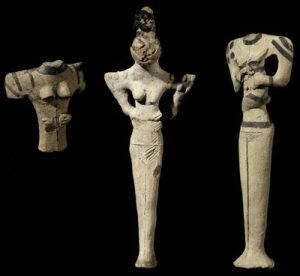
Examples have been recovered from Ur, Eridu, Tell al Ubaid, Tell el Oueili and other settlements.
Related: Ancient Relics Of Strange Wide Eyed Beings
Their forms vary, but certain features keep returning, including slender, unmistakably humanoid bodies.
Many are also decorated with painted lines and dots.
Most striking are the elongated heads and enormous almond shaped eyes.
Archaeologist Aurélie Daems described their appearance as combining
“the slender body form and the non-human-like facial features” – Aurélie Daems, A Snake in the Grass
An older Penn Museum account was equally struck by their appearance.
“The nude women with slender limbs and waists, square shoulders decorated with painted marks or tattoos, curious slanting eyes, elongated heads”– Penn Museum, The al Ubaid Painted Pottery
Whatever they represented, somebody wasn’t simply pinching clay at random.
The Woman With the Reptilian Head
One of the clearest examples was excavated at Tell al Ubaid by Leonard Woolley.
It’s tiny, only a little over 4 centimeters tall, but its surviving features are unmistakable. 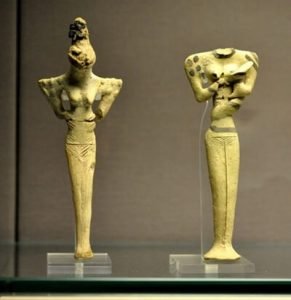
“elongated reptilian head”– British Museum
She has slanting, deeply incised eyes that may once have contained inlays, a bun behind her head, breasts, a choker and traces of black painted decoration.
Related: Ancient Planetary Saturnian Worship Yahweh
Another example excavated at Eridu is even more striking. The British Museum describes it as having a
“reptilian face and elongated head”– British Museum
This isn’t language borrowed from an ancient astronaut book.
It’s sitting in the museum catalogue.
Things start to get spookier…
The Reptilian Child
One of the most fascinating Ubaid figurines depicts a woman holding a child against her body.
The mother’s head is missing, but the infant’s survives.
“suckling a child with a reptilian like head”– British Museum
Black paint marks the woman’s collar, shoulders, wrists, waist and breasts. Even the infant has painted eyes, a collar and a girdle.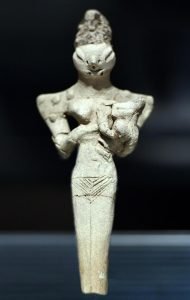
This creates an interesting problem for the idea that the strange heads simply represent ceremonial masks.
Why would an infant be portrayed with the same appearance?
Without writing from the people who made it, though, the figurine refuses to hand us an instruction manual.
Were They Really Lizard People?
The figurines eventually became associated with reptilian beings, extraterrestrials and even the Anunnaki.
But no surviving Ubaid texts explain what they represent, and the figurines predate Mesopotamian writing.
“the possible meaning, function, and use of these so-called ophidian figurines is still largely missing.” Aurélie Daems, A Snake in the Grass
Whatever they were, we’re left with a strange fact.
Prehistoric Mesopotamians repeatedly portrayed humanoid figures with distinctly nonhuman looking faces.
Serpents in the Mesopotamian Imagination
Much later Mesopotamian texts can’t explain the Ubaid figurines, but they show that serpents and dragons became important supernatural symbols.
Related: Indus Valley Script Uncracking the Uncrackable Code
A Sumerian hymn praises the god Ningishzida, who was associated with serpents.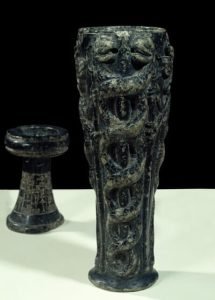
“Ninĝišzida, who brings together giant snakes and dragons!” – A balbale to Ninĝišzida
Another describes the moon god Nanna as
“Suen, mouth like a dragon’s, ruler of Urim!”– A Hymn to Nanna
These texts don’t prove a connection to the Ubaid figures.
They do show that serpent and dragon imagery eventually became part of Mesopotamia’s supernatural world.
Maybe the Heads Were Real
There’s also a more down to earth possibility.
Artificial cranial modification was practiced in the ancient Near East.
The Ubaid artists may have exaggerated the appearance of people whose skulls had been intentionally shaped.
Daems described some figurines as having elongated heads and eyes shaped like “coffee beans”.
Related: The Unknown Purpose Of The Ancient 1700 Year Old Roman Dodecahedron
Yet cranial modification doesn’t explain the enormous eyes and other features she called “non-human-like.”
The clay keeps its poker face.
Faces From a Forgotten World
The Ubaid figurines don’t need to be extraterrestrials to be mysterious.
Whether any distant thread connected those traditions to the Ubaid world remains unknown.
7,000 years later, all that remains are pieces of fired clay staring back at us with enormous slanted eyes.
References:
Britishmuseum.org/collection/object/
Isac.uchicago.edu/sites/default/files/uploads/shared/docs/saoc63.pdf?