


The Rosenheim Poltergeist and the Strange Case Scientists Couldn’t Explain
In the autumn of 1967, strange disturbances began inside a law office in Rosenheim, West Germany.
Lights flickered, bulbs exploded, automatic fuses tripped, and hanging lamps reportedly swung almost to the ceiling.
The telephone system even registered calls that employees insisted nobody had made.
Bad wiring seemed like the obvious culprit, but municipal technicians couldn’t put the matter to bed.
Their measurements only deepened the mystery, eventually drawing police, telephone officials, physicists, and a prominent parapsychologist into what became known as the Rosenheim Poltergeist.
When Bad Wiring Wasn’t Enough
The disturbances occurred in the law office of attorney Sigmund Adam.
Sharp bangs were reportedly heard around the building while electrical equipment malfunctioned and lights behaved erratically.
The Rosenheim municipal utility began investigating in November 1967. 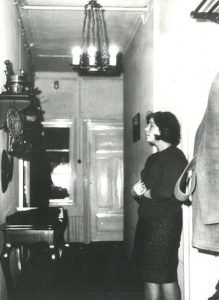
Technicians installed recording equipment, replaced parts of the electrical system, and eventually supplied the office using an emergency generator.
Related: The Hulk Sized Devils Bible
None of it apparently stopped the disturbances.
Physicists Friedbert Karger and Gerhard Zicha later described the lengths technicians had gone to.
“The electrical works had tried to elucidate the disturbances in the supply circuit, finally installing their own lamps and supplies and an emergency assembly. The phenomena did not cease.”– Friedbert Karger and Gerhard Zicha, physical investigation of the Rosenheim phenomena
At that point, blaming a loose wire was beginning to look like trying to fit a square peg into a round hole.
The case eventually reached Hans Bender, founder of the Institute for Border Areas of Psychology and Mental Hygiene in Freiburg.
His attention soon settled on a 19 year old apprentice named Annemarie Schaberl.
The disturbances appeared to cluster around her.
Physics Walks Through the Door
Bender’s involvement alone would not have made Rosenheim particularly remarkable.
Parapsychologists had investigated alleged poltergeists before.
Related: The Dark Crystal, Esoteric Symbolism Within Hollywood
The unusual turn came when Karger and Zicha examined the case as a physical problem.
They considered electrical disturbances, electrostatic effects, magnetic fields, vibrations, equipment defects, and possible interference with the measuring instruments.
They also attempted but failed to reproduce the strange recorder deflections through conventional means.
Their published conclusion was unusually strong.
“Although recorded with the facilities available to experimental physics, the phenomena defy explanation with the means available to theoretical physics. The phenomena seem to be the result of non-periodic, short duration forces.”– Friedbert Karger and Gerhard Zicha, physical investigation of the Rosenheim phenomena
They also concluded that the incidents did not appear to involve purely electrodynamic effects.
Whatever was happening, the case was slipping through the fingers of the ordinary explanations being tested.
The Mystery Leaves the Wires
The story grew considerably stranger once the reported activity spread beyond electrical equipment.
Pictures hanging on the walls supposedly swung and rotated. Drawers opened and documents moved.
A heavy cabinet weighing roughly 175 kilograms was reportedly displaced about 30 centimeters from the wall on 2 occasions.
Bender described the escalation in his published summary.
“Pictures began to move and drawers opened. An analysis of the distribution of incidents in time and space showed that they decreased with the distance from the medium.”– Hans Bender, summary of the Rosenheim investigation
The “medium” was Annemarie.
Bender believed the events represented recurrent spontaneous psychokinesis.
In this interpretation, a poltergeist does not require the ghost of a dead person rattling chains and tossing furniture around.
The disturbances might originate unconsciously from a living person experiencing intense emotional tension.
Related: MK Ultra, CIA Program to Control the Human Mind
Annemarie appeared to be standing in the eye of the storm.
According to Bender, the incidents became less frequent with increasing distance from her.
When she eventually left the law office, the disturbances reportedly stopped.
Someone Keeps Calling the Clock
The telephone system added one of the strangest wrinkles to the case.
The office reportedly accumulated charges for calls employees denied making.
Particularly peculiar were repeated calls to a service providing the correct time, sometimes occurring in rapid succession. 
Telephone technicians investigated the system, while Karger and Zicha considered the calls alongside the physical disturbances.
A random electrical surge might explain a flickering lamp.
Repeatedly dialing a particular telephone service was a different animal.
The physicists eventually made one of the boldest statements associated with Rosenheim.
“The movements seem to be performed by intelligently controlled forces that have a tendency to evade investigation.”– Friedbert Karger and Gerhard Zicha
That sentence has helped keep Rosenheim alive in paranormal literature for decades.
It doesn’t prove that an invisible intelligence was dialing the telephone or spinning pictures around.
Related: The Philip Experiment, A Fictional Ghost That Caused Strange Events
It shows how unusual the pattern appeared to investigators who had arrived looking for physical causes.
Rosenheim had gone from an electrical headache to something much harder to pin down.
A Poltergeist Without Much of a Ghost
Rosenheim hardly resembles the classic haunted house story.
There was no ancient curse or ghost wandering the corridors, only an ordinary law office filled with telephones, measuring instruments, investigators, and a young woman who appeared to stand at the center of the disturbances.
Years later, Karger remained impressed by what he had encountered.
“These experiments were really a challenge to physics. What we saw in the Rosenheim case could be 100 per cent shown not to be explainable by known physics.”– Friedbert Karger
That doesn’t prove psychokinesis, but Rosenheim has never tied itself up with a neat little bow.
Investigators entered an ordinary law office expecting to find faulty equipment and tried to catch the mystery with instruments.
The instruments only made the mystery harder to explain.