

The Gateway Process: When the U.S. Army Tried to Understand Altered Consciousness
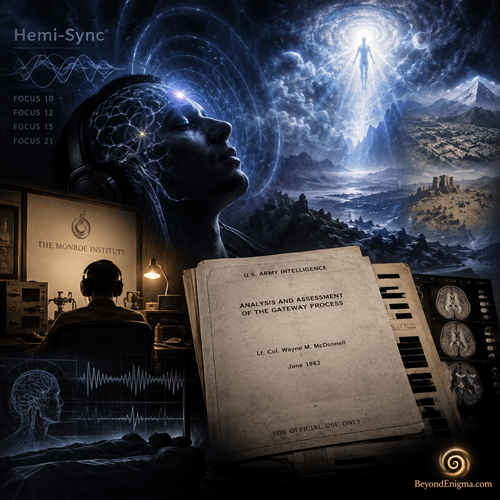
In June 1983, Lieutenant Colonel Wayne M. McDonnell of U.S. Army Intelligence was handed an unusual assignment. 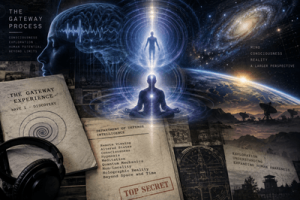
He was asked to investigate a training system designed to alter human consciousness through meditation, sound, and something called hemispheric synchronization.
The resulting document was titled Analysis and Assessment of Gateway Process.
What followed was hardly standard military paperwork.
Across roughly 30 pages, McDonnell explored everything from meditation and hypnosis to out of body experiences.
He also ventured into quantum mechanics, holographic models of reality, and the possibility that consciousness could reach beyond ordinary space and time.
And the strange part is that the Gateway Process wasn’t invented by the CIA or the Army.
It came from a man named Robert Monroe.
Robert Monroe Goes Out of Body
Robert Monroe was a broadcasting executive who became fascinated with altered states of consciousness after experiencing what he interpreted as spontaneous out of body experiences beginning in the late 1950s. 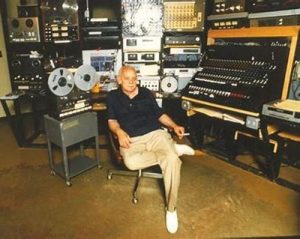
Rather than simply chalking them up as strange episodes, Monroe attempted to reproduce and study them.
His experiments eventually led to audio techniques intended to guide listeners into unusual states of awareness.
Related: Stargate Project CIA Psychic Research
The technology became known as Hemi Sync, short for hemispheric synchronization.
Different audio signals were delivered to each ear, producing a perceived rhythmic difference commonly associated with binaural beats.
Monroe built increasingly elaborate exercises around the technique.
Eventually these experiments became the Gateway Experience, a structured program intended to move participants through progressively deeper states of consciousness. 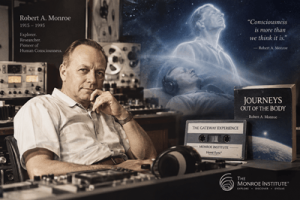
Monroe called them Focus Levels.
Focus 10, for example, represented the famous condition of the body being deeply relaxed or asleep while the mind remained awake.
Somewhere along the way, the U.S. military became interested.
The Army Steps Through the Gateway
On June 9, 1983, McDonnell submitted his assessment to the commander of the U.S. Army Operational Group at Fort Meade.
His assignment sounded simple enough.
Determine how Gateway supposedly worked and whether it had any practical value, but it didn’t stay simple for long.
“Frankly, sir, that proved to be an extremely involved and difficult business.” — Lt. Col. Wayne M. McDonnell, Analysis and Assessment of Gateway Process, 1983
McDonnell compared Gateway with hypnosis, transcendental meditation, and biofeedback. 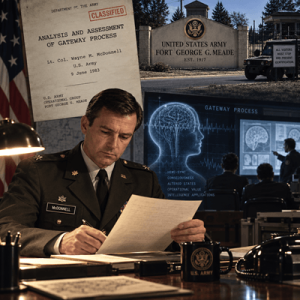
He also drew heavily upon the ideas of engineer and consciousness researcher Itzhak Bentov, whose work attempted to connect meditation, physiology, vibration, and consciousness.
McDonnell soon found himself digging into quantum mechanics and theories about the nature of consciousness just to construct a model capable of explaining what Gateway claimed to do.
The assignment had opened a much bigger door than expected.
Synchronizing the Brain
Gateway’s starting point was relatively straightforward.
The system attempted to place the brain into particular states using sound while simultaneously relaxing the body.
Related: MK Ultra CIA Trying To Hack The Human Mind
According to McDonnell’s report, Hemi Sync was intended to encourage the brain’s hemispheres to operate in a more coherent pattern.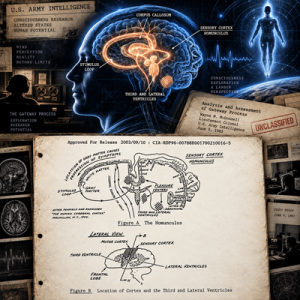
He compared the effect to concentrating scattered light into a laser.
“The human mind under the discipline of Hemi Sync acts after the fashion of a laser beam which produces a disciplined stream of light.” — McDonnell, Gateway Process report
Gateway participants were also taught visualization exercises and methods of progressively withdrawing attention from ordinary sensory input.
The goal was to reach increasingly unusual Focus Levels while remaining mentally aware.
In other words, this wasn’t simply relaxation music with a military stamp on it.
Gateway was attempting to keep consciousness alert while the body entered an increasingly sleep like state.
The idea has obvious parallels with lucid dreaming, yoga nidra, meditation, and other traditions involving awareness at the edge of sleep.
Monroe had essentially approached an ancient doorway using headphones and modern technology.
Then McDonnell tried to explain where that doorway might lead.
Reality as a Hologram
One of the strangest sections of the report concerns the idea that reality might behave somewhat like a hologram.
A hologram is unusual because information about the whole image is distributed throughout its interference pattern. 
McDonnell drew upon ideas associated with physicist David Bohm and neuroscientist Karl Pribram to explore whether consciousness and reality could operate according to similar principles.
He went considerably further than simply using holograms as a metaphor.
“The universe is composed of interacting energy fields, some at rest and some in motion. It is, in and of itself, one gigantic hologram of unbelievable complexity.” — McDonnell, Gateway Process report
McDonnell proposed that the mind might interact with this larger field of information rather than being completely confined to ordinary sensory perception.
These arguments should not be mistaken for established conclusions of physics. They were McDonnell’s attempt to construct a theoretical framework capable of explaining the experiences reported through Gateway.
Still, this was an Army intelligence officer writing an official assessment.
And he was only getting warmed up…
Consciousness Without the Body
Gateway eventually moved toward one of Monroe’s central interests, the out of body experience.
Participants attempted to experience awareness as existing independently from their physical location. 
McDonnell considered the possibility that sufficiently altered consciousness might perceive information beyond the normal limitations of the senses.
Related: Project Bluebeam Hologram To Fake Alien Invasion
Interestingly, the report says only one Gateway tape was specifically devoted to techniques for out of body movement.
The rest of the system was largely concerned with preparing the participant to reach increasingly altered states.
McDonnell nevertheless took the possibility seriously.
“Human consciousness can, with enough practice, move beyond the dimension of time space and interface with other energy systems in other dimensions.” — McDonnell, Gateway Process report
That is quite a sentence to find buried inside an Army document.
For anyone familiar with the government’s remote viewing programs, the resemblance is difficult to miss.
Programs operating under names such as Grill Flame, Center Lane, Sun Streak, and Star Gate also explored whether consciousness could obtain information beyond ordinary sensory channels.
Gateway approached the same frontier from another direction.
Instead of merely asking someone to describe a distant target, it attempted to systematically change the state of the observer.
Beyond the Clock
As participants progressed through Gateway, the Focus Levels became increasingly unusual.
Focus 10 represented the familiar body asleep, mind awake condition.
Later levels moved toward expanded awareness and experiences in which ordinary perceptions of time and space supposedly began to loosen. 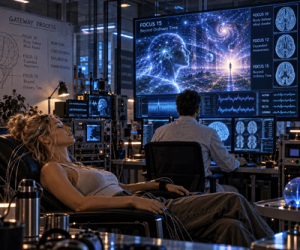
McDonnell’s report eventually discussed Focus 15 in connection with moving beyond ordinary time.
Whether this represents literal access outside time or a profound alteration in time perception is another question.
Anyone who has experienced deep meditation, dreaming, psychedelics, or extreme concentration knows that subjective time can behave strangely.
Minutes can stretch while hours disappear in the blink of an eye.
Gateway attempted to walk into that territory deliberately.
Eventually the report went even further.
Enter the Absolute
Near the deepest end of McDonnell’s analysis appears a concept he called the Absolute.
His model proposed that ordinary reality ultimately emerged from a timeless and dimensionless source of energy or consciousness.
Individual awareness, under the right conditions, might theoretically move beyond ordinary space and time and approach this underlying level. 
“Energy in this state of inactive infinity is termed by physicists as energy in its absolute state, or simply ‘the Absolute.” — McDonnell, Gateway Process report
McDonnell described intervening dimensions between ordinary physical existence and this Absolute which altered human consciousness might potentially access.
At this point, the report begins sounding less like military intelligence and more like something pulled from a shelf containing occult, esoteric, metaphysical books.
McDonnell noticed the similarity himself.
“Twentieth Century physics is using a left brain, linear, quantitative style of reasoning to approach the same knowledge which the mystics of old apparently acquired in a holistic, intuitional, right brain style.” — McDonnell, Gateway Process report
That may be one of the most revealing passages in the entire document.
Gateway was attempting to approach territory mystics had explored for centuries, only this time the traveler wore headphones.
So Did the Army Believe It?
This is where the story often gets twisted into a pretzel online.
The existence of the document does not mean the CIA proved astral projection, discovered that reality is a simulation, or officially confirmed that humans can escape space and time.
The document was an assessment written for U.S. Army Intelligence and later released among records held by the CIA.
McDonnell was trying to understand the Gateway system and determine whether its claims could fit within a coherent theoretical model.
But neither did he simply toss the entire subject into the wastebasket.
His conclusions were surprisingly receptive.
McDonnell argued that Gateway appeared to offer a faster route into altered states than some traditional disciplines, although he acknowledged that advanced stages still required substantial practice.
“The rate of progress is so much faster with the Gateway approach than it is with transcendental meditation or other forms of mental self discipline.” — McDonnell, Gateway Process report
He nevertheless stopped short of presenting his analysis as the final answer.
“This study is certainly not designed to be the last word on the subject.” — McDonnell, Gateway Process report
That sentence may be the best way to understand the entire document.
The Gateway Never Really Closed
Robert Monroe died in 1995, but his work continued.
The Monroe Institute still teaches programs derived from his consciousness research, while Gateway’s Focus Levels remain central to the system.
Meanwhile, McDonnell’s report has taken on a second life.
What began as an obscure Army intelligence document has become one of the strangest artifacts to emerge from the Cold War era’s fascination with human consciousness.
It came from a remarkable period when intelligence agencies explored ideas most scientists wouldn’t touch with a ten foot pole.
Remote viewing, anomalous perception, and altered states of consciousness were all on the kitchen table.
References:
Cia.gov/docs/CIA-RDP96-00788R001700210016-5.pdf