
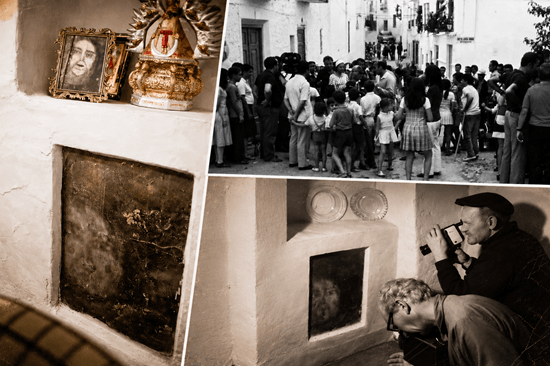

The Bélmez Faces and the Ghostly Images That Appeared From the Floor
On August 23, 1971, María Gómez Cámara noticed something strange forming on the concrete floor of her kitchen in the Spanish village of Bélmez de la Moraleda.
It looked like a human face!
Her family destroyed the disturbing image and covered the damaged section with fresh concrete, but another face reportedly began forming shortly afterward.
Before long, additional faces appeared, some seemingly changing shape over time, while news spread across Spain like wildfire.
More than 50 years later, the Bélmez Faces remain one of Spain’s strangest paranormal mysteries.
A Face Appears in the Kitchen
María lived with her family at Calle Real 5, where she reportedly noticed a dark stain developing on the kitchen floor near the fireplace.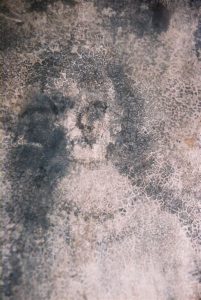
As the discoloration took shape, María thought she could make out the eyes, nose and mouth of a man staring back at her.
“I can’t believe it! It looks like a man’s face.”– Account of María Gómez Cámara’s reaction
Her family eventually destroyed the image and covered the area with new concrete, which should’ve put the strange episode to bed, except another face reportedly began materializing shortly afterward.
Related: The Philip Experiment, Trying To Make A Fake Ghost Real
The mayor intervened to prevent its destruction, and María’s ordinary kitchen was about to become famous.
More Faces Begin Appearing
Additional images reportedly formed across the concrete, ranging from vague discolorations to recognizable human faces, with some fading while others appeared to change their features.
Photographs circulated through newspapers and visitors poured into Bélmez to witness the phenomenon. 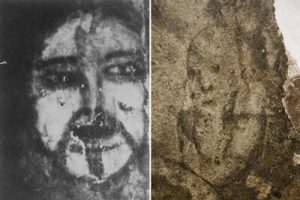
The house became known as La Casa de las Caras, or the House of the Faces.
“Twenty-five years of intense activity and controversy have passed without us being able to affirm the existence of a unanimously accepted hypothesis.”– Ciudad Futura investigation
The publicity opened a can of worms because once tourists started arriving and money entered the picture, skeptics had an obvious question about whether somebody was deliberately creating the faces.
Paranormal Investigators Arrive
The case attracted Spanish researcher Germán de Argumosa and German psychologist and parapsychologist Hans Bender, one of the best known investigators associated with Bélmez.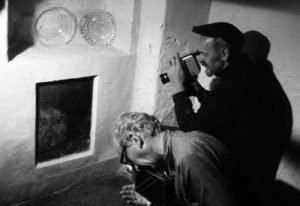
Bender had investigated alleged poltergeist activity and other unusual phenomena for years and didn’t consider the Spanish kitchen a run of the mill case.
“There is no doubt that the faces have to be considered as being parapsychological.”– Hans Bender
Bender considered the phenomenon a possible example of teleplasty, the supposed paranormal production of physical images.
Some investigators even wondered whether María herself might’ve been unconsciously producing the faces through psychokinesis, meaning nobody needed to sneak into the kitchen with a paintbrush.
Human Bones Beneath the Kitchen
In December 1971, investigators excavated beneath the kitchen floor and reportedly uncovered human remains at a depth of roughly 2.8 meters.
Related: The Russian Psychic That Had Scientists Flying From The Usa
The remains were removed and the excavation filled with fresh concrete, yet additional faces were reportedly observed afterward.
An official letter from the mayor described what happened after an earlier image had been destroyed.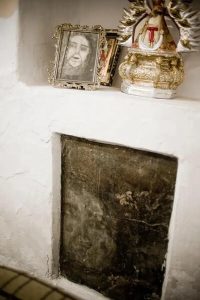
“A new face emerged.”– Mayor of Bélmez, report to the Civil Governor of Jaén
Finding human remains beneath an old Spanish building wasn’t necessarily extraordinary, but discovering them directly below a kitchen supposedly producing human faces poured gasoline on the fire.
Believers wondered whether the dead were somehow connected to the images, while skeptics argued that old bones proved nothing about stains in concrete.
Could Someone Have Painted Them?
Fraud became the obvious alternative explanation, and several methods were proposed for manufacturing the images using pigments or chemicals.
One persistent theory involved silver salts, which can darken when exposed to light and potentially create the illusion of an image slowly materializing.
Decades later, researchers Gerhard Mayer and Pilar Ramiro de Pano reviewed the available material analyses.
“The two conventional explanations… particularly their production by applying a solution containing silver salts, or a color substance, are not supported.”– Gerhard Mayer and Pilar Ramiro de Pano
That didn’t prove anything paranormal had occurred, but it meant 2 frequently repeated explanations weren’t supported by the analyses they examined.
The supposed smoking gun was firing blanks.
Trying to Catch the Faces in the Act
Investigators covered sections of the floor, photographed formations and examined samples in laboratories while attempting to determine whether somebody was secretly manipulating the images.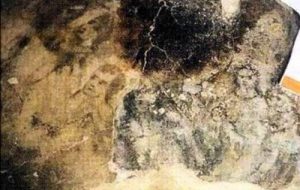
One laboratory examination reached a straightforward conclusion.
“The faces of Bélmez aren’t made with paint.”– Material analysis cited by Mayer and Ramiro de Pano
The examination reportedly found no silver salts or detectable organic residue associated with paint.
Related: 5 Premonitions That Actually Came To Pass
However, later researchers also identified deficiencies in documentation and uncertainties surrounding portions of the evidence, leaving plenty of clues but nothing capable of closing the book.
The Mystery Becomes a Circus
By 1972, the Bélmez Faces had become a national sensation as paranormal investigators defended the phenomenon while skeptical journalists argued that the affair was fraudulent. 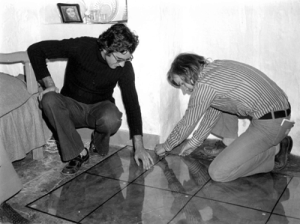
The Spanish newspaper Pueblo eventually announced
“The mystery is over.”– Pueblo, February 25, 1972
The newspaper presented a method involving silver compounds as a possible explanation, but later researchers noted that material analyses hadn’t detected silver in the examined samples.
Related: A Computer Message From The Past, Dodleston Messages
With tourists, money, journalists and paranormal claims all thrown into the same pot, separating fact from fiction became increasingly difficult.
The Faces Outlive María
María remained associated with the mystery until her death in 2004 at age 85.
If she’d secretly been creating the phenomenon, her death should’ve brought the curtain down, yet additional faces were reported afterward. 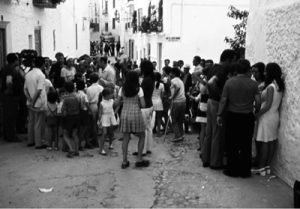
One laboratory conclusion cited during later examinations stated
“No external manipulation appears.”– Laboratory conclusion reported in the Bélmez material analyses
Those later faces became even more controversial and attracted stronger accusations of deliberate fabrication.
Whatever happened after María’s death, however, doesn’t necessarily explain what began in her kitchen in 1971.
The Faces Are Still Watching
More than half a century later, the Bélmez Faces remain caught somewhere between fraud, psychology, unusual material processes and the paranormal.
Forensic investigator Luis Alamancos attempted to reproduce similar faces using proposed methods involving substances such as hydrochloric acid, cement solvent and silver nitrate.
His reaction to the results was brief.
“Absolute bewilderment.”– Luis Alamancos
None of this establishes that ghosts, psychokinesis or teleplasty produced the faces.
Pareidolia could explain some formations, while deliberate manipulation could potentially account for others.
What remains are photographs, laboratory reports, eyewitness accounts and one extremely strange kitchen floor that turned an obscure Spanish village into the center of a mystery.
Sometimes a stain is just a stain, but things get weird when it looks back at you.
References:
https://www.researchgate.net/publication/362695928_The_Belmez_Faces Investigation
https://www.anomalistik.de/en/janom/contents/zfa-vol-18-2018-nos-1-2
https://www.anomalistik.de/en/janom/contents/zfa-vol-18-2018-no-3