

Man made From Clay Myth Across Ancient Creation Tales
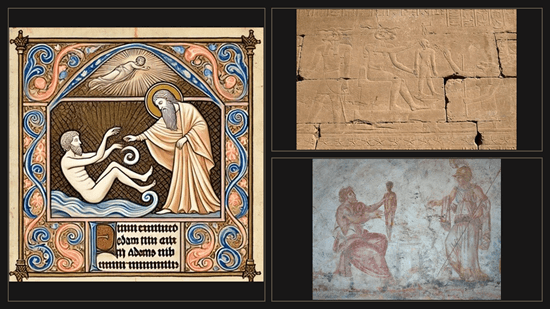
Across ancient civilizations separated by thousands of miles, the gods repeatedly reached for the same raw material when creating humanity.
From Mesopotamia and Egypt to Greece and ancient China, humans were molded from clay, mud, earth or dust before something divine brought the lifeless material to life.
The details change, but the basic idea keeps crawling back out of the dirt.
Mesopotamia Mixed Clay With the Blood of a God
Some of the oldest surviving versions come from ancient Mesopotamia, where clay wasn’t merely used to create humanity.
According to the Atrahasis Epic, it was mixed with the flesh and blood of a god.
The story begins with the lesser gods performing the exhausting labor required to maintain the world.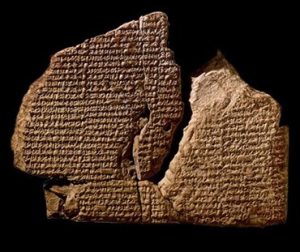
Eventually they’d had enough and rebelled, forcing the higher gods to find another solution.
Humanity was created to shoulder the burden.
The birth goddess Nintu is instructed to mix clay with the remains of a slain god.
“Let Nintu mix clay with his flesh and blood. Let that same god and man be thoroughly mixed in the clay. From the flesh of the god let a spirit remain.” — Atrahasis Epic
The story makes no chilling bones about it.
Humans are made from earth, but something belonging to a god becomes part of the recipe.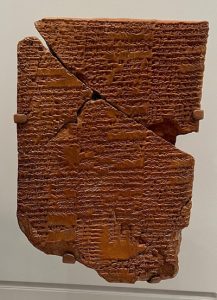
Related: Primordial World Being Myths
Another Mesopotamian text, Enki and Ninmah, describes Ninmah taking clay from above the Abzu, the subterranean freshwater realm associated with Enki, and fashioning human bodies from it.
“Ninmah took clay from the top of the abzu in her hand and she fashioned from it first a man who could not bend his outstretched weak hands. Enki looked at the man and decreed his fate.” — Electronic Text Corpus of Sumerian Literature
Clay would’ve been an obvious symbol in Mesopotamia.
People pressed it into tablets, stacked it into bricks and molded it into vessels and figurines.
In their creation stories, the gods rolled up their sleeves and did something remarkably similar with us.
Khnum Shaped Life on a Potter’s Wheel
Ancient Egypt carried the idea in a remarkably literal direction. 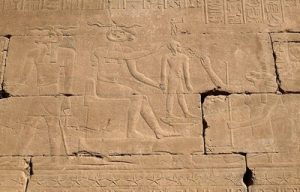
The ram headed god Khnum was associated with creation and the waters of the Nile, but he was also portrayed as a divine craftsman sitting behind a potter’s wheel.
Egyptian art shows Khnum shaping living beings on that wheel.
In royal birth scenes, he can fashion the body of the future king alongside the person’s ka while other deities prepare to bestow life.
The connection with Egypt’s landscape fits like a glove.
Every year, the Nile inundation swept across the land and left behind fertile mud.
“Probably because of his relationship with the life-giving water and the mud, Khnum also appeared as a potter, who formed man and his ‘ka’ on his wheel.” — Global Egyptian Museum
Khnum turned creation into craftsmanship.
Just as Egyptian potters transformed wet clay into recognizable forms, the divine potter shaped life itself.
The British Museum summarizes this aspect of Khnum as a “creator of life on the potter’s wheel.”
Prometheus Got His Hands Dirty Too
Greek mythology preserved another version through Prometheus.
He’s best remembered for stealing fire from the gods, but ancient traditions also connected him with shaping human beings from earth.
Related: Hand Bag Symbolism Throughout The Ancient World
While visiting Panopeus during the second century CE, Pausanias encountered stones that locals claimed were remnants of the material Prometheus had used. 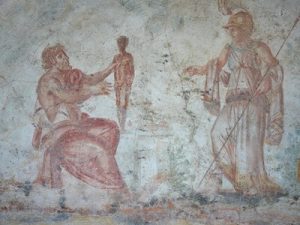
“They say that these are still left of the clay from which the whole race of men was fashioned by Prometheus. The color of these rocks is like that of clay, and they have the smell that is very like the smell of human skin.” — Pausanias, Description of Greece
People weren’t merely passing down a creation story because they were pointing toward objects in the landscape and claiming the original material was still there.
Ovid later described Prometheus mixing earth with water and molding it into the image of the gods.
“The new-made earth, but lately parted from the ethereal heavens, perhaps retained some seed of heavenly birth. Prometheus mixed it with fresh water and molded it into the image of the all-controlling gods.” — Ovid, Metamorphoses
No sacrificed deity appears here and there’s no potter’s wheel.
Prometheus simply gets his hands dirty and humanity takes shape.
Adam Was Formed From the Ground
Genesis preserves perhaps the most famous version of the motif.
Rather than simply commanding the first human into existence, God forms Adam from the ground before breathing life into him.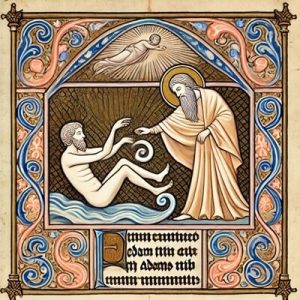
The Hebrew wording drives the connection home.
Adam, the human, is closely associated with adamah, the ground or soil.
“Then the LORD God formed the man of dust from the ground and breathed into his nostrils the breath of life, and the man became a living creature.” — Genesis 2:7
Earth supplies the body, but divine breath makes it live.
That creates an interesting parallel with Atrahasis.
One story adds the flesh and blood of a god to clay, while the other adds divine breath to material taken from the ground.
Researcher Tuğçe Erdal found the broader connection between humanity and soil appearing repeatedly in creation traditions.
“Among the myths about human creation, creation from the soil comes to the fore. It is seen that people were created by gods or semi-gods from loam, clay and mud.” — Tuğçe Erdal, The Creation of Human and Soil in Turkish and World Myths
Nüwa Molded Humanity From Yellow Earth
Ancient Chinese tradition takes us thousands of miles east, where the goddess Nüwa was credited with creating human beings after Heaven and Earth had formed.
A tradition preserved in the Fengsu Tongyi describes Nüwa kneading yellow earth and individually molding people. 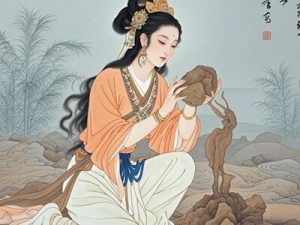
Related: Wide Eyed Relics Spanning The Ancient World
Eventually the job becomes too much, so she pulls a cord through mud and flicks droplets from it to create more humans.
“When Heaven and Earth had parted ways, but before there were any people, Nüwa kneaded yellow earth to create human beings. She worked with great industry, but did not have enough time, so she stretched a rope through the soil, and lifted it up to make people.” — Fengsu Tongyi tradition
Later versions connected the two methods with social hierarchy.
Those carefully molded by Nüwa became associated with the wealthy or noble, while those produced from scattered mud became ordinary people.
Chinese scholar Anne Birrell also discusses the tradition among the surviving fragments of early Chinese mythology.
“Nü Kua undertook the creation of human beings by molding them from yellow earth.” — Anne Birrell, Chinese Mythology
Something Divine Inside the Dirt
From the clay of Mesopotamia to the soil of ancient China, the same ol tune kept playing on the radio.
The gods shaped humanity from the earth, then breathed something divine into their creation.
Across thousands of miles and thousands of years, humanity kept rising from the same handful of earth.
References:
https://www.livius.org/sources/content/anet/104-106-the-epic-of-atrahasis/
https://www.theoi.com/Text/Pausanias10A.html
https://egypt-museum.com/figurine-of-the-god-khnum/
https://link.springer.com/chapter/10.1007/978-981-92-0734-3_2