

The Cosmic Egg Myth and the Creation Symbol That Appeared Across Ancient Cultures
Across ancient cultures, creation was sometimes imagined as emerging from an egg, embryo or sealed primordial form containing the potential of the world before it took shape.
From India and Greece to Finland, the same strange image resurfaced in different forms.
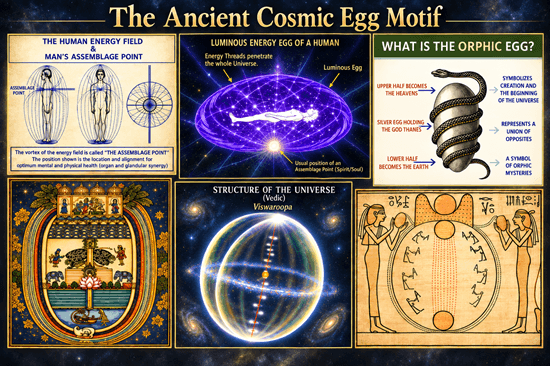
Later esoteric traditions turned the same symbol inward, describing the human being as a smaller reflection of the cosmos.
The Cosmic Egg could represent the universe itself, but perhaps it could represent us as well.
The Golden Embryo of Ancient India
One of the oldest examples appears in the Rig Veda, where Hiranyagarbha, the Golden Embryo or Golden Germ, represents the primordial source of creation.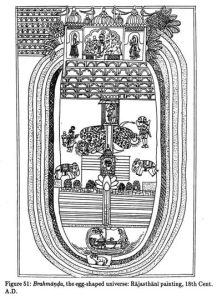
Later Hindu cosmology developed the idea through Brahmanda, the cosmic egg or egg of Brahma, imagined as an enclosed universe containing multiple realms.
The symbolism is simple but powerful because the egg already holds what will eventually emerge from it.
Creation becomes less like something appearing from nowhere and more like hidden potential becoming manifest.
“By being urged by parts of Time and Māyā, an insentient cosmic egg (aṇḍa) was evolved out of the five great elements, but it became sentient due to the entry of Puruṣa into it. From that egg, the Virāṭ, the immense being, was born, lying within the waters.”– Narada Purana, 58.62–63
The Golden Embryo therefore represented a condition before visible creation, when the possibilities of the cosmos remained concealed within their source.
The Orphic Egg and the Birth of Phanes
Ancient Greek religion preserved another striking version of the Cosmic Egg, particularly within traditions associated with Orphism.
Later accounts of Orphic cosmology describe a primordial egg appearing during the earliest stages of existence. 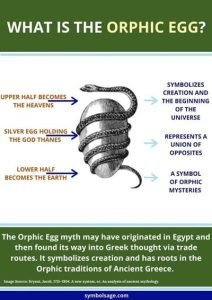
Related: Reasons For The Pyramids True Purpose?
From it emerged Phanes, a radiant deity associated with generation, light and the unfolding of the cosmos.
“O mighty first begotten, hear my prayer, twofold, egg born, and wandering through the air. Bull roarer, glorying in thy golden wings, from whom the race of Gods and mortals springs.”– Orphic Hymn to Protogonos
Phanes was sometimes represented surrounded by cosmic imagery and entwined by a serpent, embodying multiple aspects of creation.
The resemblance to Indian cosmic egg symbolism doesn’t prove a shared origin, but both traditions placed an enclosed generative form near the beginning of existence.
The egg becomes a boundary between two states, with potential concealed inside and manifestation waiting beyond the shell.
When an Egg Became Heaven and Earth
The Finnish Kalevala gives the motif a more literal form.
Ilmatar floats upon the primordial waters while a bird builds a nest upon her knee and lays its eggs there.
When the eggs fall and break, their fragments become the world itself. 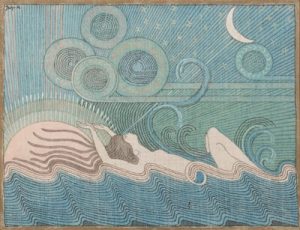
“From the cracked egg’s lower fragment, now the solid earth was fashioned. From the cracked egg’s upper fragment rose the lofty arch of heaven. From the yolk’s upper portion came the radiant sun.”– Kalevala, Poem One
Chinese traditions surrounding Pangu developed a similar image.
Heaven and earth existed together in a chaotic state compared to an egg, with Pangu growing within it until the lighter elements rose to form heaven and the heavier elements settled into earth.
The details differ, but the pattern is strikingly similar.
The cosmos begins enclosed and undivided, and creation begins when that unity breaks apart.
Egypt and the Egg From the Primordial Waters
Ancient Egypt preserved several different creation traditions rather than one universal account.
In traditions associated with Hermopolis, the cosmos emerged from the primordial waters of Nun.
These waters represented an undifferentiated state existing before light, land and ordered creation. 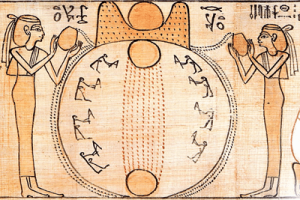
Related: Ancient Handbag Motifs Found World Wide
Some Egyptian traditions incorporated an egg into this process, with a creator or solar deity emerging from it.
The Egyptian Book of the Dead also preserves imagery of divine emergence and renewal.
“O thou who art in the egg, who shinest from thy disk and risest in thy horizon, and dost shine like gold above the sky, like unto whom there is none among the gods.”– Book of the Dead, Papyrus of Ani
The Bennu bird was associated with solar renewal and creation, while later traditions also connected divine birth with an egg.
The theme fitted naturally into Egyptian cosmology.
Life and order repeatedly emerged from darkness, water and apparent death, making creation something that could continually renew itself rather than an event locked in the distant past.
The Luminous Egg of Don Juan Matus
One of the strangest modern expressions of the idea appears in Carlos Castaneda’s accounts of the teachings of Don Juan Matus.
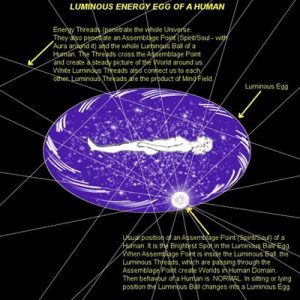
Within Don Juan’s framework, human beings aren’t ultimately perceived by seers as physical bodies.
When seen as energy, they appear as luminous configurations enclosed within an energetic boundary.
“Fibers, like white cobwebs. Very fine threads that circulate from the head to the navel. Thus a man looks like an egg of circulating fibers.”– Don Juan Matus, A Separate Reality by Carlos Castaneda
Elsewhere in Castaneda’s books, this energetic enclosure is described as a luminous cocoon.
Related: Carlos Castaneda, 10 Quotes From Art of Dreaming (Don Juan Matus)
The idea becomes more complicated through the assemblage point, which Don Juan describes as a location within the luminous structure where perception is organized.
Human beings experience a shared reality because the assemblage point normally remains fixed within a narrow range.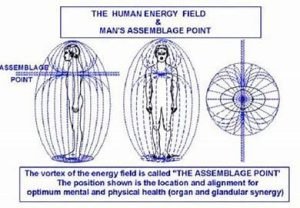
“Our total being consists of two perceivable segments. The first is the familiar physical body, which all of us can perceive; the second is the luminous body, which is a cocoon that only seers can perceive, a cocoon that gives us the appearance of giant luminous eggs.” – Don Juan Matus – Carlos Castaneda, The Eagle’s Gift
Placed beside Cosmic Egg mythology, the parallel becomes difficult to ignore.
Ancient traditions imagined the cosmos developing inside an enclosed form before emerging into manifestation.
Don Juan’s framework describes the individual as existing inside an egg shaped energetic enclosure whose internal arrangement determines the world that can be perceived.
The Cosmic Egg Within Man
Across these traditions, the Cosmic Egg holds something hidden before it emerges into form.
In later esoteric traditions, the Cosmic Egg became a symbol of transformation, while other teachings described the human being itself as enclosed within a luminous egg or cocoon.
Perhaps the old symbol endured because, sooner or later, everything hidden inside the shell has to hatch.
References:
https://www.loresandlegends.com/mythology/the-world-egg-creation-myth