


Voynich Manuscript: The Medieval Book Nobody Can Read
Sitting inside Yale University’s Beinecke Rare Book and Manuscript Library is a roughly 600 year old book that nobody can read. 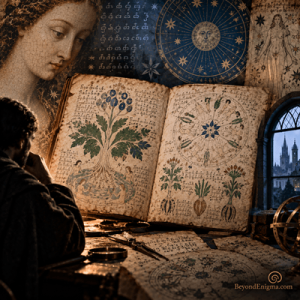
Its pages contain strange plants, astronomical diagrams, zodiac symbols, naked figures bathing in colored pools, and what appear to be medicines or herbal preparations.
Surrounding those pictures are 1000’s of words written in an unidentified script.
This is the Voynich Manuscript, one of history’s most stubborn literary mysteries.
Cryptographers, linguists, historians, and computer scientists have taken swings at it for more than a century, yet no proposed translation has gained broad scholarly acceptance.
We’re still in the dark about what it means.
A Strange Book Resurfaces
The manuscript takes its modern name from Wilfrid Voynich, a Polish born antiquarian bookseller who acquired it from a Jesuit collection near Rome in 1912.
Voynich immediately realized he had stumbled onto something unusual.
Today it is catalogued as Beinecke MS 408. 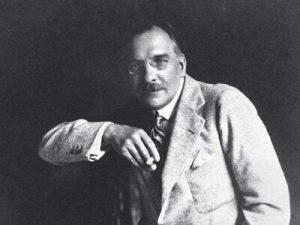
Related: Indus Valley Script Trying To Uncrack The Code
Yale divides its illustrations into sections involving plants, astronomy and astrology, bathing, cosmology, pharmaceuticals, and pages of mostly uninterrupted text that may contain recipes.
Yale describes the central mystery plainly.
“Written in an unidentified script by an unknown author, the manuscript and its meaning have been debated since its appearance on the rare book market in 1912.” — Beinecke Rare Book and Manuscript Library, Yale University
Some pages fold outward to reveal elaborate diagrams, while other leaves appear to have disappeared over the centuries.
Whatever the book was intended to be, somebody invested considerable time and resources into producing it.
Science Puts a Date on the Mystery
One early theory connected the manuscript to Roger Bacon, the 13th century English philosopher and Franciscan friar. 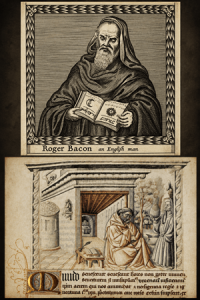
Modern science threw a wrench into that idea.
Radiocarbon analysis of its parchment dated it to the early 15th century, while examinations of its materials have remained consistent with medieval manuscript production.
Bacon died around 1292, making him an extremely unlikely author.
The important point is that this is an authentic old object.
Someone didn’t cook it up shortly before Voynich acquired it and plant it in an Italian collection.
The trail goes back centuries.
An Emperor, an Alchemist and a Mysterious Book
By the 1630s, the manuscript belonged to Prague alchemist Georg Baresch, who couldn’t make heads or tails of it either.
Baresch sent samples of the writing to Jesuit scholar Athanasius Kircher, hoping he might decipher them. 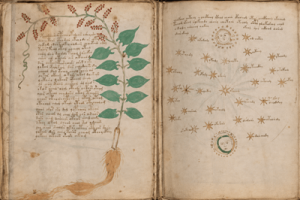
Related: Nag Hammadi Lost Scripts Of Jesus
After Baresch died, the manuscript passed to physician Johannes Marcus Marci, who sent it to Kircher in 1666.
A letter accompanying the book reported that Holy Roman Emperor Rudolf II had supposedly purchased it for 600 gold ducats and believed Roger Bacon had written it.
The claim about the purchase isn’t independently confirmed, but Rudolf is an interesting character to have in the story.
His Prague court attracted astronomers, astrologers, alchemists, mathematicians, and occult thinkers.
A mysterious book filled with unknown writing and astronomical imagery wouldn’t exactly have looked out of place there.
Welcome to Voynichese
The unknown writing is commonly nicknamed Voynichese, and this is where the mystery really tightens its grip. 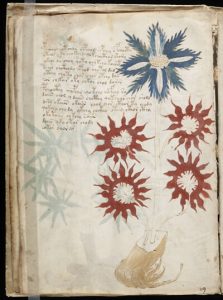
Words are separated by spaces, symbols repeat in recognizable combinations, and certain characters tend to appear in particular positions.
Different parts of the manuscript also show variations in vocabulary and writing patterns.
If someone simply filled hundreds of pages with random symbols, statistical analysis might be expected to expose the trick. Instead, researchers have repeatedly found structure.
“We show that it is mostly compatible with natural languages and incompatible with random texts.”— Diego Amancio et al., PLOS ONE, 2013
That doesn’t prove Voynichese represents an ordinary spoken language and a cipher or constructed writing system could also create patterns.
But dismissing the whole thing as meaningless scribbling isn’t quite as cut and dried as it sounds.
“We provide arguments for treating the document as natural language rather than a medieval hoax.”— Claire Bowern and Luke Lindemann, The Linguistics of the Voynich Manuscript
Carbon Dating Points to the 15th Century
In 2009, researchers at the University of Arizona radiocarbon dated 4 parchment samples from different parts of the Voynich Manuscript. 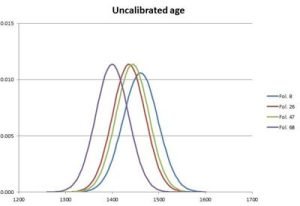
The results were remarkably consistent, placing the parchment’s origin in the early 15th century, with the combined analysis falling roughly between 1404 and 1435 at 95 percent probability.
The test dated the animal skins used to make the parchment, however, not the mysterious writing itself.
That leaves a small but important gap in the story because we still don’t know exactly how long the parchment sat unused before someone began filling its pages.
Plants That Almost Look Familiar
Much of the manuscript resembles a medieval herbal. 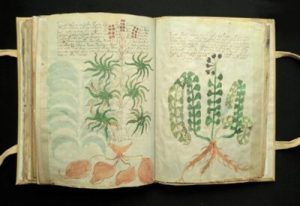
Plants fill entire pages while Voynichese text wraps around their roots, stems, leaves, and flowers.
The problem begins when researchers try identifying them.
Some resemble recognizable species, while others appear to combine parts from different plants.
Familiar looking flowers sit above unusual leaves and bizarre root systems.
Another section contains objects resembling pharmaceutical jars alongside roots and other plant material.
Without the text, we’re assembling the puzzle while half the pieces remain face down.
Women in the Green Pools
Numerous pages show small nude female figures standing or sitting inside pools and interconnected structures filled with green or blue liquid.
Some are linked by elaborate tubes, while others appear beside stars and circular designs. 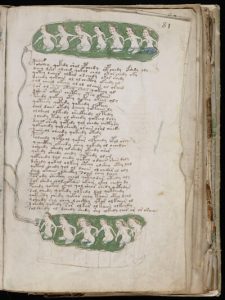
These pages are often called the balneological section, although nobody knows exactly what they represent.
Related: The Corpus Hermeticum Ancient Esoteric Text About 1,900 years Ago
Interpretations range from therapeutic bathing and medicine to anatomy, fertility, and astrology.
The zodiac imagery elsewhere may provide a clue.
Astrology and medicine were closely connected in medieval Europe, so the plants, pharmaceutical containers, bathing figures, and celestial diagrams might all belong to one larger medical system.
Just when the manuscript begins to look familiar, it changes lanes.
The Nine Rosettes
One of its most spectacular foldouts contains 9 large circular designs connected by what resemble pathways, tubes, walls, or channels. 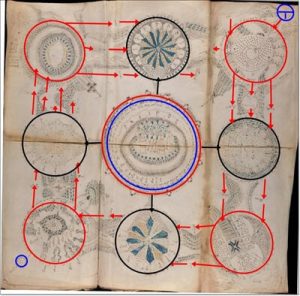
It’s usually called the Rosettes page.
Some see a map or cities, while others interpret it as a cosmological or symbolic diagram.
Small structures resembling towers and buildings appear throughout, but nobody can confidently explain what the entire arrangement represents.
Is It an Elaborate Hoax?
If Rudolf II really paid 600 ducats for the manuscript, someone would have had a powerful financial incentive to manufacture mysterious ancient knowledge.
Yet producing it required parchment, pigments, elaborate illustrations, and page after page of structured writing.
Statistical studies also suggest its word distribution doesn’t behave like simple random gibberish.
Researchers Marcelo Montemurro and Damián Zanette found complex organization in the distribution of words, although they stopped short of closing the door on deception:
“Naturally, the hypothesis of a hoax… cannot be discarded either.”— Montemurro and Zanette, PLOS ONE, 2013
The writing appears too organized to dismiss casually, but organization alone doesn’t prove that a meaningful language is hiding underneath.
If it’s a hoax, someone went the extra mile.
References:
Beinecke.library.yale.edu/beinecke-cipher-voynich-manuscript