
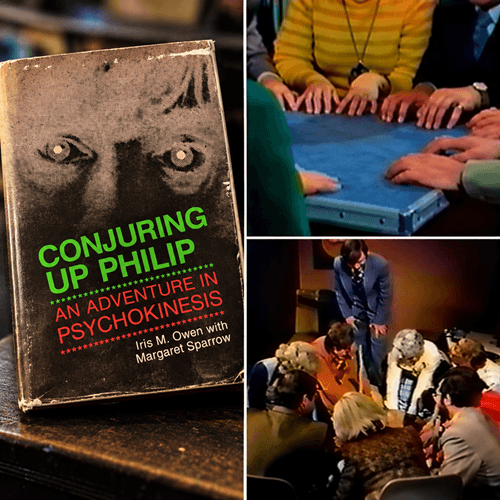

The Philip Experiment and the Ghost That Never Existed
In 1972, a group of Canadian researchers set out to contact a dead man who’d never lived.
Members of the Toronto Society for Psychical Research invented Philip Aylesford, a fictional 17th century English aristocrat complete with a face, troubled marriage, forbidden affair, and tragic death.
Then they tried to summon him and for months, nothing happened.
But after the group changed its methods, rapping sounds reportedly began answering questions.
Soon the table around which they gathered was tilting and moving across the room.
Everyone knew Philip was imaginary but what they couldn’t explain was what seemed to be answering for him.
Building Philip
The experiment was led by Iris Owen, with her husband, mathematician and psychical researcher A. R. G. Owen, acting as an adviser.
Philip supposedly lived at Diddington Manor during the English Civil War and married a woman named Dorothea.
The marriage wasn’t happy, and Philip eventually fell in love with another woman named Margo.
Related: 10,000 Case Studies Of Reincarnation Researched By Doctor Stevenson
According to the story, Dorothea discovered the affair and accused Margo of witchcraft. 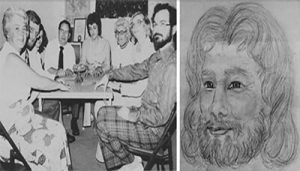
Margo was burned at the stake while Philip failed to save her. Consumed by guilt, he later committed suicide at 30.
One participant even drew Philip’s portrait.
Historical inconsistencies were deliberately included so he couldn’t later turn out to resemble someone who’d actually lived.
The researchers explained how completely manufactured their communicator was.
“A detailed but totally fictitious ‘history’ had been made up for Philip. This was known to all members of the group, and they had participated in elaborating his personality and background.”– Iris M. Owen and Margaret H. Sparrow, Generation of Paranormal Physical Phenomena in Connection With an Imaginary ‘Communicator, 1973
A Year of Almost Nothing
The group initially relied on meditation and visualization.
Members concentrated on Philip and imagined scenes from his life, hoping something would give.
Nearly a year passed without significant results.
The researchers then became interested in experiments by Kenneth Batcheldor and others involving table movements. 
His approach emphasized a relaxed atmosphere rather than intense concentration.
Related: Unexplainable Real Premonitions
The group changed tactics and they gathered around a table, joked, talked, and sang while encouraging Philip to respond.
Unlike the stereotypical séance, they didn’t need darkness.
“At no time did the Toronto group work in the dark. The room was always sufficiently illuminated for the hands and movements of every member of the group to be clearly visible.”– Iris M. Owen and Margaret H. Sparrow, Generation of Paranormal Physical Phenomena in Connection With an Imaginary ‘Communicator,1973
Within several sessions, participants began feeling vibrations in the table.
These reportedly developed into distinct raps (knocking sounds).
One rap became yes and two became no.
Philip had apparently found his voice.
When the Table Started Moving
The group began asking questions about Philip’s fictional life.
His answers generally followed the biography they’d created, but he didn’t reveal unknown information about 17th century England.
Related: Extra Sensory Perception Doorway To The Unseen World
About 4 weeks after the knocking (raps) began, the table reportedly started moving around the room.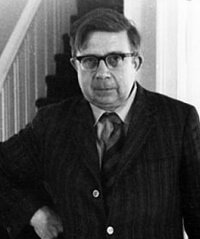
Participants sometimes had to leave their chairs and follow it across the floor.
Owen and Sparrow later described the unusual behavior.
“The table would tilt in various ways, lifting one, two, or three legs, and pivot, sometimes almost dancing. Sometimes one leg in turn would rise, giving the impression that the table was walking.”- Iris M. Owen and Margaret H. Sparrow, Conjuring Up Philip, 1976
Visitors were eventually invited to observe the sessions and reportedly witnessed movements and heard knocks themselves.
Researchers also attempted to examine the forces involved and later accounts describe strain gauges registering unusual forces.
In another test, a piece of candy reportedly remained on the tabletop while it tilted sharply, yet slid off when researchers manually reproduced the angle.
Owen and Sparrow admitted they couldn’t explain what was happening.
“What is the nature of the physical force at work? How does it happen? These are questions to which we have no satisfactory answers, although the phenomena themselves have now occurred on many occasions.”– Iris M. Owen and Margaret H. Sparrow, Conjuring Up Philip, 1976
Philip Goes on Television
The experiment eventually attracted Canadian television coverage, allowing the table movements to be filmed outside the group’s regular meetings.
Iris Owen acknowledged that when the table first started moving, the participants suspected one 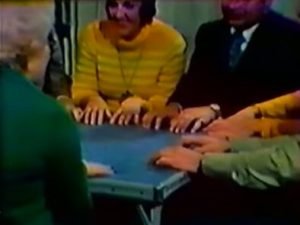 another.
“We accused each other of pushing it, naturally. Everybody watched everybody else’s hands and feet, and we were extremely suspicious of each other in the beginning.”– Iris Owen interview, Canadian television documentary Extra Special People
The footage showed the table moving, but it couldn’t establish the cause. Participants generally remained in contact with it, leaving unconscious muscular movement as a possible explanation.
Was Philip Really the Group?
Because Philip had never existed, the researchers wondered whether the group itself was somehow producing the effects.
Iris Owen described the question at the heart of the experiment.
“How does a combined thought from a group of people transform itself into something that can produce a physical effect such as a noise or a table movement? This is the question which seems to us much more important than the personality of Philip.”– Iris Owen interview, Canadian television documentary Extra Special People
Under this interpretation, Philip acted as a psychological focus while some unconscious process produced the phenomena attributed to him. 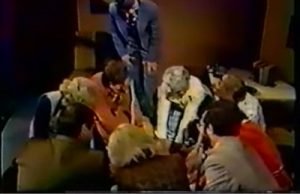
Researchers later experimented with other fictional personalities.
Related: Nina The Russian Psychic Who Proved Her Gifts To Scientists
One was Lilith, an imaginary French Canadian woman supposedly executed as a spy during World War II.
Within several weeks, that group reportedly experienced similar table movements and raps.
Philly boy apparently wasn’t unique enough.
The Ideomotor Problem
The ideomotor effect occurs when expectations produce unconscious muscular movements.
It’s commonly used to explain Ouija boards, pendulums, dowsing rods, and table turning.
Several people touching a lightweight table could therefore move it without consciously intending to.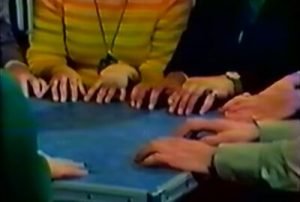
The Philip experiments never completely eliminated this possibility, and convincing contact free levitation wasn’t demonstrated under controlled conditions.
Related: Saints That Supposedly Took Flight Levitating
The researchers believed the knocking, movements, and unusual forces suggested something more.
They interpreted the results as evidence for collective psychokinesis.
The Ghost That Never Lived
Philip’s entire life was invented, from his marriage and lover to his tragic death.
Yet the group reported knocks, moving tables, and answers to questions that seemed to reflect the personality they’d created.
They knew exactly where Philip came from.
What they couldn’t explain was where the knocks came from.
References:
New Horizons Journal PDF includes the original Owen and Sparrow 1973 paper
Philip Psychokinesis Experiments PDF Society for Psychical Research