

The Hessdalen Lights
In a remote Norwegian valley southeast of Trondheim, something has been turning on the lights for more than 40 years. 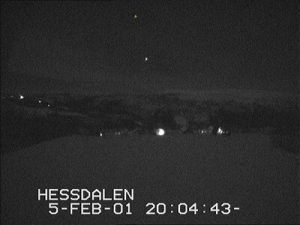
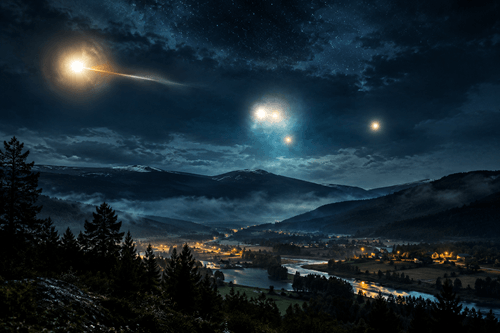
They appear above mountains, hover over houses, drift through the valley and occasionally race across the landscape.
Witnesses usually describe brilliant white or yellow lights, although red, blue and green have also been reported.
Some remain visible for seconds, while others have reportedly hung in the sky for more than an hour.
Normally, this is where a UFO story begins to wobble.
Someone sees something strange, somebody takes a blurry photograph, and everyone spends the next 30 years arguing about it.
Hessdalen took a different dirt road.
Researchers brought cameras, radar, magnetometers, spectrum analyzers, seismographs, Geiger counters, lasers and infrared equipment into the valley.
The lights did not politely disappear when the scientists arrived.
When the Valley Lit Up
Hessdalen is a sparsely populated valley near the old mining town of Røros in central Norway.
Strange lights had reportedly been seen in the region before the 1980s, but something changed dramatically near the end of 1981. 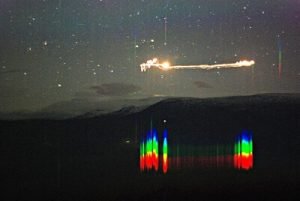
Residents began reporting them again and again.
Related: Face Of Mars, Impossible Natural Anomaly
At the height of the activity, as many as 20 sightings were being reported in a single week.
The lights appeared near homes, over the mountains and sometimes close to the ground.
The original 1984 Project Hessdalen technical report described just how strange the situation had become.
“The lights could stand still for more than an hour, they could move around slowly, and sometimes they could stop.”– Project Hessdalen technical report, Erling Strand, 1984
The most common objects were yellow or yellow white lights.
Researchers divided the observations into several categories, including brief white or blue flashes, larger luminous objects and groups of lights that appeared to maintain fixed distances from one another.
Some witnesses described something even harder to shrug off. 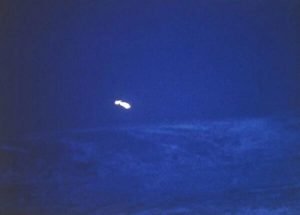
The lights did not always behave like distant stars, aircraft or brief flashes in the atmosphere.
Related: Old School Paintings Depicting UFO’s?
They appeared capable of stopping, changing speed and remaining motionless.
And eventually a group of researchers decided that watching from the kitchen window was no longer enough.
Project Hessdalen Arrives
Project Hessdalen was established in 1983 with the straightforward goal of figuring out what people were seeing.
The first major field investigation ran from January 21 through February 26, 1984. 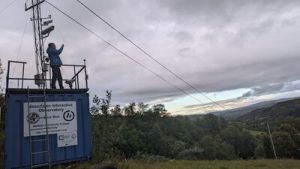
Researchers stationed themselves at several locations around the valley and surrounded themselves with equipment.
Cameras were ready and the radar was running.
A magnetometer monitored changes in the magnetic field.
Researchers also employed a seismograph, spectrum analyzer, Geiger counter, infrared viewer and laser.
It was less a UFO stakeout than a temporary laboratory built in the middle of the mystery.
During the investigation, researchers recorded 53 observations of the Hessdalen phenomenon.
Some were photographed and some produced instrument readings.
Most importantly, the investigators concluded that there really was a physical phenomenon available for measurement. 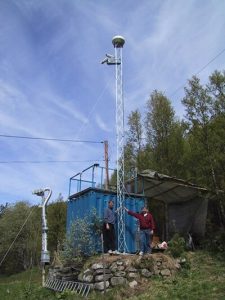
Whatever explanation eventually won the day, Hessdalen could not simply be filed away as a collection of campfire stories.
J. Allen Hynek, the astronomer who had spent years advising the United States Air Force on UFO investigations, recognized the opportunity.
“Hessdalen is really a UFO laboratory. It’s a place where things are happening and where things can be studied.”– J. Allen Hynek, 1985
That may be the most important thing about Hessdalen.
The mystery came with its own laboratory.
When Radar Joined the Conversation
Eyewitness testimony can be slippery, cameras can fool us, and judging distance against a dark sky is notoriously difficult.
Radar made the Hessdalen story harder to brush aside.
Related: Ancient UFO’s Text From India
During the 1984 investigation, researchers recorded 36 radar returns, three of which were apparently associated with lights being observed at the same time.
After examining one radar photograph, an expert from the Norwegian Defence Research Establishment offered an intriguing assessment.
“If this isn’t a reflection of a solid object, but only gas in the air, the gas has to be locally and strongly ionised.”– Project Hessdalen technical report, 1984
One observation became especially strange when researchers tracked a target moving north at an estimated 8,500 meters per second, or roughly 30,600 kilometers per hour. 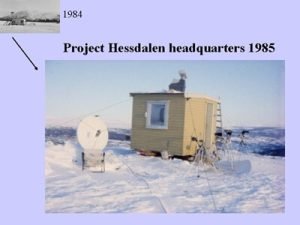
The researchers did not claim every radar return represented the mysterious lights and openly considered atmospheric effects and other possible sources of reflection.
Three occasions stood out because observers reportedly saw a light in the same direction while radar registered something there.
During one event, radar detected the target on every second sweep even though observers could see the light continuously.
Strand raised an obvious question.
“Could it be that the light does not reflect radar waves all the time? Only sometimes?”– Project Hessdalen technical report, Erling Strand, 1984
It was not proof of an exotic craft, but it gave researchers something more substantial than another strange light in the distance.
The mystery had acquired fingerprints.
A Light That Refused to Behave
One of the strangest incidents occurred on February 20 when researcher Leif Havik stepped outside the project caravan with two local men nearby.
According to the technical report, a strong red point of light appeared on the ground and moved around Havik’s feet before disappearing within seconds.
One witness suspected a reflection, while Havik thought it resembled the project’s laser. 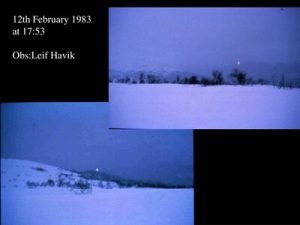
There was one rather inconvenient problem.
The laser was in Oslo.
Related: Alien Signal Sent From Space, WOW Signal
Researchers later attempted to recreate the appearance without settling the question.
The incident was brief, strange and ultimately inconclusive, but it demonstrated that not every Hessdalen observation involved a distant object floating conveniently on the horizon.
Sometimes the mystery came knocking on the door.
The Blue Box Starts Watching
The extraordinary wave of sightings declined after the early 1980s, but Project Hessdalen did not simply close the file.
Researchers eventually decided that instead of gathering large groups of people to watch the sky, they needed equipment capable of watching continuously.
Students at Østfold College began developing an automatic measurement station, which became operational in Hessdalen in 1998. 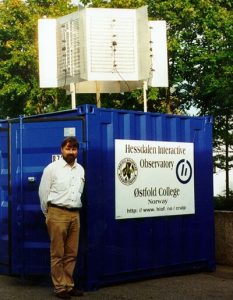
A later Project Hessdalen report explained the reasoning.
“An automatic station could do this all the time with a minimum of cost. Instruments recordings and pictures could be recorded automatically.” – Project Hessdalen report
The station became known as the Blue Box.
Its early equipment included cameras, computers, a video recorder and magnetometer, with the system designed to react automatically when unusual lights appeared.
Related: Real Crop Circles That Has Skeptics Scratching Their Heads
Research continued for years after its installation.
A later scientific analysis of Hessdalen observations concluded that the extended campaign had confirmed something important.
“The installation of the automated research container in 1998 and the following campaign, lasting more than a decade, has determined the existence of the Hessdalen phenomenon and its location to this area.”– Bjørn Gitle Hauge, Acta Astronautica
Whatever was producing the lights, Hessdalen had moved well beyond a handful of stories told by residents.
Researchers now had a place where unusual luminous phenomena could be watched repeatedly with instruments.
Is the Valley Producing the Lights?
One possibility is that the answer is not arriving from above at all.
Researchers have explored whether Hessdalen’s geology, atmosphere and electrical environment could interact to produce unusual luminous phenomena.
A 2024 study in the Journal of Applied Geophysics examined roughly 100 square kilometers of the valley using electromagnetic surveys and identified several conductive zones, many associated with sulfide bearing mineral deposits. 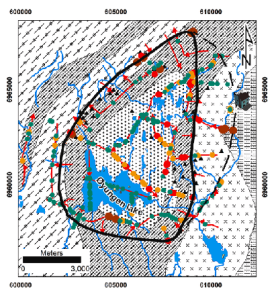
The researchers began with a straightforward hypothesis.
“Interactions between Earth’s subsurface and atmosphere could result in the generation of various geophysical phenomena including atmospheric lights.”– Journal of Applied Geophysics, 2024
This raises an intriguing possibility that the ground beneath Hessdalen may be just as important as the sky above it.
Related: Ancient Artifacts on Mars Points To Advanced Civilization
Other researchers have proposed forms of atmospheric plasma.
One model published in the Journal of Atmospheric and Solar Terrestrial Physics suggested that ionized air and dust could form luminous structures under particular conditions.
“Several physical properties observed in HL phenomenon can be explained through the dust plasma model.”– Gerson Paiva and Carlton Taft, 2010
These theories could help explain why unusual lights repeatedly appear in the same geographical area, but none has turned every Hessdalen observation into an open and shut case.
Knowing where the magician might be standing is not the same as knowing the trick.
What Makes Hessdalen Different
Hessdalen occupies an unusual place in the history of unexplained aerial phenomena.
They’re more dramatic UFO stories involving alleged landings, occupants and military encounters, but Hessdalen offers something much rarer.
Repeatability.
Astronomer J. Allen Hynek recognized that advantage when discussing the valley in 1985.
“Hessdalen is really a UFO laboratory. It’s a place where things are happening and where things can be studied.”– J. Allen Hynek, 1985
Nobody can schedule a Hessdalen light for Tuesday at 8 PM, but the same geographical area has produced enough observations that researchers have repeatedly brought instruments there and waited.
People saw unusual lights, and researchers arrived with instruments to investigate them. They recorded more unexplained phenomena, some of which produced photographs and instrument readings.
Maybe the final answer will turn out to be an obscure natural phenomenon…
References:
Sciencedirect.com/science/article