

Seven Headed Serpents Across Ancient Mythology
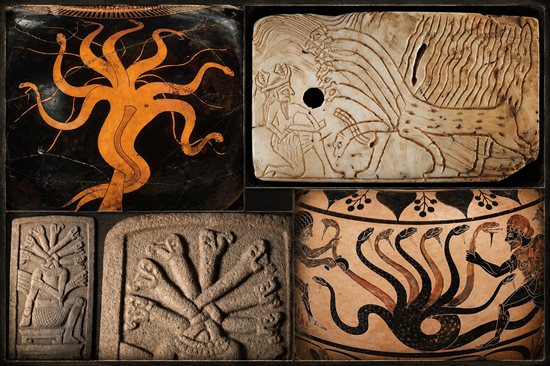
Seven headed serpents turn up in some surprisingly distant places, stretching from the myths of ancient Mesopotamia and Ugarit to the religious art of India and Cambodia and the traditions of Mexico.
Sometimes gods battled and killed them, while elsewhere they guarded sacred figures or appeared alongside storms and floods.
Despite those different roles, the same bizarre image of a supernatural serpent crowned with seven heads kept slithering back into mythology.
The Seven Headed Serpent of Mesopotamia
Some of the oldest evidence comes from Mesopotamia.
Sumerian mythology places a seven headed serpent among the supernatural creatures connected with the warrior god Ninurta.
Ninurta’s Return to Nibru lists the beast alongside dragons and monstrous animals defeated or brought forth by the god. 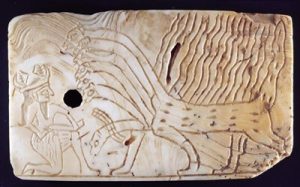
“He brought forth the Anzud bird from the halub haran tree. He brought forth the Seven headed serpent from the mountains. He mustered them all before him.”– Ninurta’s Return to Nibru
Later in the composition, Ninurta displays the conquered creatures around his battle chariot and hangs the seven headed serpent from its shining crossbeam.
Related: Why Serpents Keep Popping Up In The Ancient World
The beast wasn’t some random snake with extra hardware.
It belonged to a wider Mesopotamian tradition where divine warriors confronted serpents and dragons representing dangerous supernatural forces.
Lotan and the Seven Headed Serpent
Farther west, the ancient Syrian city of Ugarit preserved another version.
The Baal Cycle describes the storm god Baal battling forces connected with sea, death and chaos.
Among them appears Lotan, a twisting serpent associated with Yam, the divine Sea. 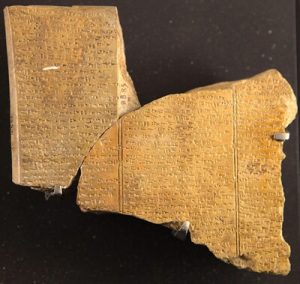
“When you killed Lotan, the fleeing serpent, finished off the writhing serpent, Shalyat, the seven headed one. The heavens grew hot, they withered.” – The Baal Cycle
A storm god battles a supernatural serpent connected with water, and the monster has seven heads.
Similar imagery later appears around the Hebrew Leviathan.
Isaiah calls Leviathan a fleeing and twisting serpent, while Psalm 74 describes God smashing the heads of the sea monster.
The Ugaritic material preserves the seven headed version explicitly, making Lotan one of the strongest ancient examples of the motif.
India Turned the Monster Into a Guardian
Move east and the serpent changes jobs.
Indian traditions describe nagas, supernatural serpents connected with water, fertility, underground realms and divine power.
Artists repeatedly carved naga kings beneath spreading cobra hoods, sometimes numbering seven.
The most famous example appears in the story of Muchalinda. 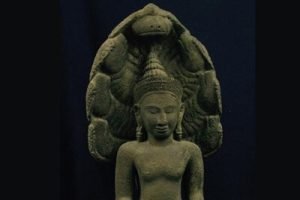
After the Buddha’s enlightenment, a violent storm arrives and the naga king emerges, coils around him and spreads his multiple hoods overhead.
“The theme of the Buddha and the naga has its origins in the Indian legend of the meditating Buddha being protected by the nagaraja Mucalinda during a mighty rainstorm. It is likely that in Southeast Asia we are witnessing the grafting of indigenous snake cult concepts onto a broader Indic notion of the naga as protector of the sacred.”– The Metropolitan Museum of Art
Archaeology puts the story into cold stone.
Related: Sea People Weird Myths Surrounding People Coming From The Ocean
A third or fourth century sculpture from Nagarjunakonda shows the Buddha protected beneath a seven headed Muchalinda.
Serpent, water, storm and seven heads are still in the mix, but somebody shuffled the deck.
Instead of attacking the sacred figure, the serpent protects him.
Cambodia Put Seven Headed Nagas Everywhere
Khmer civilization made the multi headed naga hard to miss.
At Cambodian temples, enormous stone serpents stretch along bridges, stairways and causeways. Great fans of cobra heads rise at their ends, often with seven heads spreading outward.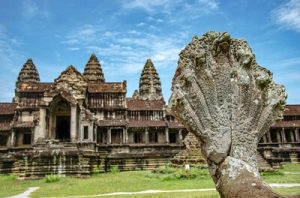
“It depicts what must be assumed was the seated Buddha in deep meditation, resting on the coils of a snake that raises its seven headed hood above the Buddha’s head. The cult of the animistic naga is an ancient practice in India and was readily taken up in Angkorian Cambodia.” – The Metropolitan Museum of Art
The motif became part of sacred architecture itself.
Visitors approaching temples crossed beside enormous nagas, while Buddhist sculptures placed the Buddha directly upon their coils.
A creature that western gods battled had become a guardian of holy ground.
Greece Gave the Serpent Seven Heads
Ancient Greece adds another seven headed serpent to the tail.
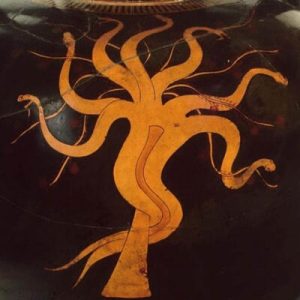
Ladon was the monstrous serpent that guarded the golden apples of the Hesperides, wrapping himself around the sacred tree while keeping watch over its fruit.
Related: Strange Ancient Reptilian Humanoid Figurines
Ancient writers described Ladon with varying numbers of heads, but Greek artists sometimes gave the guardian exactly seven.
“They found the sacred plot where, till the day before, the serpent Ladon had kept watch over the golden apples. But now the snake, struck down by Herakles, lay by the trunk of the apple-tree.”– Apollonius Rhodius, Argonautica
A surviving Attic red figure vase attributed to Euphronios, dating to around 500 BCE, depicts Ladon coiled around the tree with seven serpent heads rising from his body.
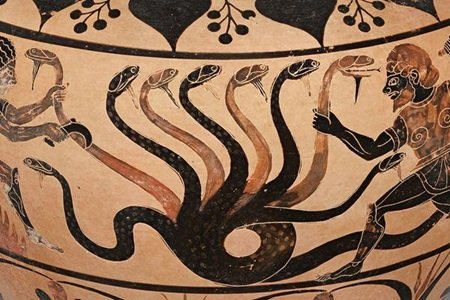
Unlike the monsters battled by Ninurta and Baal, Ladon wasn’t simply a creature of chaos waiting to be killed.
He stood guard over something sacred, bringing the seven headed serpent surprisingly close to the protective role it later played in Indian and Cambodian naga imagery.
Seven Serpents in Ancient Mexico
Ancient Mexico adds a strange variation to the seven serpent pattern.
A stone stela from Aparicio, Veracruz, dating to roughly 800–1100 CE, depicts a decapitated ballplayer with seven serpents rising from his neck instead of streams of blood.
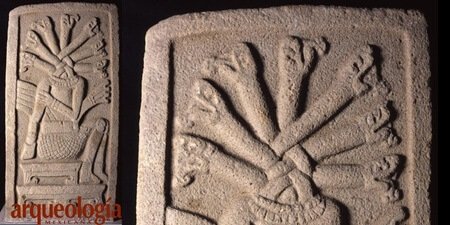
Archaeologists have connected the imagery with fertility and possibly Chicomecoatl (Seven Serpent).
“The character has been decapitated and seven serpents emerge from his neck instead of blood. The serpents possibly allude to Chicomecóatl, ‘Seven Serpent.’” – Museo Nacional de Antropología
It isn’t literally a seven headed serpent, but the same combination of serpent imagery and the number seven appears unmistakably on the ancient stone.
The Seven Headed Sky Serpent
Comparative mythologist David Talbott offered a much more radical explanation for these recurring forms.
In his Saturn theory, Talbott argued that ancient gods and cosmic monsters preserved memories of a radically different sky.
His Polar Configuration placed Saturn, Venus and Mars in an extraordinary planetary arrangement whose changing appearance supposedly inspired recurring mythological symbols.
“Many years ago I began to follow a simple principle. I would treat nothing as a given. I would seek to understand the ancient symbols in their own terms.”– David Talbott
Serpent imagery became part of that reconstruction. 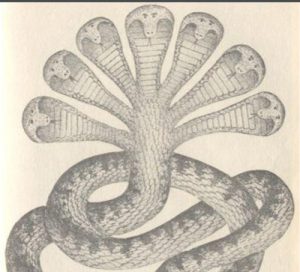
Talbott questioned why serpents repeatedly became creator figures, cosmic monsters and structures surrounding the ancient gods.
“The unanswered question is, Why? The last thing suggested to us by slithering serpents is the idea of a creator! Yet the serpent stood at the very beginning of things.” – David Talbott, The Saturn Myth
The seven heads fit what Talbott called the Primeval Seven, recurring groups of seven gods, sages, stars and other figures that he connected with a sevenfold celestial configuration.
His explanation flips the usual argument.
Related: The Ancient Cosmic Egg Mythology Told From Different Civilizations
Talbott proposed that seven became sacred because ancient people had witnessed a sevenfold structure in the sky.
For Talbott, distant cultures weren’t merely inventing similar monsters.
They were remembering the same ancient sky.
The Mystery Still Has Seven Heads
Seven headed serpents appeared across cultures separated by enormous distances, yet the creature never played exactly the same role twice.
Maybe seven simply became the perfect number for a supernatural serpent, or maybe Talbott was onto something when he traced the pattern back to the ancient sky.
Either way, the mystery of why seven heads kept appearing is still a tough skin to shed.
References:
Oxford ETCSL Ninurta’s Return to Nibru and the Seven Headed Serpent ETCSL
Cambridge University Press Seven Headed Serpents in Mesopotamian and Ugaritic Tradition Cambridge University Press
Archaeological Survey of India Seven Headed Naga Museums of India
The Metropolitan Museum of Art Buddha Protected by a Seven Headed Naga
State Hermitage artifact reference Greek Ladon depicted as a Seven Headed Serpent Theoi.com
Universidad Veracruzana Chicomecóatl the Seven Serpent Motif
https://www.thunderbolts.info/visualizing-the-polar-configuration