

Hollow Boat Japan and the Mystery of Utsuro-bune
In 1803, fishermen along the coast of Japan reportedly spotted something unusual drifting offshore.
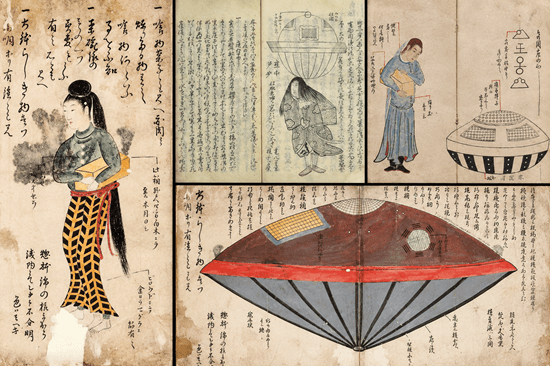
It was round, unlike the fishing vessels of Hitachi Province, with a metal reinforced lower portion and transparent windows above.
They hauled the object onto the beach and discovered a young woman inside. 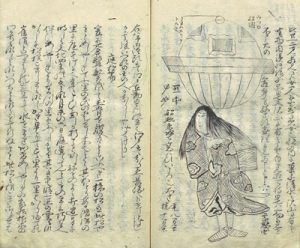
She looked foreign, spoke an unknown language, wore unfamiliar clothing, and guarded a mysterious box that she refused to let anyone touch.
Strange symbols were reportedly written inside her vessel.
More than 200 years later, nobody knows exactly where this damsel in distress came from.
The story became known as Utsuro-bune, meaning the Hollow Ship.
Something Strange Comes Ashore
One of the best known accounts appears in Toen Shōsetsu, an 1825 collection of strange stories and rumors associated with a literary circle led by writer Kyokutei Bakin.
The story places the encounter on February 22, 1803, along the coast of Hitachi Province, part of modern Ibaraki Prefecture.
The vessel measured approximately 5.5 meters across and was compared to a kōgō, a round container traditionally used for incense.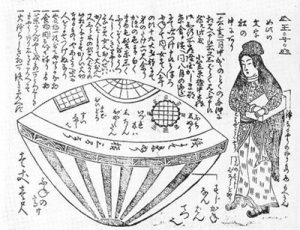
Transparent windows covered its upper portion while iron plates reinforced the bottom, apparently protecting it from rocks.
Related: UFO Lights Over Norway 1983
Another account preserved in Hirokata Zuihitsu gives a similar description.
Whatever the fishermen expected to find offshore that day, they were about to get more than they bargained for.
Through the windows, the fishermen could see a young woman sitting alone inside.
The Woman and Her Mysterious Box
Accounts describe her as around 18 to 20 years old and approximately 1.5 meters tall.
In Toen Shōsetsu, her hair and eyebrows were red while her face had a pinkish complexion.
Long white material appeared to have been added to her hair, and her clothing was unlike anything familiar to the witnesses. 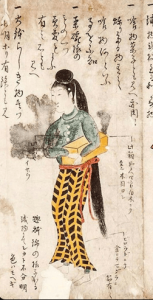
Another account, Ume no Chiri, emphasized her unusual appearance.
“Her skin was as white as snow.” Ume no Chiri, 1844
The woman spoke, but nobody understood her language.
Related: Proof of Real Crop Circles That Are Unexplainable
She also guarded a box approximately 60 centimeters across and refused to allow anyone near it.
An elderly villager proposed a grisly explanation.
Perhaps she was a foreign princess who had committed adultery.
Her lover had been executed and she had been condemned to drift across the ocean.
Then the old villager went out on a limb and suspected the box contained her lover’s severed head.
There was no evidence for the theory, but Toen Shōsetsu gives the old man’s reasoning rather coldly.
“From human sight it might be cruel, but it seems to be her predetermined destiny.” Toen Shōsetsu, 1825
Whatever the box contained, she was keeping it close to her chest.
Writing Nobody Could Read
The vessel contained bedding, water, food, and what appeared to be meat.
Unknown characters were also reportedly written inside.
Several surviving illustrations reproduce versions of these symbols. 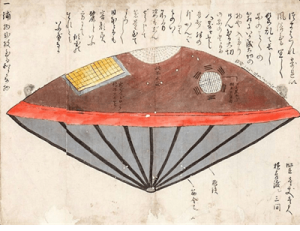
The author of Toen Shōsetsu attempted to connect them with foreign writing.
“I found similar characters on a British ship that recently arrived offshore from Uraga in Japan.” Toen Shōsetsu, quoted by Kazuo Tanaka
The writer wondered whether the woman might have been British, Bengali, American, or from somewhere else.
Edo period writers were already looking overseas for answers.
They Sent Her Back
The villagers apparently didn’t imprison the woman or keep her unusual craft.
Instead, they returned her to Utsuro-bune and pushed the vessel back into the water.
Becoming involved with an unknown foreigner could bring unwanted attention from Edo period authorities.
Related: Flight Mh370 Disappears In Thin Air
Sending her back to sea may have seemed easier than dealing with the consequences.
The woman disappeared with her mysterious box and peculiar vessel.
The Story Survived
Utsuro-bune wasn’t preserved in a single manuscript.
Versions appear in Ōshuku Zakki, Toen Shōsetsu, Hirokata Zuihitsu, Hyōryūki-shū, and Ume no Chiri.
Modern research has identified 14 volumes containing 13 types of historical documents associated with the story. 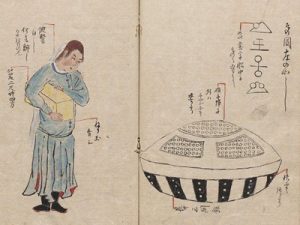
Researcher Kazuo Tanaka, professor emeritus at Gifu University, spent decades investigating these accounts and their surprisingly modern looking illustrations.
Related: WOW Signal Alien Message From Outer Space?
Tanaka has described Utsuro-bune as “the only real UFO mystery in the world” as far as he knows.
His point wasn’t that extraterrestrials landed in Japan.
Images resembling the popular conception of a UFO appear in genuine Edo period documents created long before the modern flying saucer era.
An Older Hollow Ship Tradition
Utsuro-bune wasn’t an entirely new concept in 1803.
Japanese folklore contains older stories involving mysterious hollow vessels and unusual women arriving from across the sea.
The 1803 account could therefore be an older legend adapted to a particular time and place.
Reality could’ve supplied the spark while folklore supplied the gasoline.
Castaway or Something Stranger
A foreign castaway remains a straightforward explanation.
Japan’s isolation during the Edo period was never absolute.
Dutch traders operated through Nagasaki while Russian vessels appeared around Japanese territory.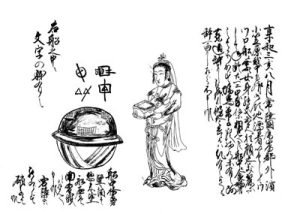
A European or Russian woman could explain her appearance, clothing, and incomprehensible language.
Kazuo Tanaka investigated whether the story preserved the memory of a Russian castaway, but no matching shipwreck has been identified.
Related: UFO’s In Old School Paintings
The vessel itself may have changed with each retelling.
Even Toen Shōsetsu recognized inconsistencies.
“I am somewhat disappointed because the illustrations and sentences are not consistent.” Toen Shōsetsu, quoted by Kazuo Tanaka
The Edo Period UFO
Then there’s the interpretation that made Utsuro-bune famous around the world.
Look at the surviving illustrations and it’s difficult not to think of a flying saucer.
The craft is circular, its lower section appears metallic, windows surround the upper portion, and strange symbols appear inside. 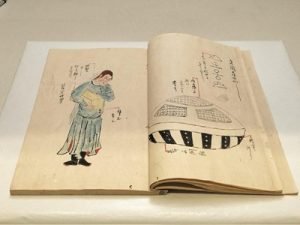
But nothing in the historical accounts describes Utsuro-bune soaring through the sky or performing impossible maneuvers.
It’s quite literally an unidentified floating object.
Yet the illustrations existed more than a century before the modern flying saucer era.
The Mystery That Floated Away
More than two centuries later, Utsuro-bune remains somewhere between folklore and possible history.
There’s no surviving vessel to examine, no passenger to identify, and no mysterious box to open.
The fishermen supposedly had the mystery dangling in front of them.
Whatever Utsuro-bune really was, the answer floated away with it.
References:
National Archives of Japan — Utsuro-bune historical documents
Chukyo University — Academic paper on the mysterious Utsuro-bune symbols
National Diet Library — Utsuro-bune academic source
Chukyo University — Kazuo Tanaka paper on the Hitachi Utsuro-bune legend
CiNii Research — Utsuro-bune Cosmic Letters paper