
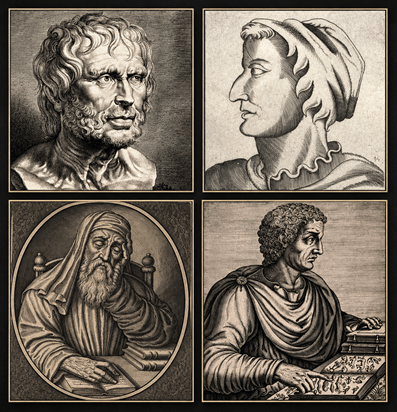

Ancient Astronomers Who Knew Too Much Before Telescopes
For 1000’s of years, astronomers studied the heavens with nothing but their eyes, mathematics and a whole lot of patience.
Yet some left behind accounts that sound downright eerie today
They described mountains on the Moon, recognized reflected moonlight, tracked Venus as a single object and somehow figured out a few other cosmic goodies.
How in Billybob’s bait shop did they know?
Pliny and the Strange Nature of the Planets
Roman naturalist Pliny the Elder packed Natural History with astronomical observations circulating during the first century CE.
We’ve already covered his stranger planetary accounts in detail, but several fit this mystery too well to leave on the cutting room floor.
Pliny described Saturn as rigid and cold, Mars as fiery and Venus as overwhelmingly bright, and his account of Venus gets remarkably specific.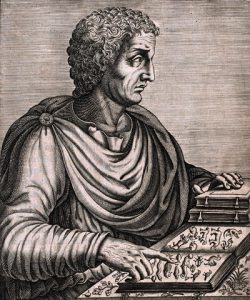
“It excels all the other stars in size. Its brilliancy is so considerable that it is the only star which produces a shadow.”– Pliny the Elder, Natural History Book II
That sounds over the top until you learn that Venus really can cast a faint shadow under exceptionally dark conditions.
Pliny also linked Jupiter with celestial thunderbolts and treated it as the principal planetary source associated with lightning.
Related: Ancient Solar System Jupiter Migration System
Today we know Jupiter churns with violent storms and electrical activity, while real lightning flashes through its atmosphere.
None of that can be seen with the naked eye from Earth, which is why that ancient association still raises eyebrows.
“The fires which fall upon the earth, and receive the name of thunderbolts, proceed from the three superior stars, but principally from the one which is situated in the middle… and hence it is commonly said, the thunderbolts are darted by Jupiter.”- Pliny the Elder, Natural History Book II
Plutarch Put Mountains on the Moon
Around the 1st century CE, Plutarch studied the Moon in On the Face Which Appears in the Orb of the Moon.
His speakers argue that the markings spread across its surface come from physical terrain rather than simple changes in color.
They describe mountains, hollows, chasms and deep regions where sunlight can’t fully reach. 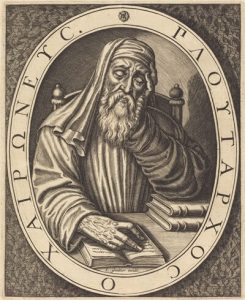
“Our earth has certain great gulfs. So that earth yawns with great depths and clefts which contain water or murky air.”– Plutarch, On the Face in the Moon
Plutarch also refers to bright mountains and open regions across the lunar surface.
To the naked eye, the Moon looks like a glowing disk covered with vague patches, not a battered world filled with mountain chains and deep valleys.
Related: Ancient Mars Geoglyph Anomalies Points To Advanced Civilization
He connected those shadows to uneven terrain and rejected the idea of a perfectly smooth heavenly sphere.
Roughly 1,500 years later, Galileo aimed a telescope at the Moon and found exactly the kind of broken landscape Plutarch had described.
Parmenides Recognized Reflected Moonlight
Parmenides recognized something fundamental about the Moon.
It wasn’t producing its own light because the glow came from sunlight reflecting off its surface.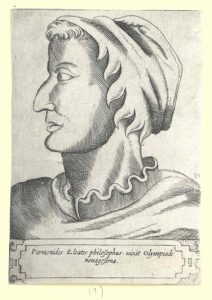
“Night shining, wandering around the earth, a foreign light. Always looking towards the rays of the sun.”– Parmenides, Fragments 14 and 15
Ancient tradition also credits him with identifying the morning star and evening star as the same object, Venus.
That connection sounds obvious once somebody hands you the answer, but it wasn’t written in the sky with a label attached.
Ancient observers had to track Venus across the horizon, compare its appearances over time and connect the dots.
“He was the first to declare that the evening star and the morning star are the same.”– Diogenes Laertius, Lives of the Eminent Philosophers
Seneca Said Comets Would Come Back
Comets made a mess of ancient astronomy because they’d appear out of nowhere, streak across the sky and vanish for years or generations.
Plenty of people treated them as temporary fires or disturbances in the atmosphere.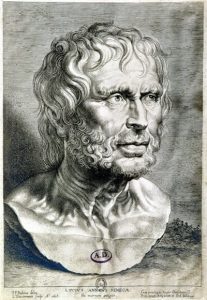
Seneca wouldn’t bite the bullet.
Related: Ancient Sky Gods (Planetary Battles)
In Natural Questions, he argued that comets could be permanent celestial bodies following paths humans simply hadn’t watched long enough to understand.
“Why then do we marvel at comets? Their recurrence is after immense intervals.”- Seneca, Natural Questions Book VII
More than 1,600 years later, Edmond Halley calculated that the comet seen in 1682 followed the same path as comets recorded in earlier centuries.
The comet hadn’t vanished forever because it had simply traveled beyond sight before looping back around.
Seneca couldn’t calculate the orbit, but he’d already grasped the basic idea long before astronomy could prove it.
Written in the Stars
Ancient astronomers didn’t have telescopes, spacecraft or modern instruments, yet some still described the heavens with eerie accuracy.
They watched, measured and connected the dots.
Sometimes, they got close enough to make you wonder just how much the ancient sky had already revealed.
References:
https://www.perseus.tufts.edu/hopper/text?doc=Perseus
https://penelope.uchicago.edu/The_Face_in_the_Moon
https://plato.stanford.edu/archives/sum2008/entries/parmenides