

The Isdal Woman and the Eight Names Nobody Could Trace
In November 1970, hikers above Bergen, Norway, found a burned woman among the rocks.
She had used at least eight names across Europe, and 50 years later nobody knows which, if any, was real.
The Body in Ice Valley
On 29 November 1970, a father and his two daughters found her in Isdalen, Ice Valley, below Mount Ulriken, a place locals called Dødsdalen, Death Valley.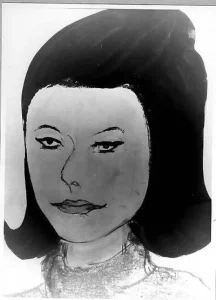
She lay on her back, hands clenched, her face burned beyond recognition.
Around her lay a liqueur bottle, rubber boots, an umbrella and jewelry, with a petrol-stained fur hat beneath her.
Every label and identifying mark had been removed.
“The placement and location of the objects surrounding the body was strange.” – Tormod Bønes, forensic investigator, speaking to the BBC
Bergen police opened a full-scale investigation, but they had a body and no name.
The Suitcases at the Station
Three days later, a fingerprint on a pair of sunglasses linked her to two suitcases abandoned at Bergen railway station.
Inside were clothes, wigs, makeup, maps, fake glasses and Belgian, British and Swiss coins, all with the labels removed.
Related: The Lead Masks Case and the Men Who Waited for a Signal
Five 100 Deutsche Mark notes were hidden in the lining, and a notepad held coded rows of letters and numbers.
“The question was, what was she doing in those places?” – Carl Halvor Aas, police lawyer on the original 1970 investigation, to NRK
Eight Names, One Woman
Hotel forms showed she had traveled Norway and Europe under at least eight fake identities, including Geneviève Lancier, Claudia Tielt, Vera Jarle and Elisabeth Leenhouwer.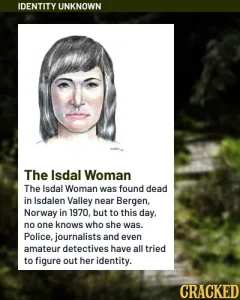
Her birthdays and jobs changed, but she always claimed to be Belgian.
In Bergen she switched rooms right after checking in, and said she was a traveling saleswoman and antiques dealer.
Witnesses recalled wigs, broken English, German, Flemish and garlic, and a waitress saw her dine beside two German Navy men.
Another overheard three words to a man in German.
“Ich komme bald” (“I am coming soon”) – The Isdal Woman, as overheard by a hotel witness
Who she was coming to, nobody ever found out.
Suicide or Murder?
The autopsy found phenobarbital and carbon monoxide poisoning: she had swallowed 50 to 70 sleeping pills, with twelve more beside her.
Police ruled it a likely suicide, but soot in her lungs showed she was alive as she burned, and her neck was bruised.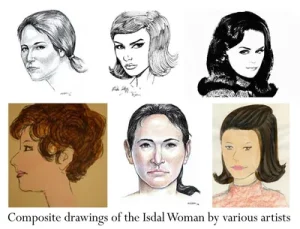
“My father could never put this case away.” – Tore Osland, son of Bergen investigator Harald Osland, to the BBC
On 23 November she checked out of the Hotel Hordaheimen and took a taxi, and in 1991 an anonymous driver said a man had joined her for the ride.
In 2005, a Bergen man said that days before the body was found, he saw her on the Fløyen hillside, dressed for the city and walking ahead of two men in coats.
Related: The Ghost Blimp Mystery and the 2 Navy Men Who Vanished
She seemed about to speak but didn’t, and police brushed off his report.
“Forget her, she’s been seen to. The case won’t ever be solved.” – What the witness says the police told him, Bergensavisen, 2005
A Spy in Cold War Norway?
In 1970, Norway was secretly testing the anti-ship Penguin missile, a prime target for foreign spies.
Declassified military records suggest her movements match the trials, and a fisherman saw her near the Stavanger test area. 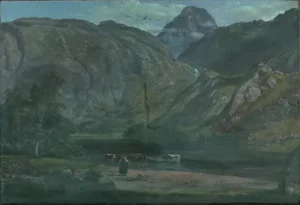
In 2023, Switzerland’s Neue Zürcher Zeitung claimed the Norwegian Intelligence Service had meddled in the investigation.
Some of the original officers felt the same way.
“My grandfather had this feeling that barriers were being put on their work.” – Cecilie Thorsted Flo, granddaughter of a Bergen police officer, to the BBC
Skeptics note her travel dates don’t match the missile tests exactly.
But eight passports, a coded travel log and a habit of turning up near secret weapons tests are hard to explain away.
What Science Found
Investigators kept her jaw and teeth, which had 14 fillings and gold crowns in a style foreign to Norway.
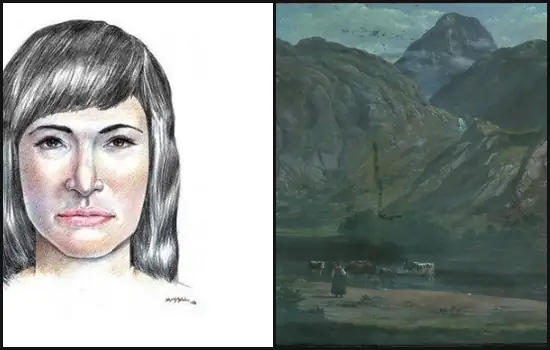
In 2016, broadcaster NRK reopened the case with police, and forensic artist Stephen Missal drew six new sketches of her.
Related: The Arthur’s Seat Coffins and the 17 Tiny Bodies Hidden Beneath Edinburgh
In 2017, isotopes in her teeth placed her birth around 1930 near Nuremberg, Germany, with a childhood spent toward France.
That year, Kripos also sent her DNA profile worldwide through an Interpol Black Notice.
“What is new is that we have finally been able to create a DNA profile.” – Maj Nordskaug, Kripos senior advisor, to NRK
Later tests traced her maternal line, haplogroup H24, to Southeast Europe or Southwest Asia.
The BBC and NRK podcast Death in Ice Valley chased listener leads, but none solved it.
The Woman With No Name
Within weeks, the case was closed.
She got a Catholic burial in an unmarked grave, in a zinc coffin kept for relatives who might come.
None ever did.
We know where she was likely born and which rooms she slept in, but we still don’t know her name.
References:
The Isdal Woman Cold Case (A&E)
Norway makes international appeal to solve 46-year-old mystery (The Local)